
A consultant configures Sales Accelerator sequences for a 20-person sales team. Reps report that the AI-generated next-best-action queue keeps recommending outbound calls to contacts a teammate already called earlier the same day, causing duplicate outreach. Calls are logged automatically through a Teams-to-Dataverse calling integration that syncs activity records on a scheduled interval rather than instantly. What is the most likely cause and correct fix?
Select an answer to reveal the explanation.
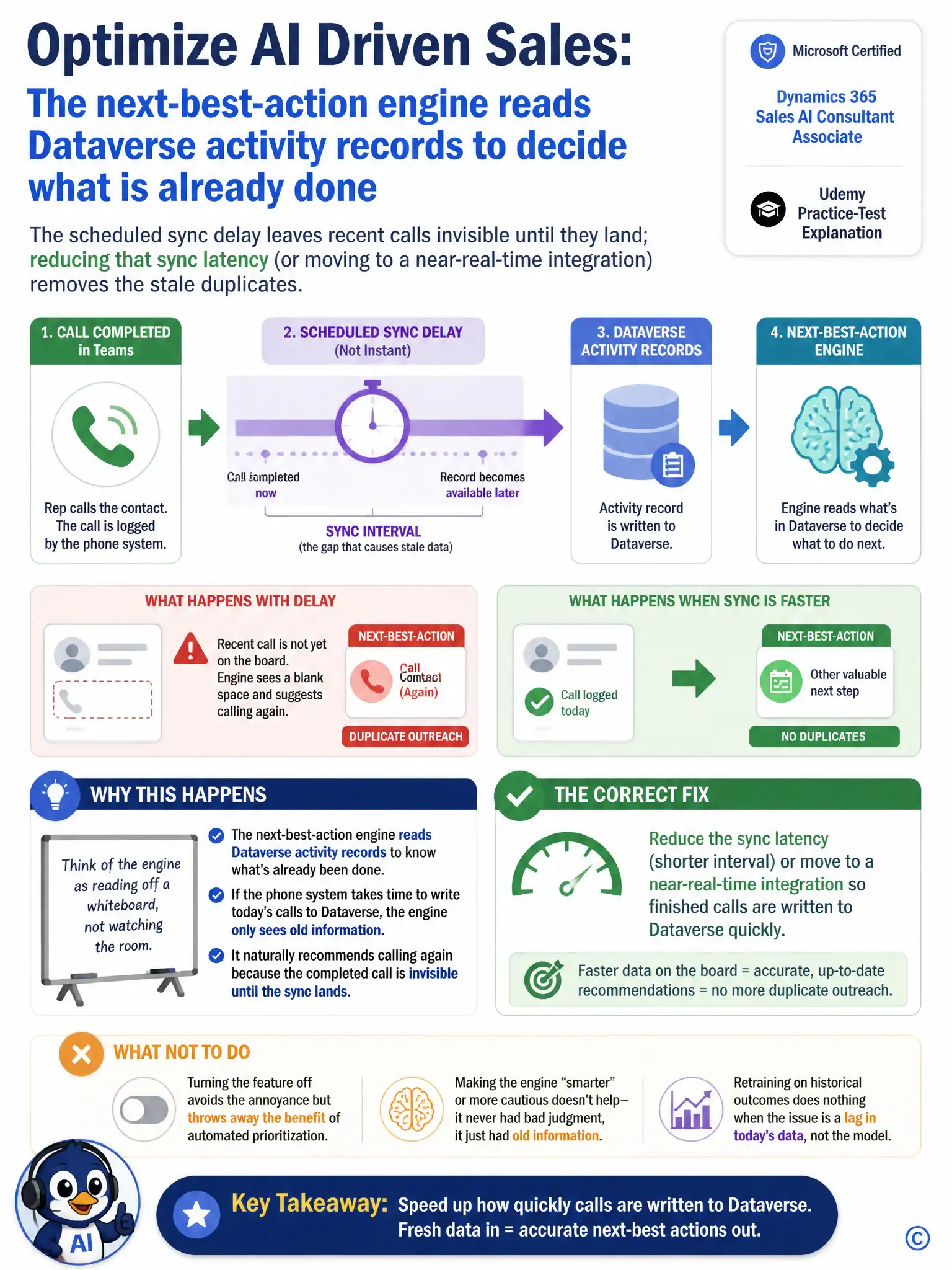
Short Explanation
The next-best-action engine only sees what has already landed in Dataverse, so if the Teams-to-Dataverse sync is slow, today's calls stay invisible and it suggests them again. Speed up the sync or move to near-real-time integration so the engine has current activity data. Turning the feature off or retraining the model won't fix stale data.
Full Explanation
The correct answer is the scheduled sync delay explanation: Sales Accelerator's next-best-action logic works from the activity history stored in Dataverse at the moment it generates a recommendation; it has no independent awareness of what happened in a call outside that record. When the Teams-to-Dataverse integration only syncs on a scheduled interval, a call that happened an hour ago may not yet exist as a record, so the engine still treats that contact as untouched and recommends it again. Closing that latency gap, or switching to a faster sync pattern, gives the engine current data to reason from and eliminates the duplicate suggestions. The confidence-threshold fix is incorrect because a confidence threshold governs how certain the model must be before it suggests an action at all, not whether its underlying data is current; raising it would suppress some valid suggestions without fixing the staleness. The retraining-the-model fix is incorrect because the problem is not a pattern the model failed to learn from history, it is a timing gap in the data pipeline feeding live recommendations, so retraining on old outcomes would not touch it. The turn-off-recommendations fix is incorrect because disabling the feature removes its value entirely instead of addressing the root cause, and reps would lose the benefit of prioritized outreach altogether.