
Several sellers on a mid-market team stop acting on the AI-generated next-best-action suggestions that appear in their Dynamics 365 Sales workspace. In interviews, sellers say the suggestions feel arbitrary because they cannot tell what prompted a given recommendation. A consultant is asked to improve adoption without removing the feature.
Select an answer to reveal the explanation.
Short Explanation
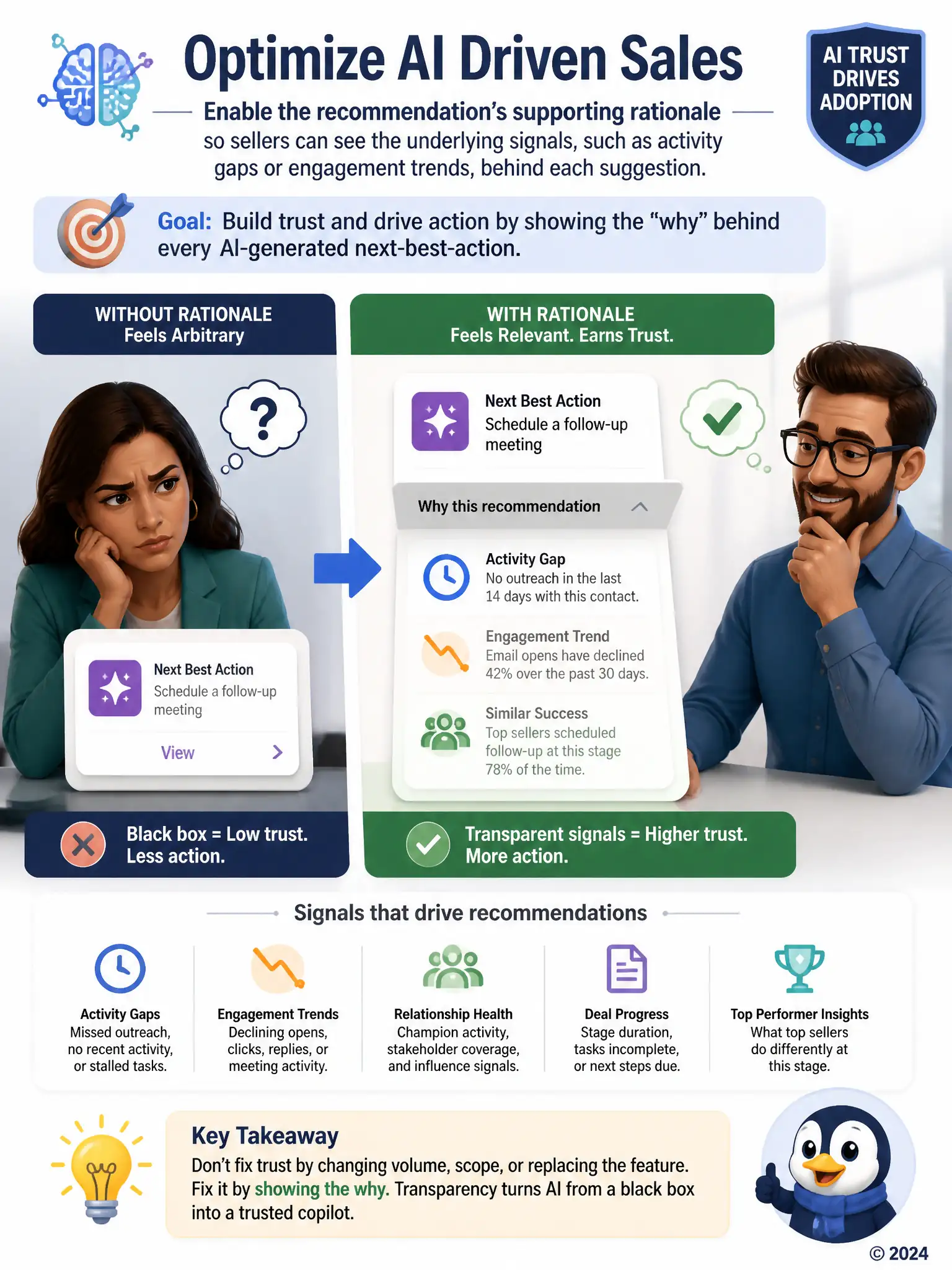
When sellers don't trust a next-best-action suggestion because they can't see why it appeared, show them the signals behind it. You'll fix the black-box feeling by exposing activity gaps or engagement trends, not by sending more suggestions, narrowing them, or replacing them with a script.
Full Explanation
The correct answer is the option that enables the recommendation's supporting rationale so sellers can see the underlying signals, such as activity gaps or engagement trends, behind each suggestion. The sellers' complaint is specifically about trust and transparency, not volume or scope, so surfacing the rationale behind each recommendation, the actual signals like an activity gap or a slipping engagement trend that triggered it, directly addresses why they are ignoring the feature. The option to increase the frequency at which next-best-action suggestions refresh throughout the day is incorrect because refreshing suggestions more often increases how frequently an unexplained recommendation appears without making any single one more understandable, which would likely worsen the frustration. The option to restrict next-best-action suggestions to only the highest-value opportunities is incorrect because narrowing suggestions to high-value opportunities changes which deals get recommendations but does nothing to explain the reasoning behind them, leaving the core trust problem untouched. The option to replace next-best-action suggestions with a static, manager-authored call script is incorrect because replacing the artificial intelligence feature with a static script abandons personalized, data-driven guidance entirely, which solves the adoption problem only by eliminating the capability the team was asked to improve, not by fixing it. For a consultant, the key insight is that adoption problems rooted in a lack of explainability are solved by adding transparency into the artificial intelligence's reasoning, not by adjusting the feature's frequency, scope, or replacing it with a non-artificial-intelligence alternative.