
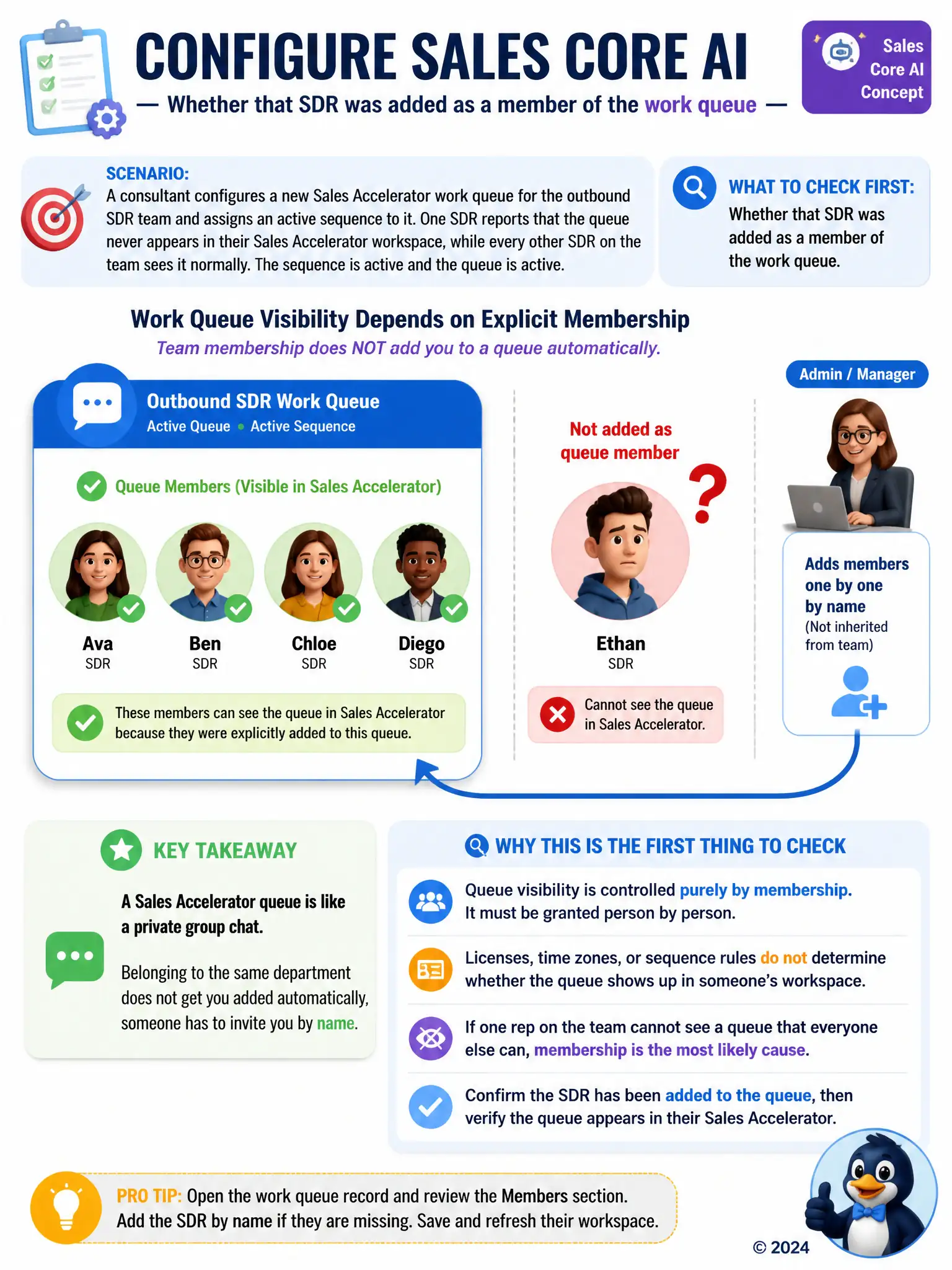
A consultant configures a new Sales Accelerator work queue for the outbound SDR team and assigns an active sequence to it. One SDR reports that the queue never appears in their Sales Accelerator workspace, while every other SDR on the team sees it normally. The sequence is active and the queue is active. What should the consultant check first?
Select an answer to reveal the explanation.
Short Explanation
Sales Accelerator queue behaves like a private group chat: belonging to the same team doesn't add you automatically, someone has to add you by name. If one SDR can't see a queue that everyone else can, check whether that SDR was added as a queue member first. Missing add-on licenses, time-zone settings, or sequence trigger rules don't control whether the queue appears in the workspace.
Full Explanation
The correct check is whether that SDR was added as a member of the work queue, because a Sales Accelerator work queue only appears in a seller's workspace if that seller has been explicitly added as a queue member; simply belonging to the same team or business unit as other members is not enough. Since the sequence and queue are both confirmed active, the most direct explanation for one SDR being unable to see the queue while teammates can is that the membership assignment was never made for that individual. The Copilot for Sales license explanation is incorrect because Copilot for Sales licensing governs generative features like email drafting and summaries, not access to work queues, which are controlled through queue membership and security roles. The system time zone explanation is incorrect because Dynamics 365 Sales does not hide or reveal queues based on a user's local time zone; time zone settings affect how dates and times display, not visibility of workspace objects. The enrollment trigger conditions explanation is incorrect because enrollment trigger conditions determine which records get added into a sequence in the first place, not whether a seller can see a queue that already exists; a seller could have zero enrolled records and still see an empty queue as long as they are a member.