
A consultant configuring Dynamics 365 Sales for an enterprise account team wants stakeholders to see, at a glance, whether an opportunity's key relationships are strengthening or weakening over time, factoring in response times, meeting frequency, and sentiment across every contact involved in the deal, not just the primary buyer. Which capability should the consultant enable to meet this requirement?
Select an answer to reveal the explanation.
Short Explanation
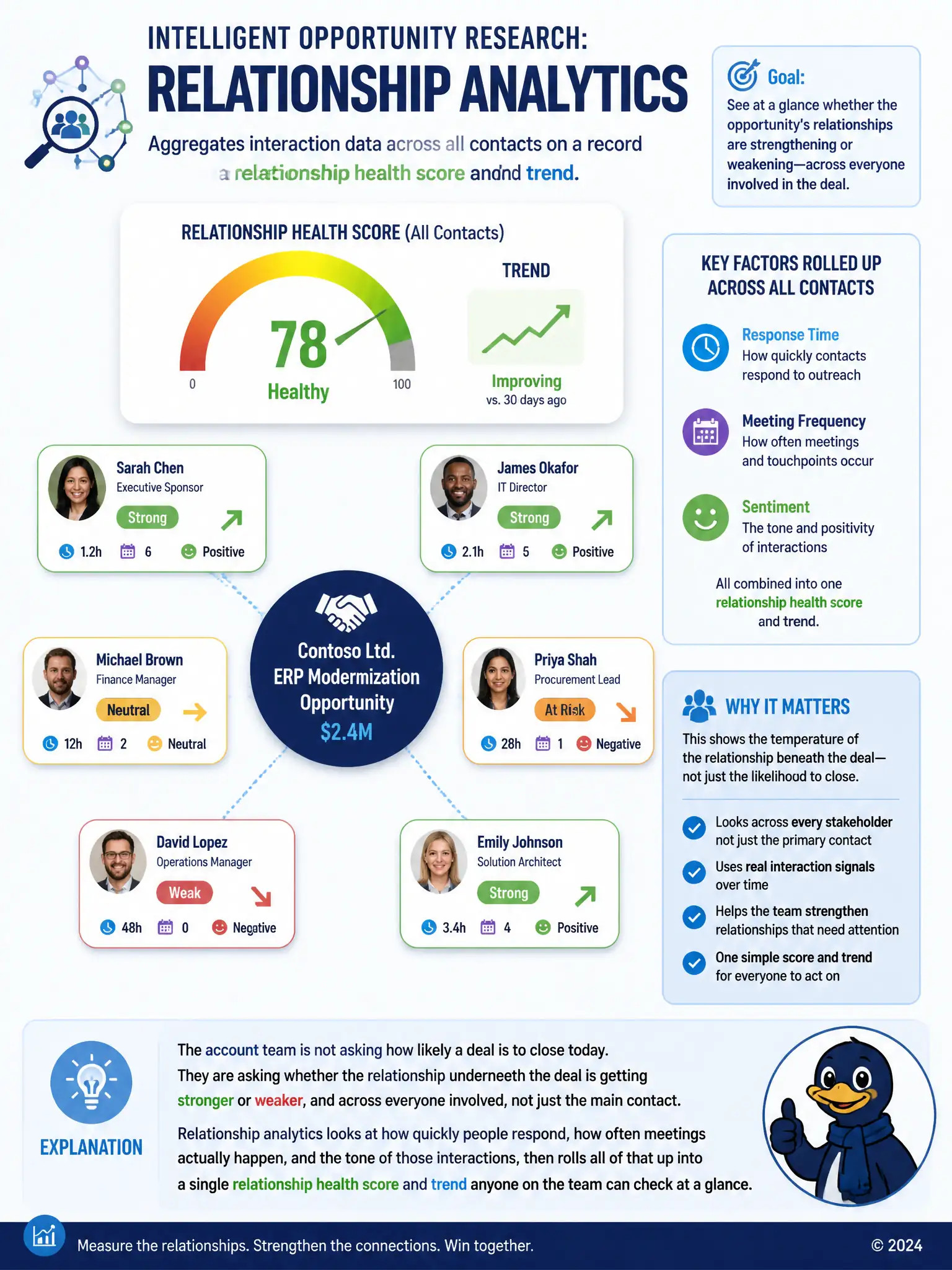
You need relationship analytics because it rolls response times, meeting frequency, and sentiment across every contact into a health score and trend. That gives stakeholders a quick read on whether the deal relationship is strengthening or weakening over time. The other capabilities score leads, automate next tasks, or track seller targets, not multi-contact relationship health.
Full Explanation
The capability that meets this requirement is relationship analytics in Dynamics 365 Sales. It aggregates interaction signals, including response times, meeting cadence, and sentiment, across every contact connected to a record to produce a relationship health score and trend. That gives the account team the multi-contact, over-time view they asked for, rather than a snapshot of one primary buyer. Predictive lead scoring is not the right fit because it operates on leads before qualification and ranks conversion likelihood; it does not track ongoing relationship strength across multiple stakeholders on an active opportunity. Sales accelerator sequences are also incorrect because they automate and prioritize a seller's next outreach tasks; they help execute activity but do not analyze or surface relationship trend data. Goal management is incorrect because it measures a seller's performance against quota or activity targets, which addresses individual productivity rather than the health of the customer relationship itself. Relationship analytics is the purpose-built feature for the requirement described.