
A consultant is preparing to enable predictive lead scoring for a client whose Dynamics 365 Sales environment holds clean historical data spanning eighteen months, with qualified or disqualified outcomes recorded on roughly 60,000 leads. Which two actions should the consultant take before activating the model? (Select TWO.)
Select all correct answers, then click Submit.
Short Explanation
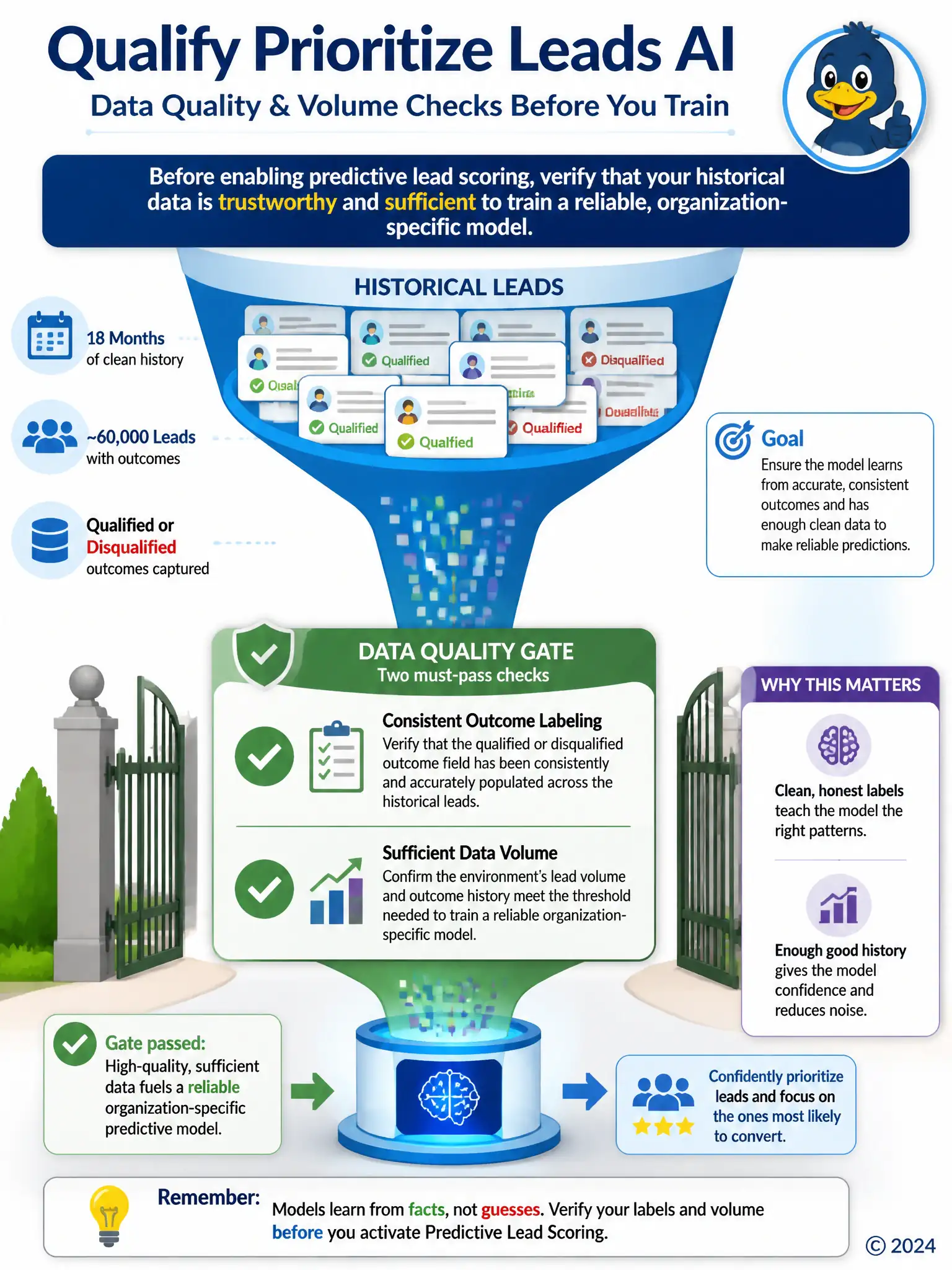
Before flipping this feature on, you need to trust the fuel going into the engine. Check that past leads were honestly and consistently labeled as qualified or disqualified, and confirm the environment actually has enough clean history to train a reliable organization-specific model. Hand-scoring open leads or disabling assignment rules does not help the model learn conversion likelihood.
Full Explanation
The correct actions are verifying that the qualified or disqualified outcome field has been consistently and accurately populated across historical leads, and confirming that the environment's lead volume and outcome history meet the threshold needed to train a reliable organization-specific model. Predictive lead scoring learns by comparing patterns in past leads to their recorded outcomes, so the model is only as good as the data feeding it; gaps or inconsistent labeling teach the model the wrong lessons. The consultant must also confirm the organization's data volume and history actually clear the threshold for a reliable org-specific model rather than assuming eighteen months and 60,000 records automatically qualifies, since data quality and completeness matter as much as raw count. The action of manually assigning a numeric score to every currently open lead is incorrect because manually scoring open leads has no bearing on model training, which learns from closed historical outcomes, not from scores seeded onto records that have not yet reached a conclusion. The action of disabling all lead assignment rules so the AI model can take over owner assignment during scoring is incorrect because lead scoring evaluates conversion likelihood and has nothing to do with owner assignment; disabling assignment rules would disrupt lead routing for no benefit to the scoring model and conflates two unrelated capabilities within the platform.