
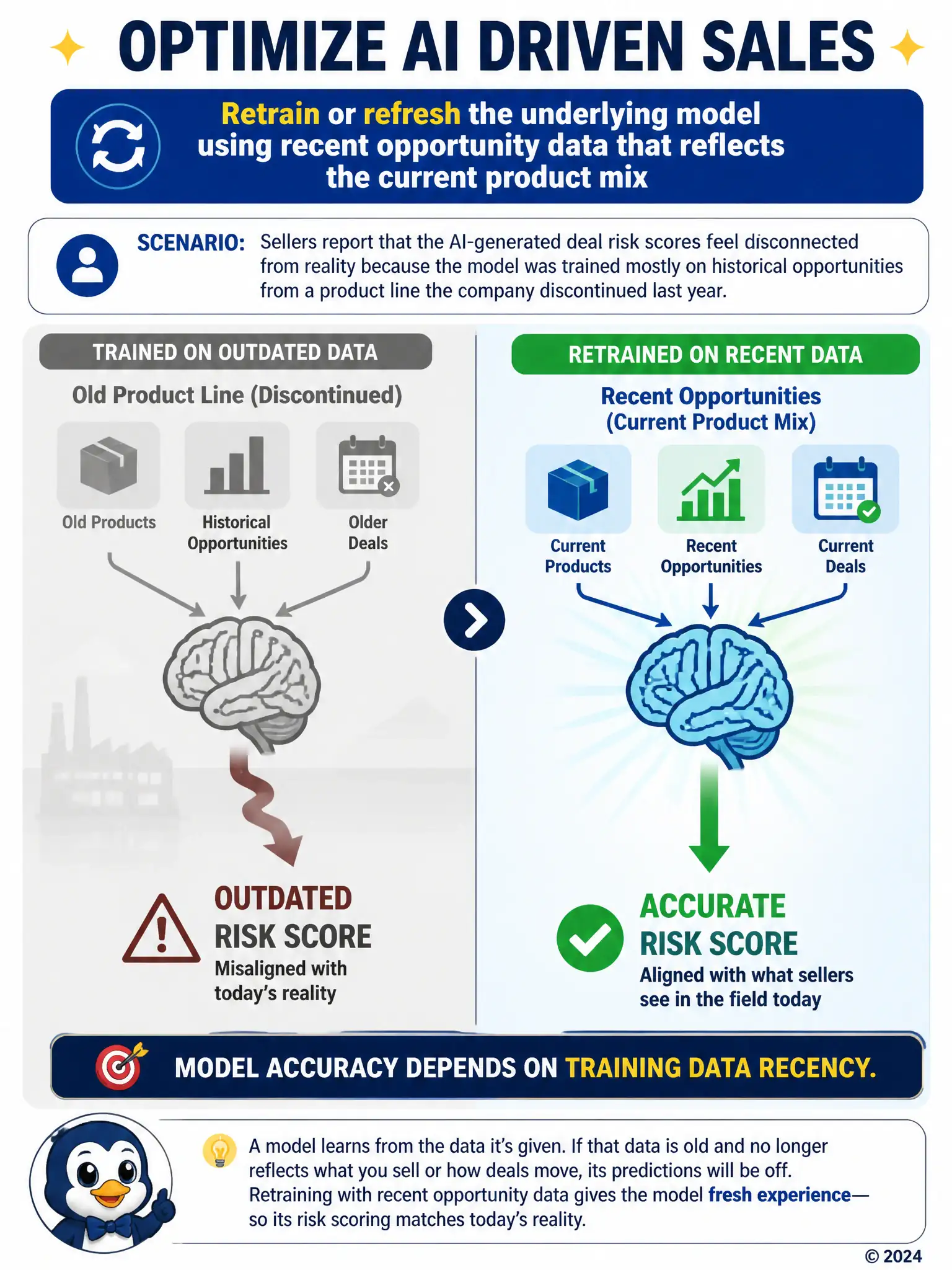
A Dynamics 365 Sales admin is configuring the Sales Copilot forecasting assistant. Sellers report that the AI-generated deal risk scores feel disconnected from reality because the model was trained mostly on historical opportunities from a product line the company discontinued last year. Which action should the consultant recommend to improve the relevance of the AI-driven insights going forward?
Select an answer to reveal the explanation.
Short Explanation
Think of a forecasting model like an employee who learned the job years ago and never got retrained after the company changed direction. If most of what it learned came from a discontinued product line, its risk instincts are going to be off, no matter how confident it sounds. The fix is to give it fresh, relevant experience: recent opportunity data that reflects the current product mix, not disable it, add required fields, or lower the confidence threshold.
Full Explanation
The correct action is to retrain or refresh the underlying model using recent opportunity data that reflects the current product mix. When an AI scoring model was trained on data that no longer reflects the business, such as a discontinued product line, the fix is to refresh the training data with recent, representative opportunities so the model's patterns match current reality. Disabling the forecasting assistant and relying only on manager judgment for risk scoring is incorrect because it discards a capability the organization wants to keep rather than fixing the root cause, and it abandons the investment without addressing the data quality issue. Increasing the number of required fields on the opportunity form so sellers enter more data manually is incorrect because it increases data entry burden and may improve some inputs, but it does not correct a model trained on stale, irrelevant history; the problem is training data recency, not field count. Lowering the confidence threshold so the assistant surfaces more deals as at risk is incorrect because it changes how sensitive the output is, not whether the model's learned patterns are accurate, so it would surface more false positives rather than better ones. Retraining with current data directly addresses why the risk scores feel disconnected: the model needs examples that reflect today's business, not a product line the company no longer sells.