
A bank's proof of concept ran on a global model deployment, and the privacy office allowed that proof. The production build copies the same global deployment. What should the architect do before production?
Select an answer to reveal the explanation.
Short Explanation
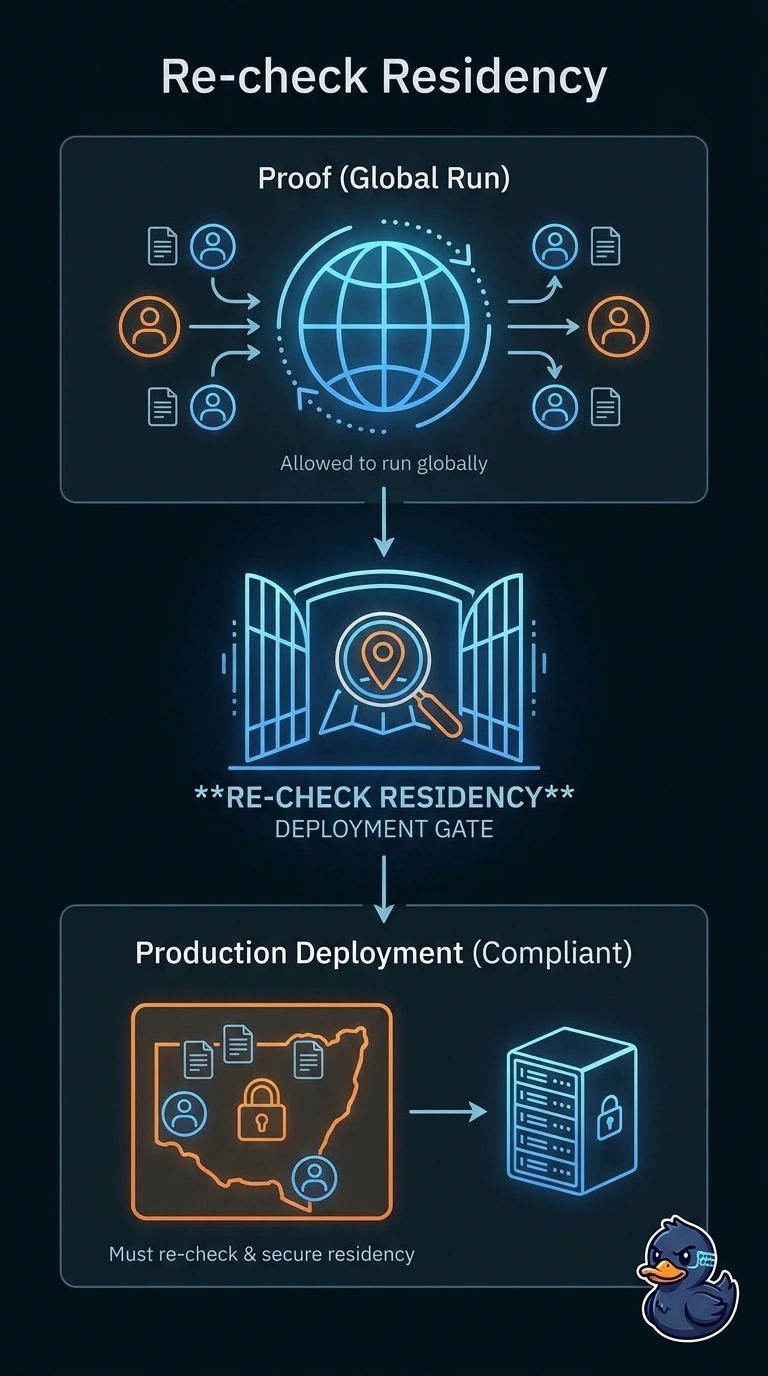
A hall pass for the rehearsal is not a permit for opening night. You re-check residency for the production deployment, even though the privacy office allowed the global deployment for the proof of concept. Keeping it global, changing the agent description, or publishing to Teams does not establish production residency.
Full Explanation
Residency depends on the deployment that processes production prompts, not on the exception granted for a proof of concept. A global deployment can process outside the boundary the bank requires for production data, so you re-check residency before production even though the privacy office allowed the proof to run globally. Keeping the global deployment because the proof was allowed treats a limited approval as production approval; the proof’s allowance does not automatically apply to production. Rewriting the agent description to claim that processing stays in-region changes only the wording and leaves the global deployment unchanged, so it does not move where the work is processed. Publishing the production agent to Teams changes the channel people use, not the deployment type or where prompts are processed, so it is not a residency control. Exam caveat: the privacy office may allow a proof to use the deployment accepted for that proof’s data, but that allowance does not transfer when the same deployment is used for production. Practical check: record the production deployment type and confirm residency with the privacy office before production; do not proceed with the global deployment unless it has been approved for production data.