
A hospital maker edits the production Copilot Studio agent and exports that unmanaged change to save it. What should the architect require instead?
Select an answer to reveal the explanation.
Short Explanation
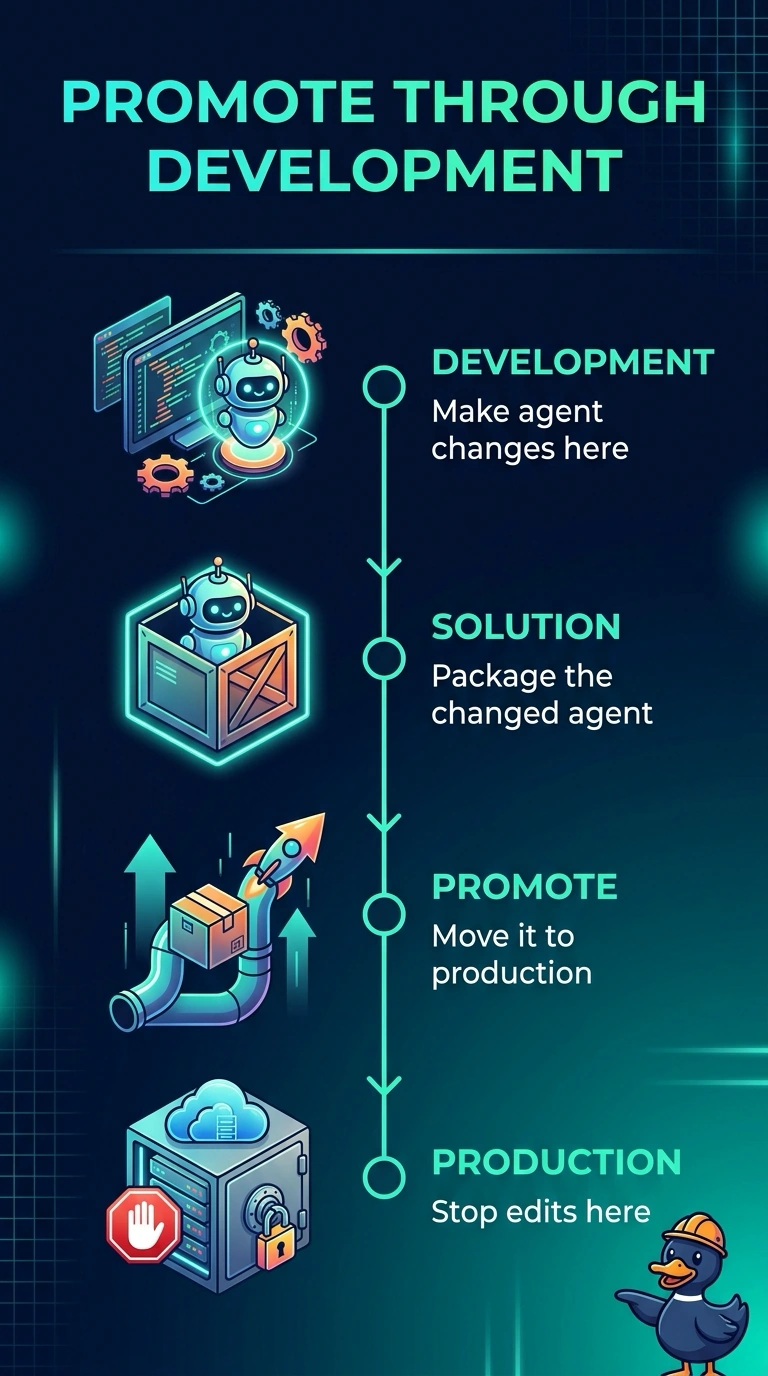
Saving a spare key by copying it off the live door still means someone is working on the live door. You stop production edits and promote the hospital agent from development in a solution. An unmanaged export from production is a souvenir of a change that bypassed the pipeline.
Full Explanation
Copilot Studio agents move across development, test, and production as solutions. The maker's unmanaged export from production freezes a hotfix that was typed on the live agent, and the next promote from development can miss it or collide with it. The architect stops edits in production and requires the change to start in development and ride the solution forward. Treating the unmanaged production export as the new source and importing it back over development makes production the authoring environment, which is the habit the pipeline exists to end. Keeping the production edit and filing the chat transcript records a conversation, not a solution component that test can run. Applying the same wording by hand in production and again in each lower environment multiplies the drift, because nothing checks that the three copies match. Exam caveat: a solution promotion still needs connection references bound in each environment. Stopping the production edit does not bind those references by itself. Operational check: confirm the production environment rejects maker edits, make the change in development, and verify the same solution version is what test and production import.