
A bank uses Copilot to draft test cases for a payment agent. The draft covers successful payments and skips declines and timeouts. What should the test strategy do?
Select an answer to reveal the explanation.
Short Explanation
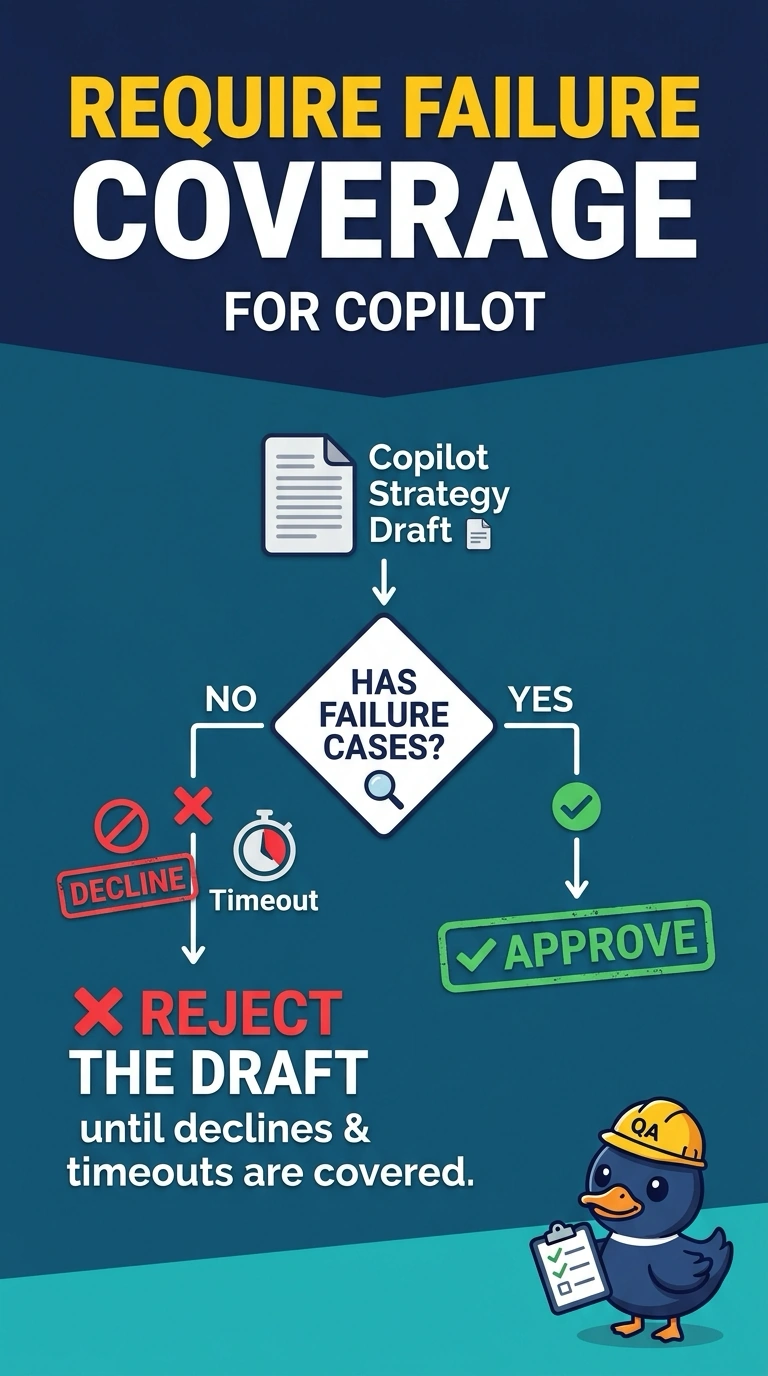
A fire drill that only walks people out on a sunny day does not tell you the exits work. You reject a Copilot draft that skips declines and timeouts, because your strategy has to include those failure cases. More happy-path cases do not fill that hole.
Full Explanation
A test strategy for an agent that takes action has to include the unhappy path, not only the payment that succeeds. Copilot can draft cases, and a draft that covers successful payments while skipping declines and timeouts should be rejected until those failure cases are in the suite. Accepting the draft would let the suite pass an agent that mishandles a decline or a timeout, which are the paths that cost the bank money and trust. Adding more successful-payment cases increases coverage of the path the draft already has and still leaves the failure cases out. Scoring only how quickly a successful payment completes measures speed on the happy path and marks the failure cases out of scope, which is the opposite of the strategy. Exam caveat: rejecting the draft does not mean Copilot cannot be used. It means this draft is incomplete until the failure cases and their expected results are present. Operational check: list the payment outcomes the agent can produce, mark declines and timeouts as required cases, and refuse to baseline the suite while either one is missing.