
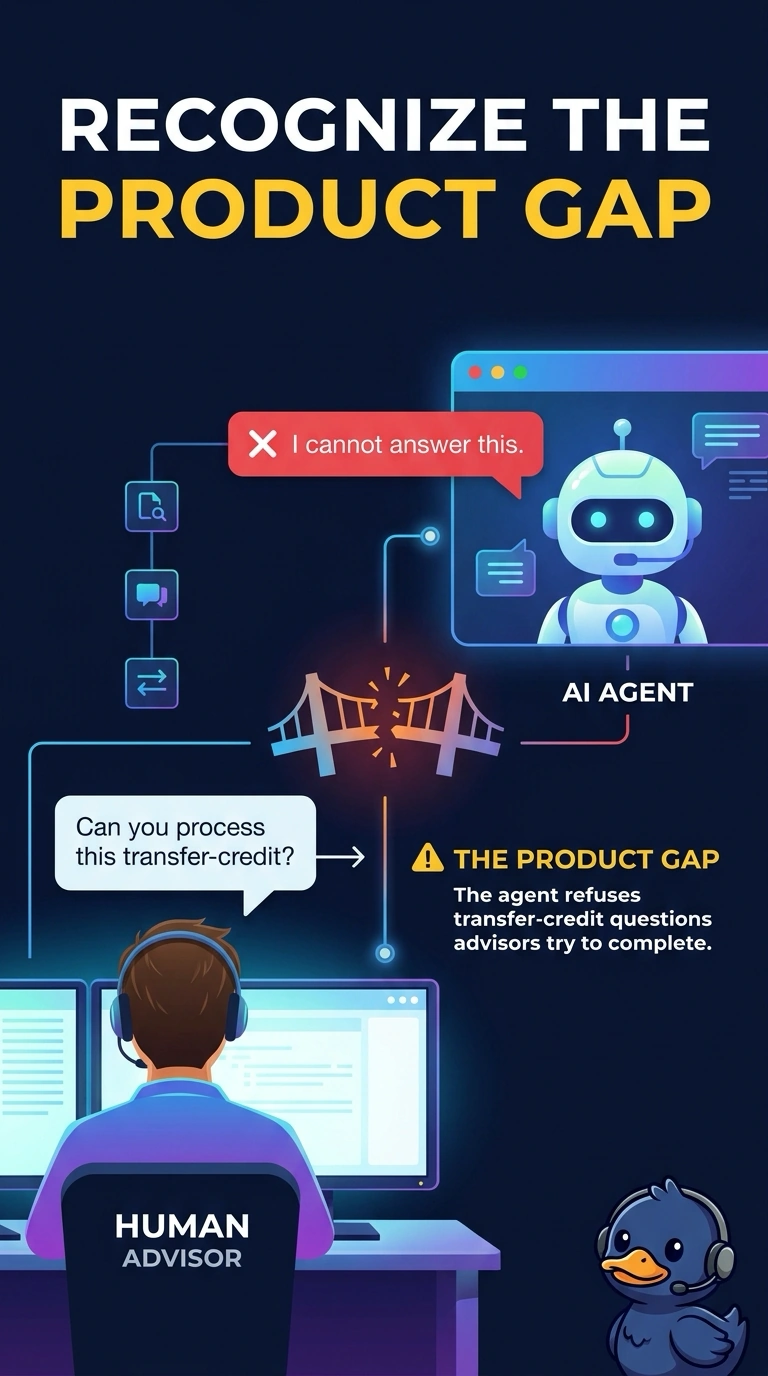
Advisors at a university have stopped using the registration agent. Their feedback says it refuses every transfer-credit question, and they now email the registrar instead. What should the architect treat this pattern as?
Select an answer to reveal the explanation.
Short Explanation
When a whole office walks around a tool, look at the tool before you blame the office. You treat the advisors' bypass as a product gap, since the agent refuses the transfer questions they came to finish. A reminder to try the same question again ignores the feedback they already gave.
Full Explanation
Repeated bypass plus feedback that names a refused task is a product gap. The advisors stopped using the registration agent because it refuses every transfer-credit question, and they email the registrar to get the work done. Treating that pattern as user error, and reminding them to ask again, blames people who already explained the refusal. A license shortage does not follow from the feedback. More seats would give more people the same refusal, and nothing in the comments says the agent was unavailable for lack of a license. Erasing the feedback log hides the refusal pattern and leaves the agent unable to finish the transfer questions. The gap belongs on the backlog as a missing capability, to be sized and fixed, rather than as a note about advisor behavior. Exam caveat: one confused user is not the same signal as a whole office leaving for the same stated reason. Operational check: read the bypass comments, confirm they cluster on transfer-credit refusals, and open that gap as a product item before sending any reminder to try again.