
A community member asks how the official MCP Registry currently prevents spam submissions. Which set of measures does the registry documentation describe?
Select an answer to reveal the explanation.
Short Explanation
The registry's spam defence is basically: prove who you are, keep it short and valid, and the maintainers can pull bad entries. The trap is the ideas the docs list as future considerations, sold as if they were current.
Full Explanation
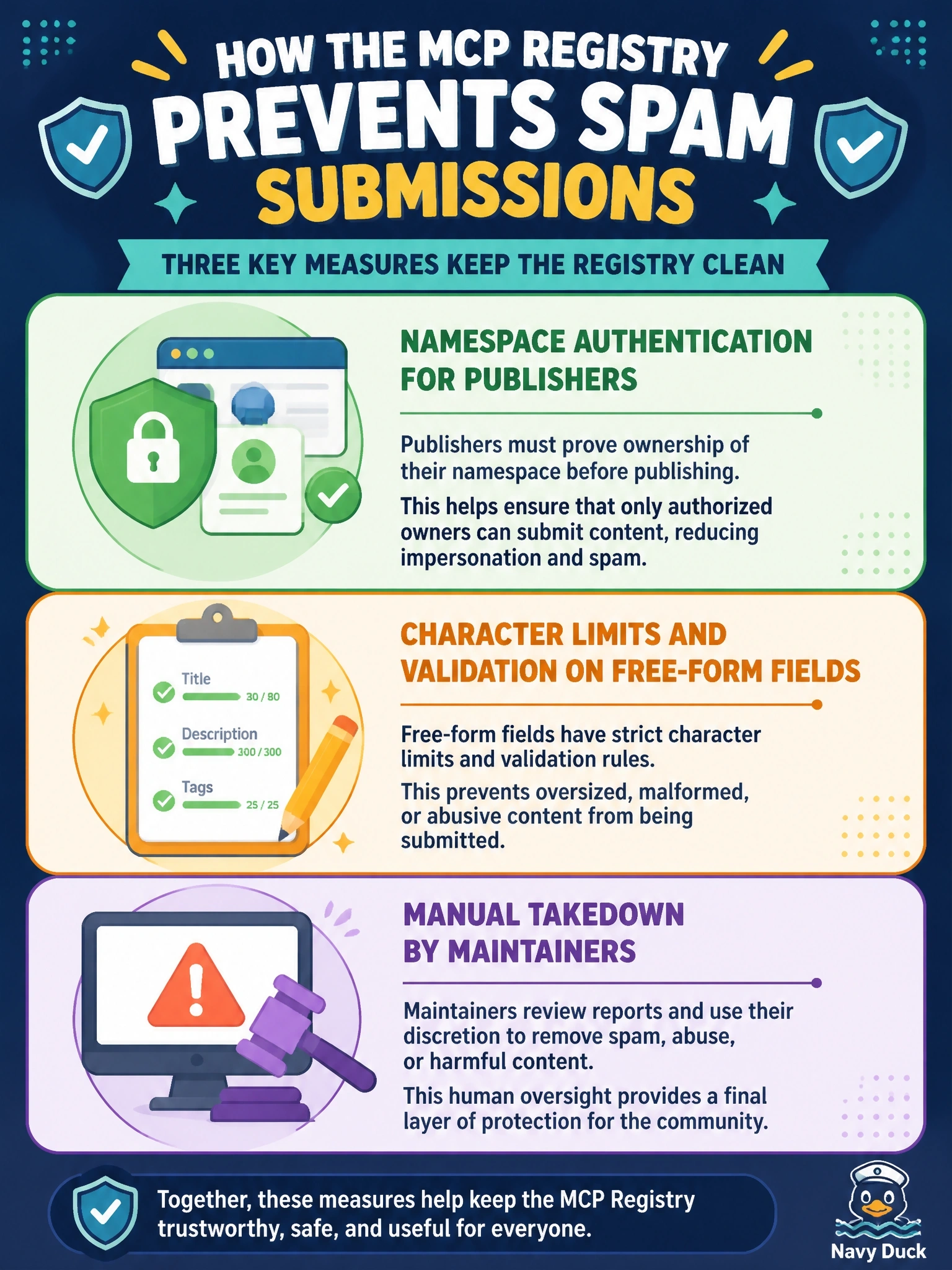
The registry documentation lists three current spam-prevention mechanisms. First, namespace authentication requires publishers to verify ownership of their namespace through GitHub, DNS or HTTP challenges, which prevents arbitrary spam submissions under names they do not control. Second, free-form fields carry strict character limits and regex validation to prevent abuse. Third, registry maintainers can manually remove spam or malicious servers under the moderation policy. AI-based spam detection, community reporting and stricter rate limiting are described only as future measures under consideration, so presenting them as today's controls misstates the documentation. The registry charges no publishing fee and performs no mandatory code review or waiting period; it focuses on namespace verification and metadata hosting. It also delegates security scanning to package registries and downstream aggregators rather than scanning packages itself, and it publishes no reputation score or automated removal based on ratings; curation and ratings belong to downstream aggregators. Exam caveat: the registry is in preview, so these measures may evolve before general availability. Operational check: when a suspicious listing appears, check its namespace against the publisher's verified GitHub account or domain, review the moderation policy, and report it through the registry's issue tracker.