
An older MCP server still exposes only the HTTP+SSE transport from protocol revision 2024-11-05, and the team asks whether to keep building on it. What is the right guidance?
Select an answer to reveal the explanation.
Short Explanation
HTTP+SSE is the old road that's still open but marked for closure, so you start planning the detour now. The trap is thinking it's gone already, or that a session header could revive it.
Full Explanation
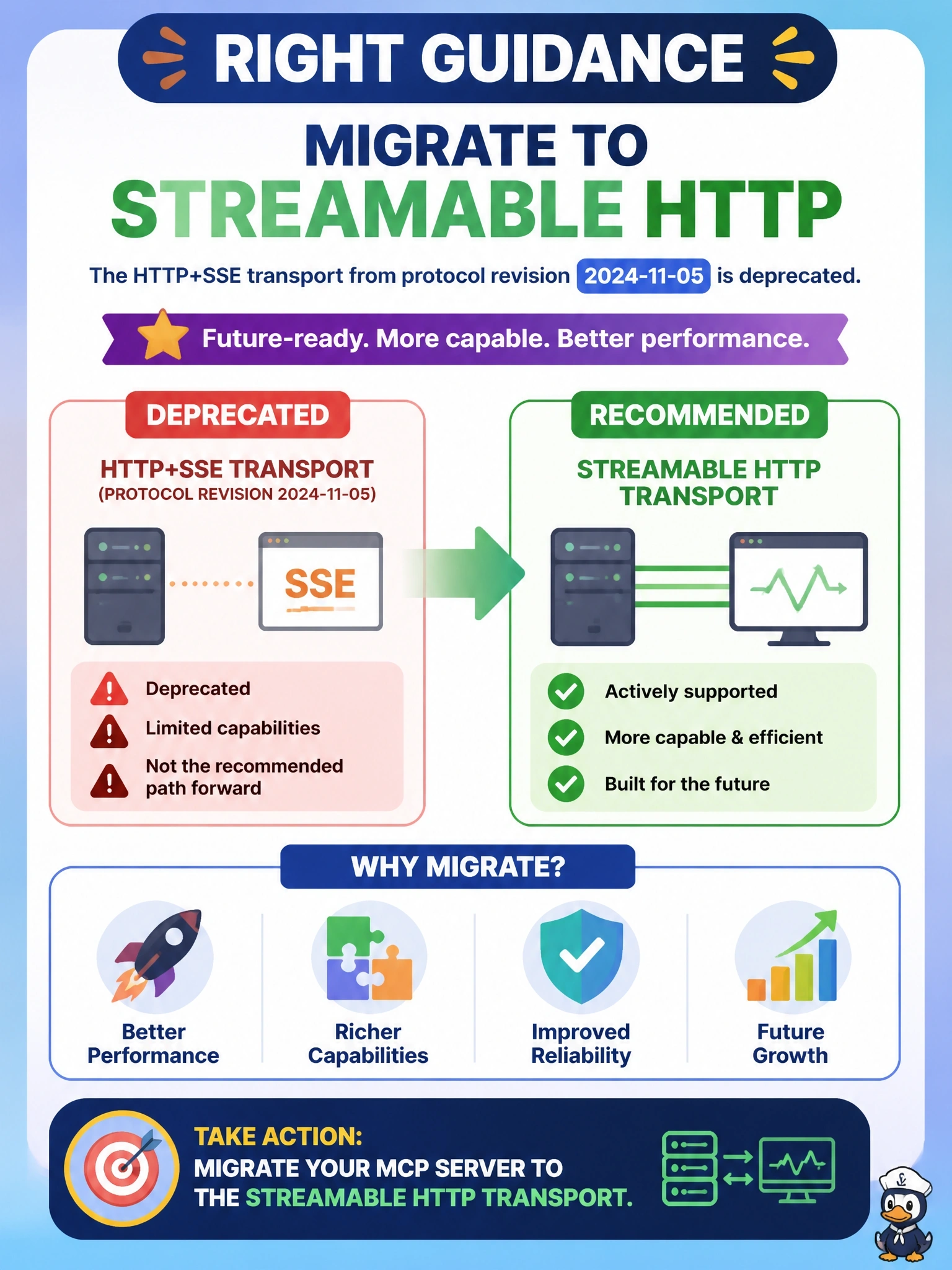
The HTTP+SSE transport from revision 2024-11-05 was replaced by Streamable HTTP in revision 2025-03-26 and is classified as deprecated under the feature lifecycle policy. New implementations should not adopt it, existing implementations should migrate to Streamable HTTP, and it is listed in the deprecated features registry as eligible for removal in a future revision, so it keeps working for now but has no long-term future. Calling it current or preferred contradicts that status: Streamable HTTP, with a single POST endpoint and request-scoped responses, is the standard remote transport. It is not yet removed, and the specification still describes how dual-era clients can fall back to it by issuing a GET and waiting for an endpoint event after a failed modern POST, so modern clients can reach it through that compatibility path. Adding Mcp-Session-Id would not modernize it; that header belongs to earlier Streamable HTTP revisions and was itself removed in 2026-07-28, which has no protocol sessions. Exam caveat: during migration a server may host both the old SSE and POST endpoints alongside the new MCP endpoint to keep older clients working. Operational check: POST a modern request to the new endpoint and confirm a JSON or event-stream response.