
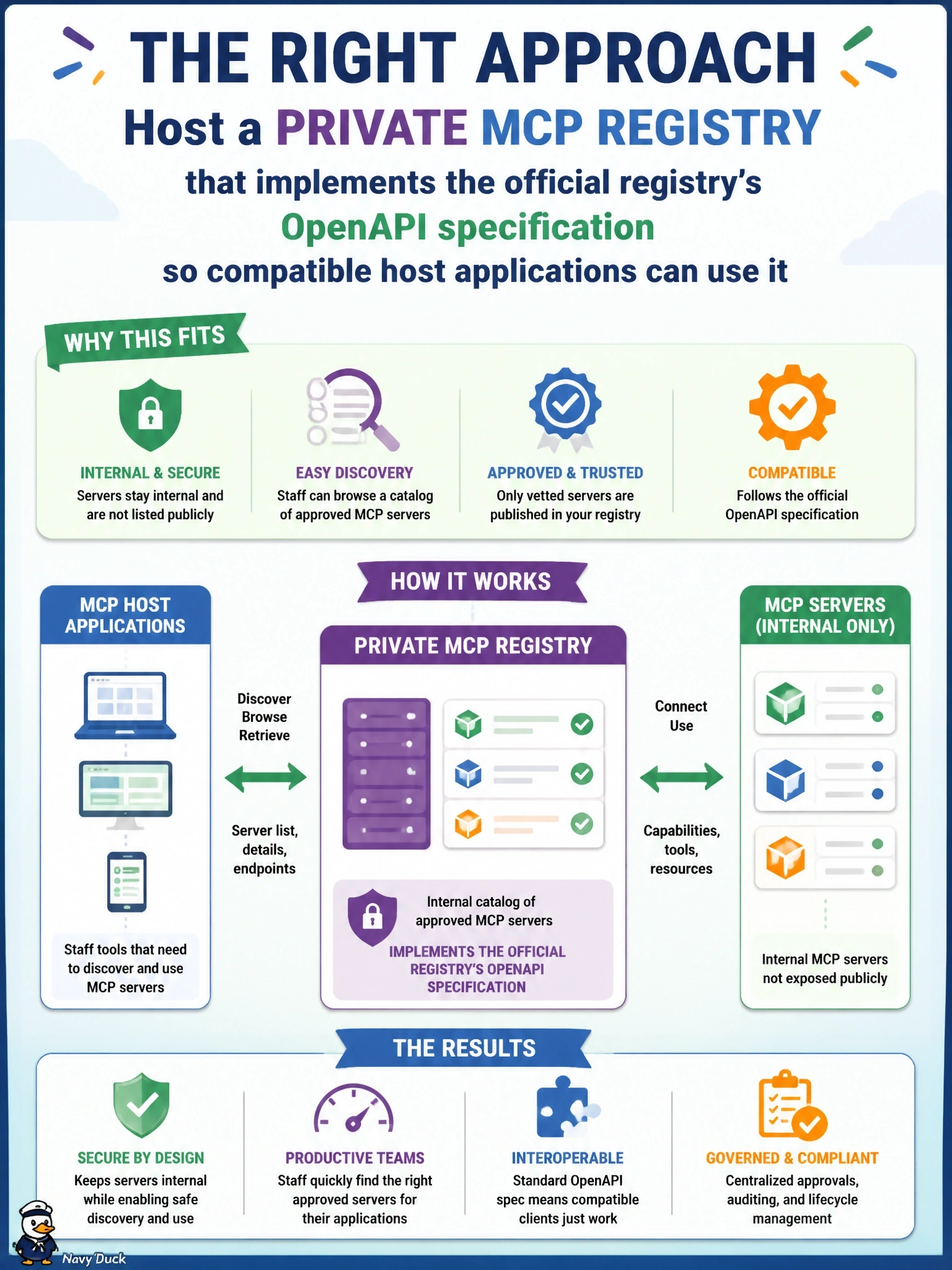
A bank's MCP servers are internal only and may not be listed publicly, but staff need a catalogue their MCP host applications can browse to find approved servers. Which approach fits?
Select an answer to reveal the explanation.
Short Explanation
Think of it as running your own company app store that speaks the same language as the public one. The trap is assuming the public registry has a private mode; it doesn't take private servers at all.
Full Explanation
The official MCP Registry is a centralized metadata repository for publicly accessible servers, and it does not support private servers, meaning those on private networks or private package registries. The registry documentation recommends that organizations wanting to catalogue private servers host their own private MCP registry. The registry defines an OpenAPI specification that other registries can implement, so a private registry that conforms to it benefits from host applications that already support that interface. The official registry has no private flag or per-entry access control; everything published there is public metadata. Forking its codebase is possible, but the documentation states the official codebase is not designed for self-hosting and the maintainers cannot support that use case, so the fork would need to be maintained and operated independently. Using a bank-owned reverse-DNS namespace proves ownership of the name but changes nothing about visibility or the rule against private servers. Exam caveat: the registry is in preview, so its schema and API may still change. Operational check: confirm the private registry serves the standard API endpoints from the published OpenAPI specification, point a host application at it, and verify that only approved internal servers appear in its results.