
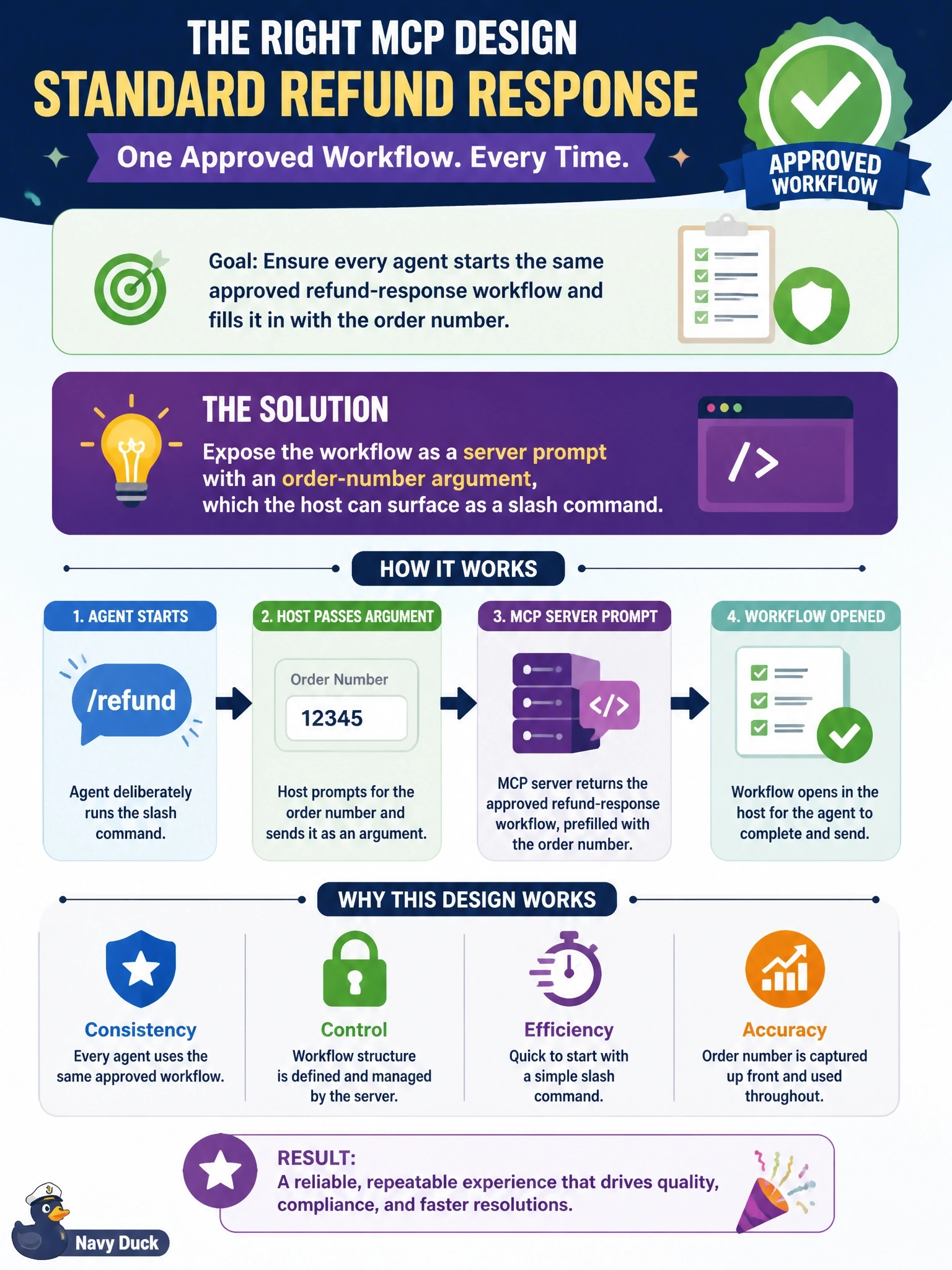
A support team wants every agent to use the same approved refund-response workflow, started deliberately by the agent and filled in with an order number. Which MCP design fits?
Select an answer to reveal the explanation.
Short Explanation
A prompt is like a saved macro button: you press it on purpose, plug in the order number, and get the approved wording every time. The trap is making it a tool, because then the model decides when it runs, not the agent.
Full Explanation
Prompts are the user-controlled primitive: the server defines reusable templates with named arguments, the user chooses when to invoke one, and the client calls prompts/get with the arguments to obtain messages that enter the conversation. Hosts commonly surface prompts as slash commands or menu entries, which matches an agent deliberately starting the approved refund workflow and supplying an order number. Exposing it as a tool hands the decision to the model, so the workflow could fire whenever refunds are mentioned rather than when the agent chooses. A resource template describes parameterized data addressed by URI, and servers do not push resources into conversations; the host decides how resources are used. Elicitation lets a server ask the user for input while it processes a request; it is not a catalogue of reusable workflows, and revision 2026-07-28 has no sessions for a server to greet at the start. Exam caveat: the protocol does not mandate a particular user interface for prompts, so a slash command is a common host choice rather than a requirement. Operational check: call prompts/list to confirm the workflow appears with an order-number argument, then call prompts/get with a sample order and review the returned messages.