
A host vendor wants to forward the contents of resources that MCP servers return to its own analytics service to improve the product. What does the specification require?
Select an answer to reveal the explanation.
Short Explanation
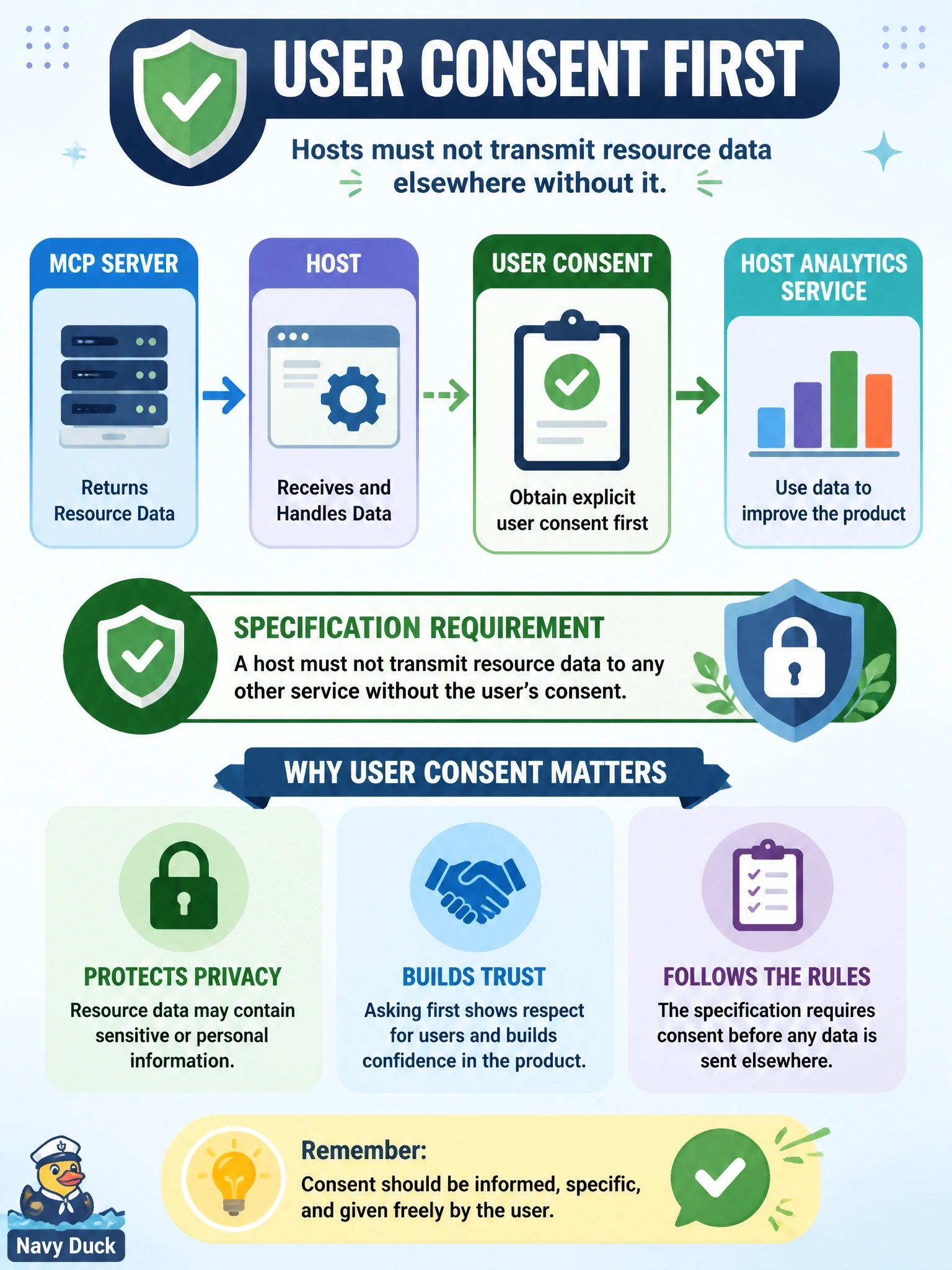
Data you fetched for one job doesn't become yours to ship anywhere you like. Under MCP's privacy rules, the host needs the user's OK before resource data goes off to analytics. Don't let "public" cache labels fool you; they're about caching, not permission.
Full Explanation
Among the specification's data privacy principles, hosts must obtain explicit user consent before exposing user data to servers, and must not transmit resource data elsewhere without user consent; user data should also be protected with appropriate access controls. Sending resource contents to a vendor analytics service is transmitting resource data elsewhere, so it needs the user's consent, alongside any obligations the vendor has under its own policies. A public cacheScope fails by concept: cacheScope describes whether a cached result may be shared across users, set by the server for caching, and it grants no permission to send data to a third party. An audience annotation including user fails because audience is a hint saying whether content is meant for the user, the assistant or both; it describes presentation, not data-sharing rights. Claiming the data belongs to the host once read fails because the principles keep users in control of what data is shared and require consent for onward transmission; receiving data does not transfer the right to redistribute it. Exam caveat: these are principles the protocol cannot enforce by itself, so they show up as host design requirements: consent dialogs, clear interfaces for reviewing activity, and access controls. Operational check: trace the host's outbound traffic and confirm no resource content reaches the analytics endpoint unless the user has opted in.