
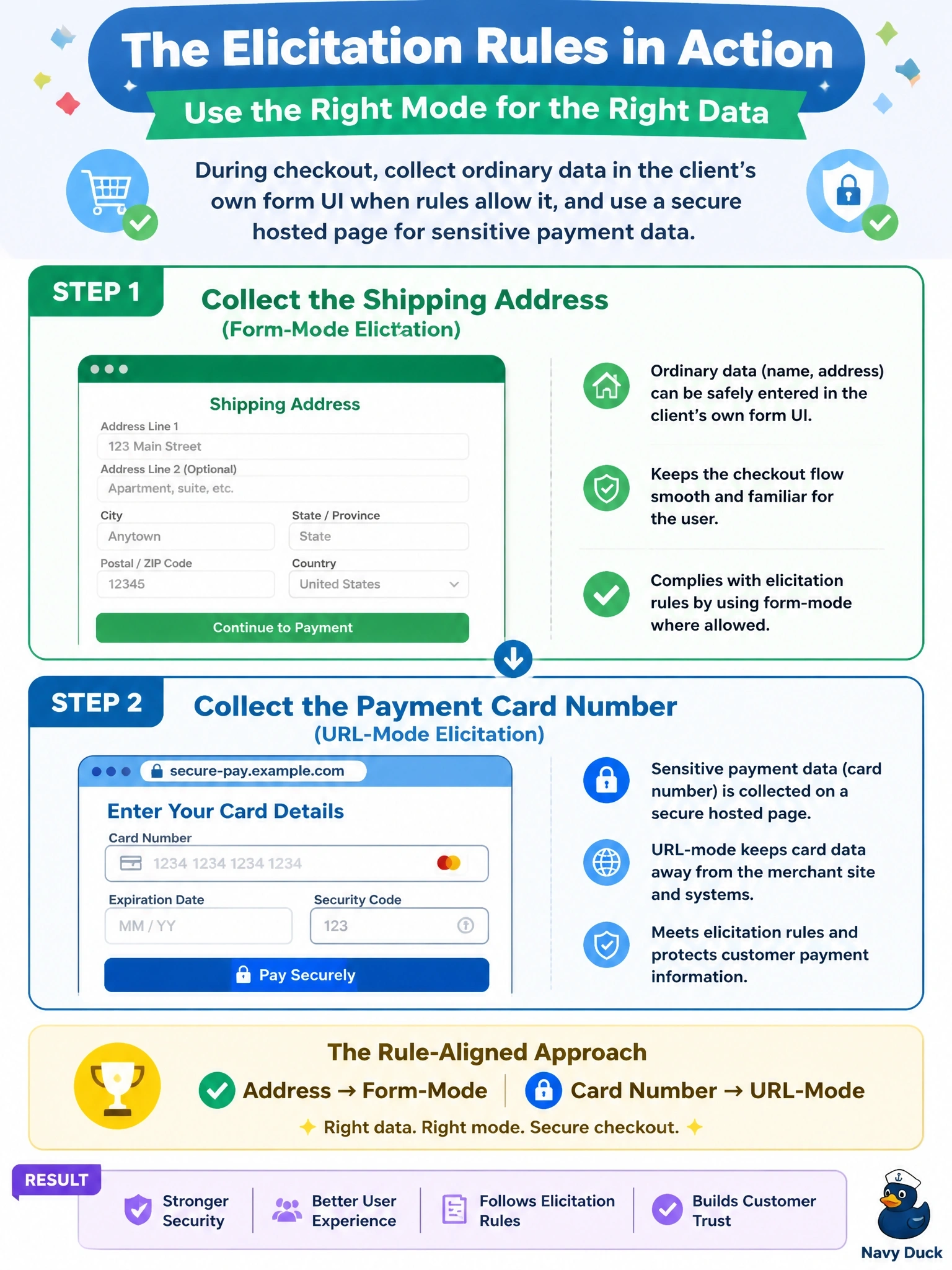
During a checkout tool call, a server needs the user's shipping address and then a payment card number. The team wants ordinary data entered in the client's own form UI where the rules allow it. Which approach follows the elicitation rules?
Select an answer to reveal the explanation.
Short Explanation
Here's the rule of thumb: everyday details can go in the client's form, but anything that unlocks money or accounts goes through a URL the client never sees inside. You don't hand your card number to the middleman. The trap is thinking form mode bans all personal data; it doesn't.
Full Explanation
Elicitation has two modes. Form mode collects structured data in-band through the client using a flat schema of primitive types, and the submitted data is visible to the client. URL mode sends the user to an external URL so the interaction never passes through the client. The specification says servers must not use form mode for sensitive information such as passwords, API keys, access tokens or payment credentials, and must use URL mode for those. It also says general contact or profile information is not categorically prohibited in form mode. So a shipping address fits form mode and a card number requires URL mode. Collecting both in form mode with a masking format fails because the prohibition covers the data itself, and form-mode string formats are limited to email, uri, date and date-time anyway. Collecting both through URL mode fails the stated preference and rests on a false premise, since ordinary personal data is allowed in forms. Having the model fill in the card number fails by concept because the credential would pass through the LLM context and the client, which is what URL mode exists to prevent. Exam caveat: URL-mode accept means the user consented to open the URL, not that the payment finished. Operational check: confirm no form-mode requestedSchema asks for a credential field.