
A client sends tools/call with JSON-RPC id 7. The server replies with a result whose resultType is "input_required", carrying an elicitation request in inputRequests and an opaque requestState. What sequence should the client follow next?
Select an answer to reveal the explanation.
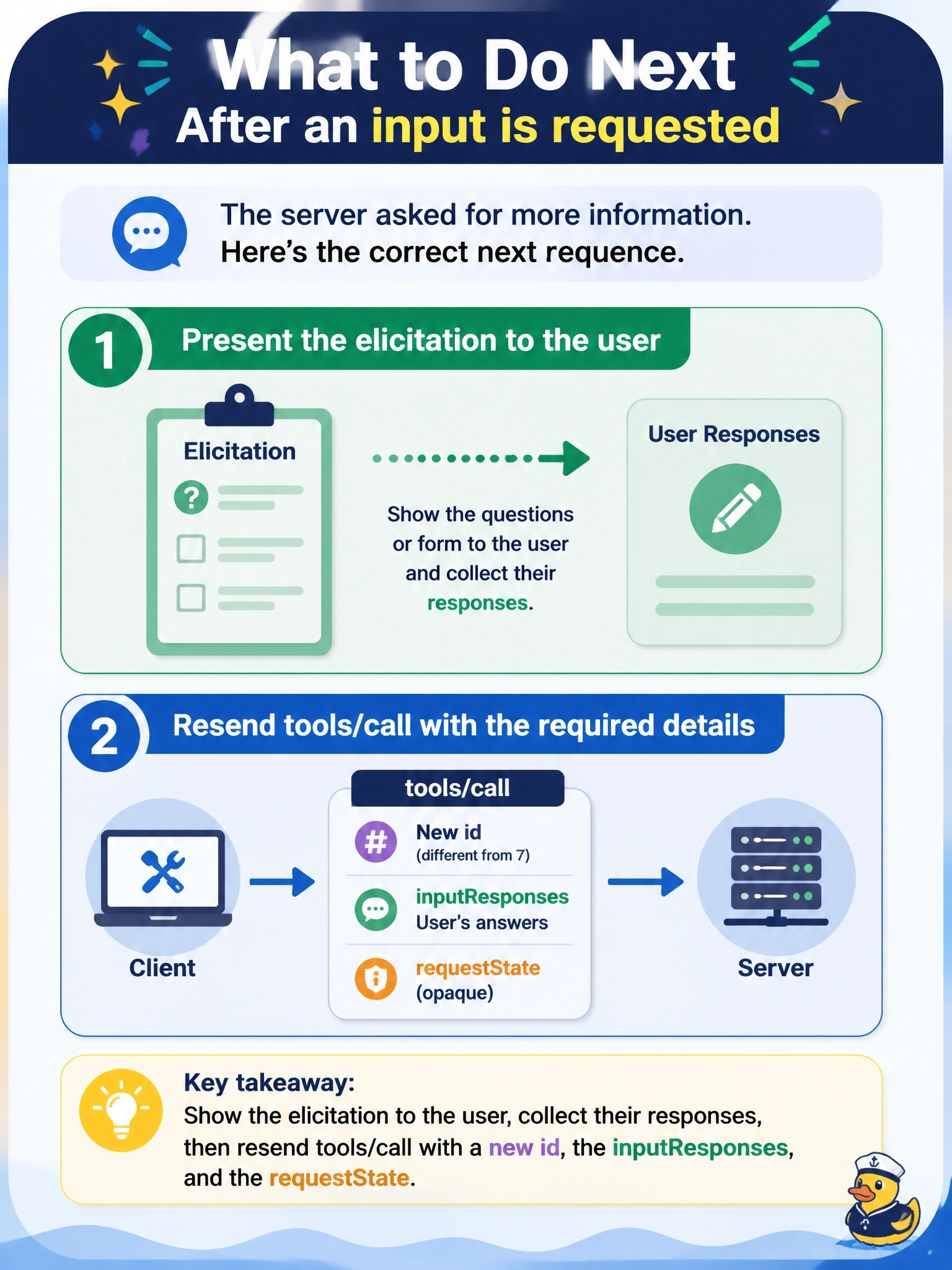
Short Explanation
It's like a clerk handing your form back saying "you missed the signature line." You don't keep standing in the old queue — you sign it and hand in a fresh form with everything attached. The trap is reusing the old request id; the retry is a brand-new request.
Full Explanation
Multi round-trip requests replace server-initiated JSON-RPC requests in the 2026-07-28 revision. When a server needs more information to finish tools/call, it returns an InputRequiredResult, which terminates that initial request. The client gathers the requested input, here by showing the elicitation to the user, and then retries the original request, including inputResponses keyed to the server's inputRequests identifiers and echoing requestState exactly. The retry must use a different JSON-RPC id because it is an independent request; the server reconstructs context from requestState rather than from connection memory. Answering an elicitation/create request by id describes the legacy model in which servers sent their own requests; under this revision servers never send JSON-RPC requests, so there is nothing to reply to. Reusing id 7 violates the rule that the retry and the initial request have different ids. The notifications/elicitation/complete message was removed in this revision because the client learns the outcome simply by retrying. Exam caveat: if the InputRequiredResult had no inputRequests, the client could retry immediately, still with a new id. Operational check: trace the exchange and confirm the second tools/call carries a new id, the same tool name and arguments, inputResponses and an unmodified requestState.