
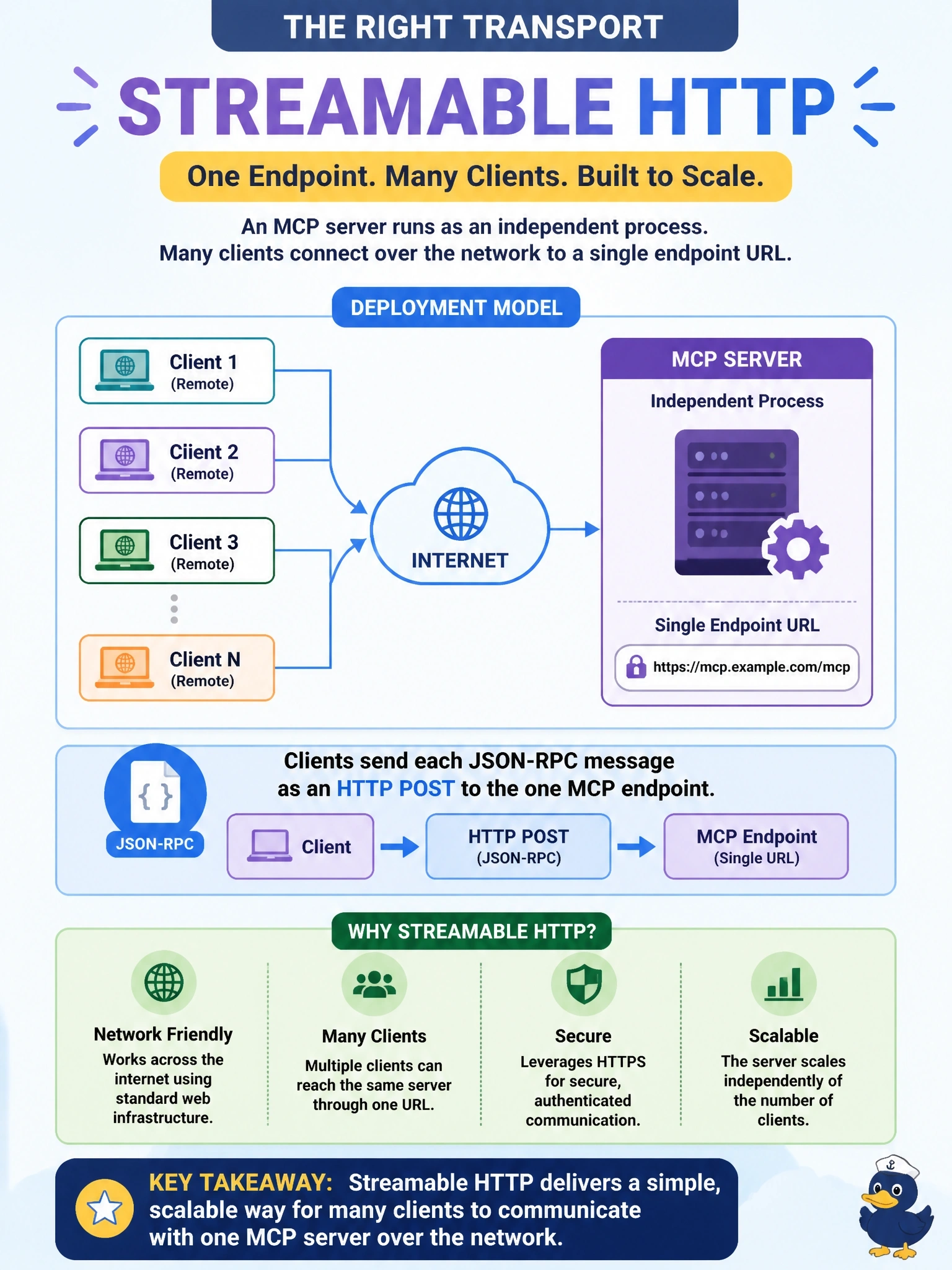
A company deploys an MCP server as an independent process that many clients reach over the network at a single endpoint URL. Which transport matches this deployment model?
Select an answer to reveal the explanation.
Short Explanation
Many clients, one URL, server running on its own: you're looking at Streamable HTTP. Each message is its own POST to the MCP endpoint. HTTP+SSE looks tempting, but it's the deprecated 2024 transport.
Full Explanation
In the Streamable HTTP transport, the server operates as an independent process that can handle multiple client connections. It exposes a single HTTP endpoint, the MCP endpoint, which accepts POST; the client sends every JSON-RPC request or notification as its own POST, and the server answers each request with either a single JSON object or a Server-Sent Events stream scoped to that request. That model matches a networked service reached by many clients at one URL. stdio is designed for a client that launches the server as its own subprocess, and a single standard input stream cannot be shared by unrelated network clients. HTTP+SSE is the transport from protocol version 2024-11-05; it has been deprecated since 2025-03-26, new implementations SHOULD NOT adopt it, and it remains only for backward compatibility. WebSocket is not one of the standard transports in this revision, which defines stdio and Streamable HTTP; other channels would be custom transports. Exam caveat: the 2026-07-28 version of Streamable HTTP removed the GET stream and protocol-level sessions, so long-lived notifications now flow on a subscriptions/listen response stream. Operational check: confirm the server exposes one MCP endpoint that accepts POST, validates the Origin header, and answers requests with application/json or text/event-stream.