
An architect is documenting the duties of the AI application that coordinates MCP connections on a user's behalf. Which set of responsibilities belongs to this host?
Select an answer to reveal the explanation.
Short Explanation
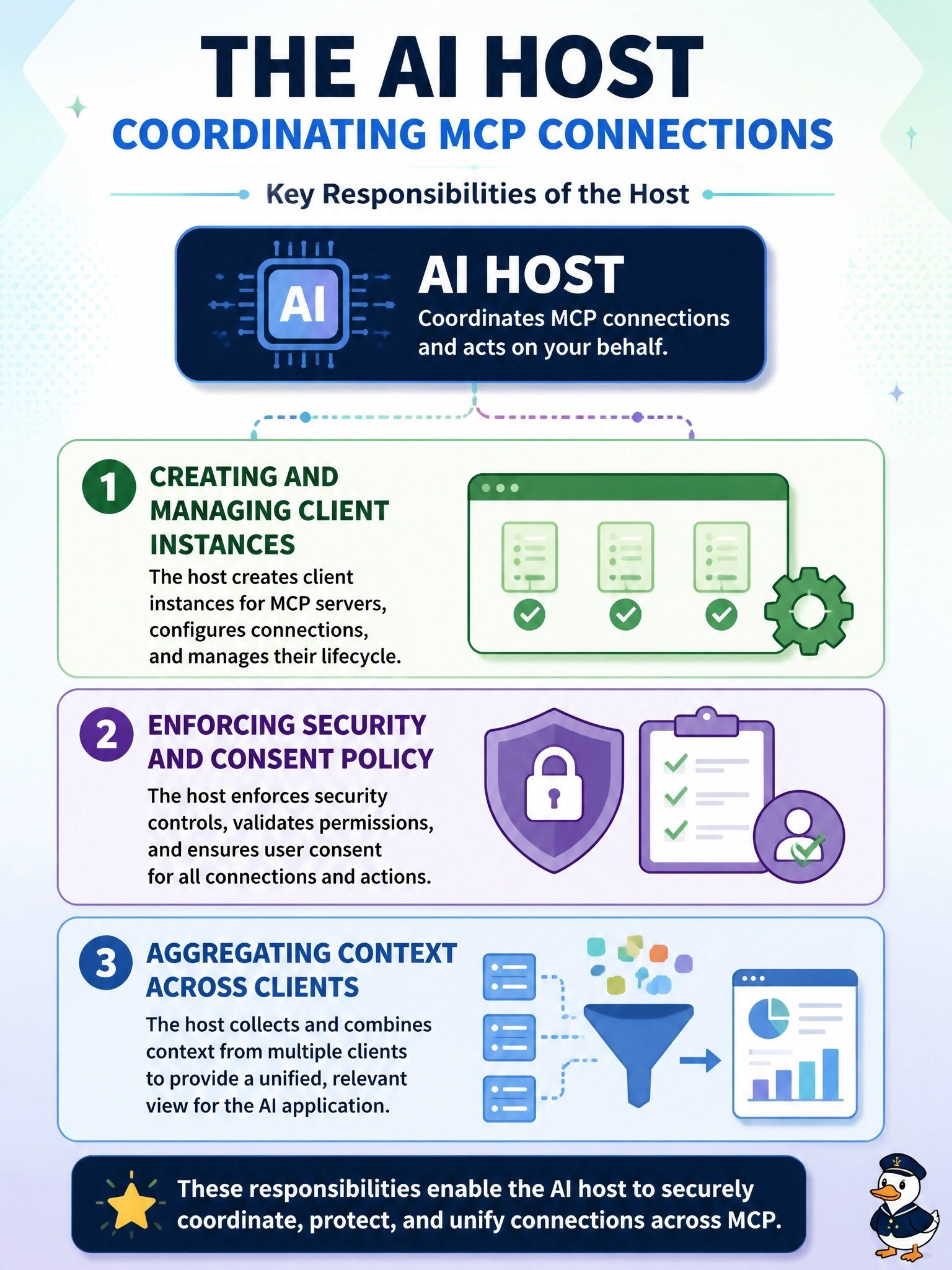
The host is the conductor of the orchestra. It creates the clients, decides what's allowed, asks for your consent and pulls context together. It doesn't play the instruments; servers and clients do that.
Full Explanation
The architecture specification describes the host as the container and coordinator. It creates and manages multiple client instances, controls client connection permissions and lifecycle, enforces security policies and consent requirements, handles user authorization decisions, coordinates AI and LLM integration, and manages context aggregation across clients. Those are precisely the duties listed in the correct set. Exposing tools, resources and prompts and executing calls against back ends describes a server, which provides specialized context and capabilities through MCP primitives. Holding a single dedicated connection to one server and attaching protocol version and capabilities to every request describes a client, which the host creates for each server connection. Issuing OAuth tokens and publishing Protected Resource Metadata confuses several parties: tokens are issued by an authorization server, and Protected Resource Metadata is published by the MCP server acting as an OAuth resource server, not by the host. Exam caveat: MCP itself cannot enforce user consent at the protocol level; the specification places that obligation on the host, which is why consent appears in its duties. Operational check: map each component in the deployment to host, client or server and confirm that consent prompts and context aggregation are implemented in the host application rather than in any server.