
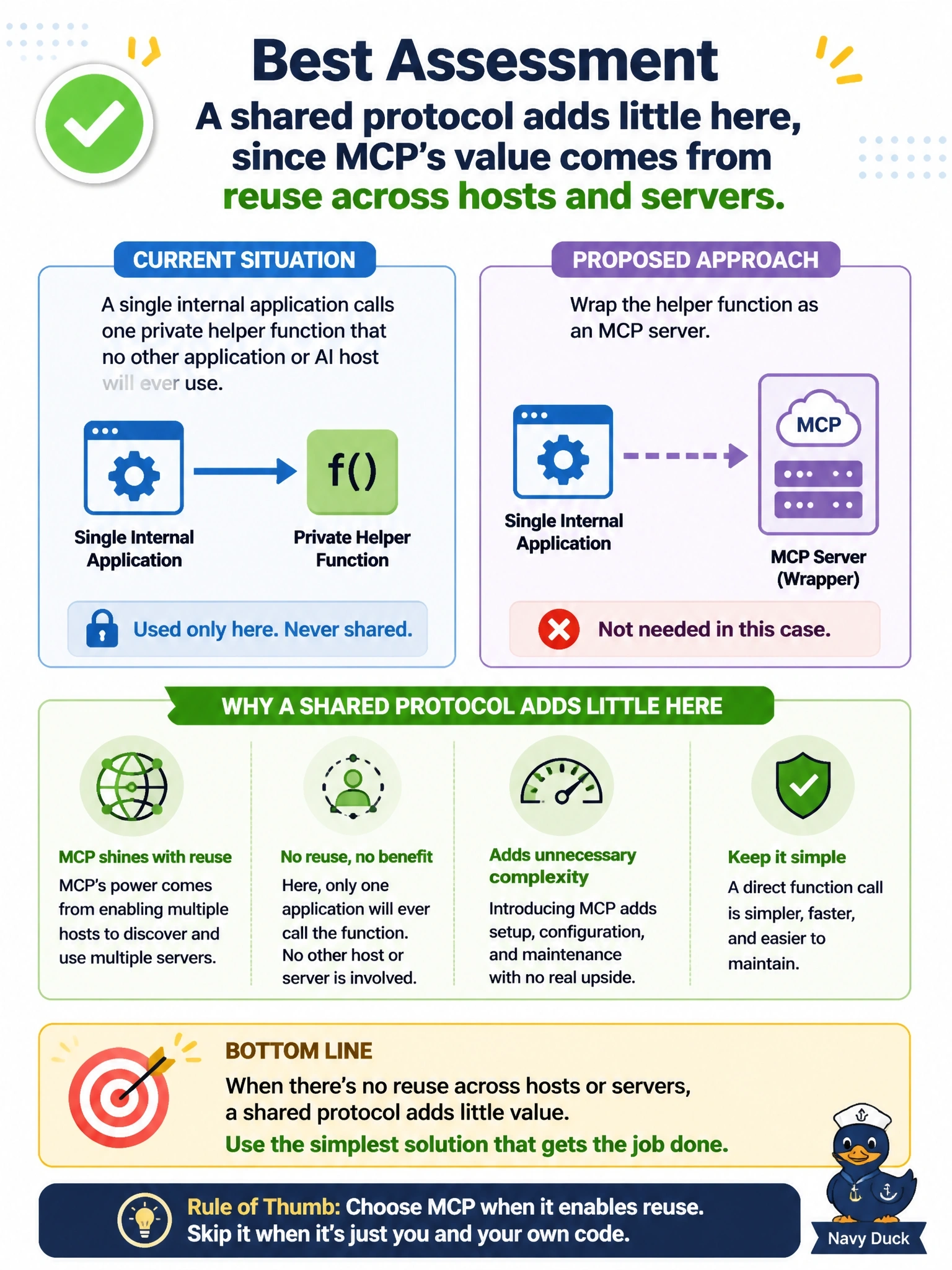
A single internal application calls one private helper function that no other application or AI host will ever use. A developer proposes wrapping that function as an MCP server. What is the best assessment?
Select an answer to reveal the explanation.
Short Explanation
A universal adapter is great when you've got lots of devices — not when one plug only ever fits one socket. With a single private consumer, you're adding plumbing without getting reuse. The trap is believing every LLM function call has to go through MCP.
Full Explanation
MCP's value comes from standardizing the connection between many AI applications and many sources of tools and context: a server written once can be reused by any conforming host, and capability negotiation lets independent implementations work together. When a single application calls a single private function with no other consumers, there is no reuse for the protocol to unlock, so a direct integration is usually simpler. MCP is not mandatory for model tool use; hosts can offer a model functions directly through the provider's function-calling interface, and MCP is one way to source those tools. Auditing does not depend on the protocol either. Logging is a deprecated MCP utility in revision 2026-07-28, with migration to stderr or OpenTelemetry, and an application can log direct calls itself. Performance is not an argument for MCP; adding a client, transport and server introduces serialization and process boundaries that a direct call avoids. Exam caveat: the assessment changes if more hosts, teams or agents are expected to use the function later, or if the organization wants a uniform consent and authorization boundary around all AI-accessible actions. Operational check: count the current and planned consumers of the function; if it is only one host with no reuse expected, keep the direct call and revisit when a second consumer appears.