
An enterprise worries that tools it builds for one LLM vendor's assistant would be locked to that vendor. How does MCP address this concern?
Select an answer to reveal the explanation.
Short Explanation
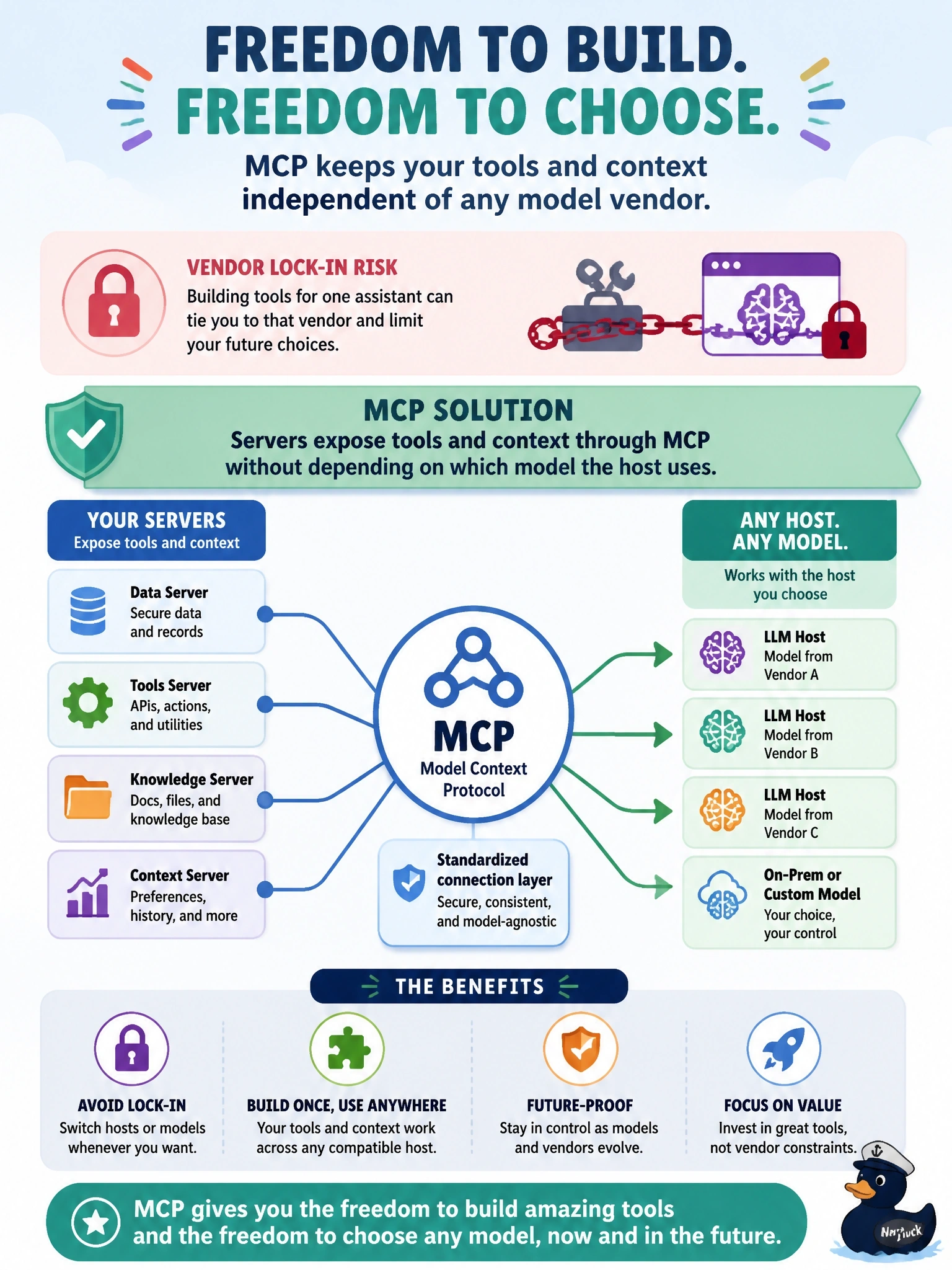
MCP is the wall socket, not the appliance brand. You build your tools once as an MCP server, and whatever model a host plugs in can use them. That's how you dodge vendor lock-in.
Full Explanation
MCP decouples context and tool providers from model choice. A server exposes tools, resources and prompts through standard JSON-RPC methods, and the host decides which language model consumes them. The architecture documentation states that MCP does not dictate how AI applications use LLMs, and the protocol is vendor-neutral and openly governed. An enterprise can therefore build a server once and use it from hosts powered by different providers, or switch a host's model without rewriting the server. Requiring all hosts to use one model is the opposite of MCP's design and would itself create lock-in. Servers do not need to bundle a language model; most servers are ordinary programs that wrap systems and data, and the deprecated sampling feature existed precisely so servers could use the host's model rather than embedding one. Translating tools into each vendor's function format is not the server's job; the server publishes tools in MCP's format, and each host adapts them to whatever its model expects. Exam caveat: tool descriptions and schemas still influence how well different models use a tool, so portability of the interface does not guarantee identical behaviour across models. Operational check: connect the same server to two hosts that use different model providers and confirm both can list and call its tools without server changes.