
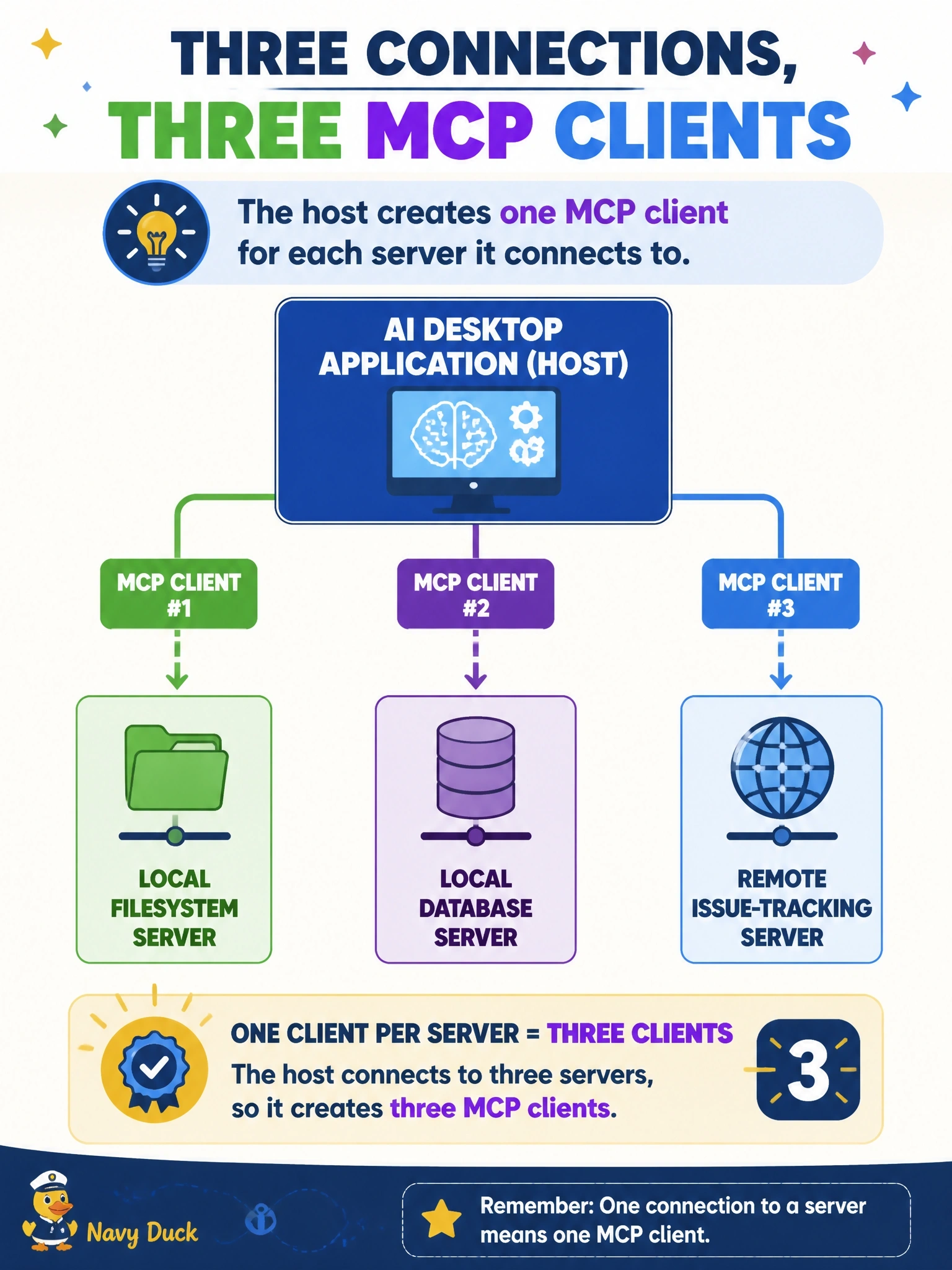
An AI desktop application connects to a local filesystem server, a local database server and a remote issue-tracking server. How many MCP clients does the host create for these connections?
Select an answer to reveal the explanation.
Short Explanation
Think of the host as a switchboard with one dedicated line per caller. Three servers means three clients, each holding its own connection. Don't let 'local versus remote' tempt you into grouping them — the count follows servers, not transports.
Full Explanation
MCP follows a client-server architecture in which the host, the AI application, establishes connections to one or more servers by creating one MCP client for each server. Each client maintains a dedicated connection with its corresponding server, so three servers produce three clients. The architecture documentation illustrates this with an editor that instantiates an additional client object each time it connects to another server. A single client multiplexing every server contradicts the one-to-one relationship; it would blur which server's capabilities, errors and authorization apply to each message. Grouping by transport, one client for local stdio servers and one for remote HTTP servers, is not part of the model; transport choice affects how a client talks to its server, not how many clients exist. A separate coordinating client is also not defined; coordination is the host's job, and the host is not itself an MCP client. Exam caveat: a single remote server may be connected by many clients from many hosts, and the architecture diagram even shows two clients in one host connected to the same remote server, so the count is per connection rather than per unique server product. Operational check: in the host's diagnostics, count active client connections and confirm there is one for each configured server, each reporting that server's own capabilities.