
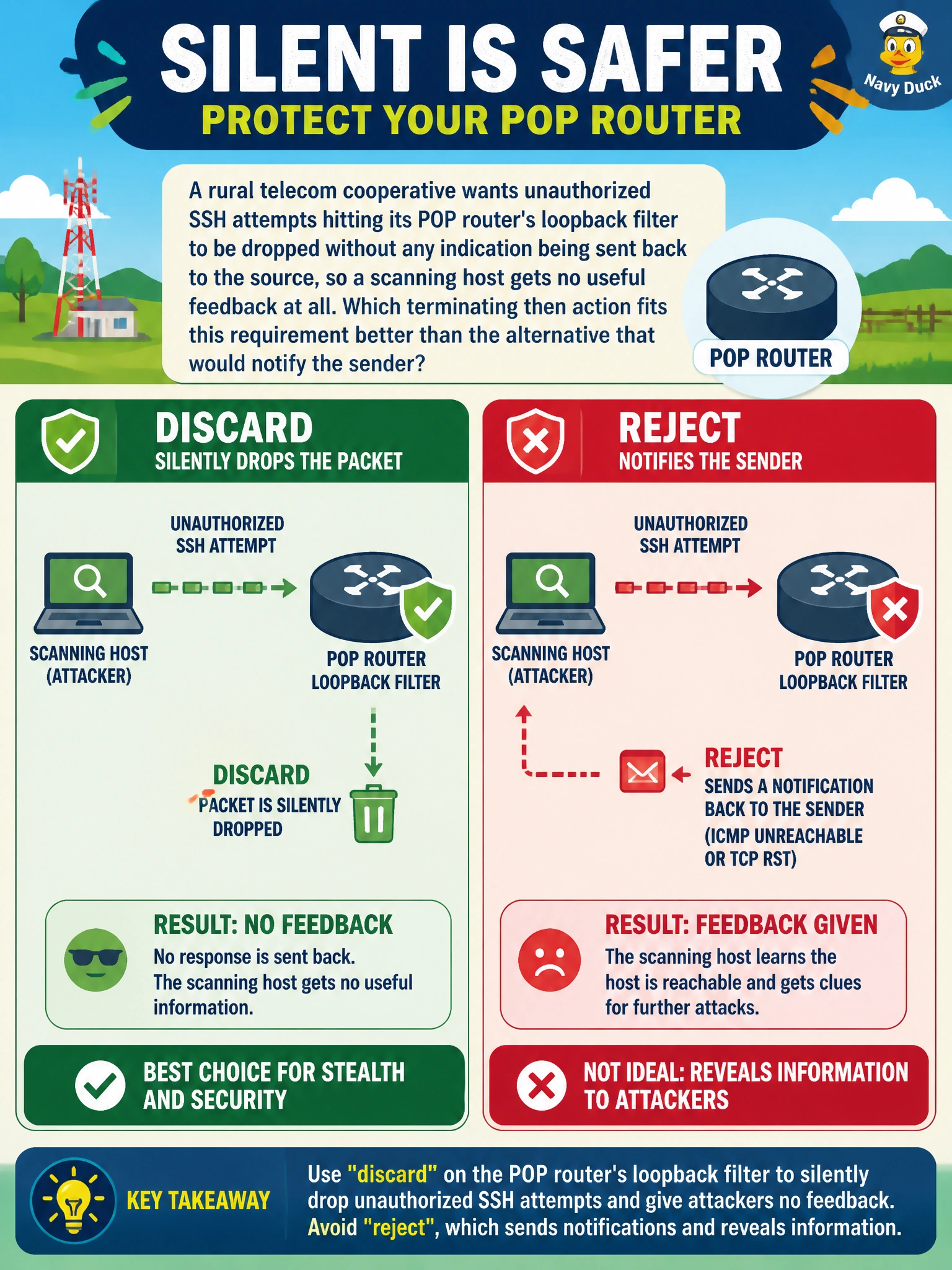
A rural telecom cooperative wants unauthorized SSH attempts hitting its POP router's loopback filter to be dropped without any indication being sent back to the source, so a scanning host gets no useful feedback at all. Which terminating then action fits this requirement better than the alternative that would notify the sender?
Select an answer to reveal the explanation.
Short Explanation
Two actions in Junos both stop unwanted traffic cold, but they behave very differently toward the sender: one drops the packet and stays completely silent, and the other drops it while politely telling the sender it was refused. For a scanning host you don't want tipped off, silence is the better choice.
Full Explanation
Both discard and reject are terminating actions in a Junos firewall-filter term, and both prevent the matched packet from continuing on, but they differ in what the sender experiences. Discard drops the packet silently, generating no response of any kind, which denies a scanning or probing host any confirmation that a port or address is being filtered. Reject also drops the packet but sends a notification back to the source, typically an ICMP destination-unreachable message for most protocols or a TCP RST for TCP traffic, which can actually help an attacker confirm that something is listening or being actively blocked at that address. The correct choice for the stated goal is therefore discard, contrasted explicitly against reject's notifying behavior. Accept is the wrong category entirely — it is terminating but it forwards the packet, doing the opposite of blocking the SSH attempt, so it fails the requirement outright. Count is non-terminating and only increments a counter for visibility; used alone, without a terminating action, it does not drop the packet at all, so unauthorized SSH traffic would still reach the Routing Engine. Choosing discard over reject on a loopback filter protecting the Routing Engine is a common hardening practice specifically because it denies reconnaissance value to unauthorized probes. To confirm the behavior, an engineer can attempt SSH from outside the permitted range and observe that the connection simply times out with no RST or ICMP response, while the loopback filter's term counter still increments.