
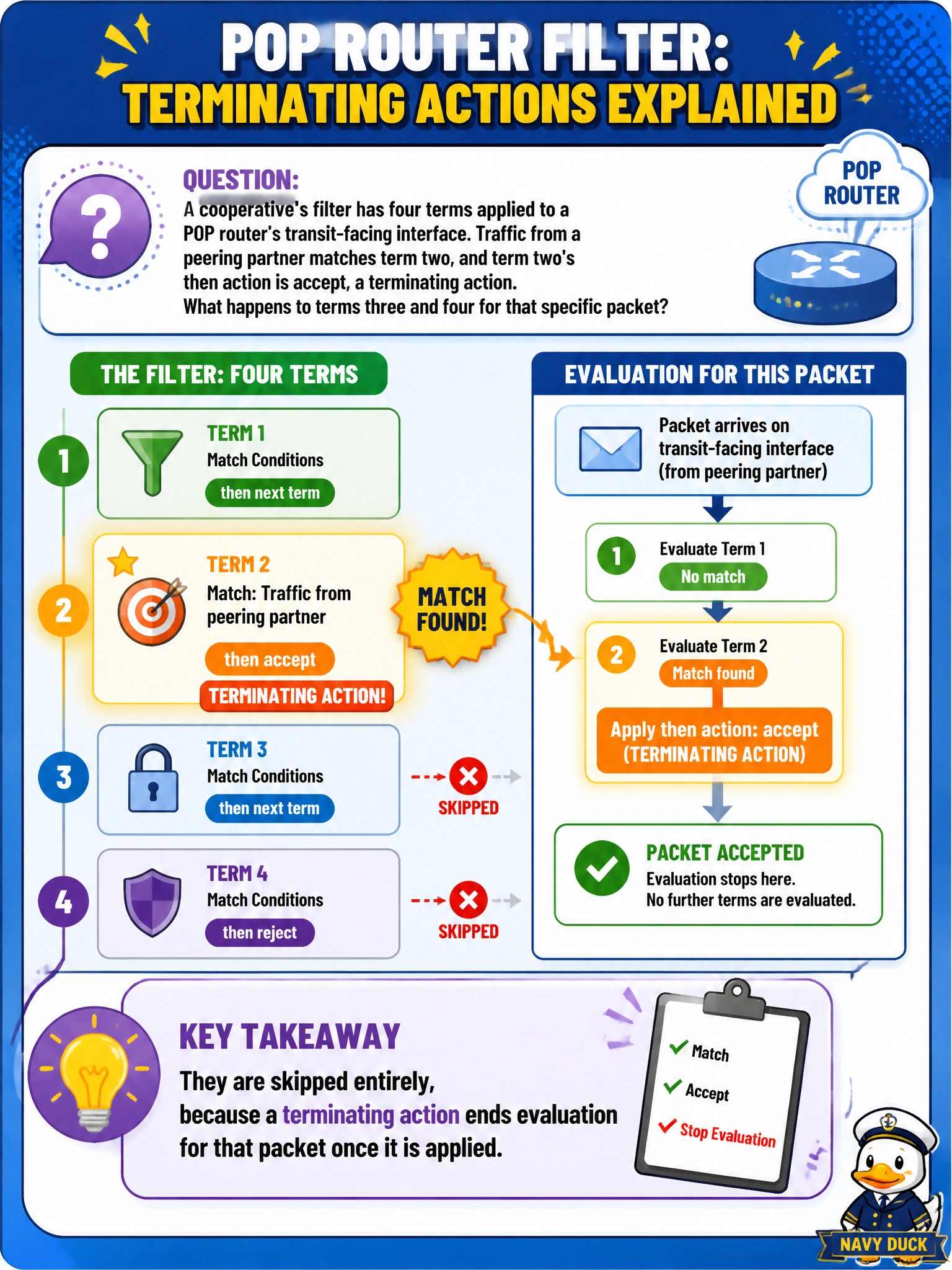
A cooperative's filter has four terms applied to a POP router's transit-facing interface. Traffic from a peering partner matches term two, and term two's then action is accept, a terminating action. What happens to terms three and four for that specific packet?
Select an answer to reveal the explanation.
Short Explanation
Once a packet hits a term with a terminating action, the filter's job for that packet is done — it doesn't keep reading. Accept, discard, and reject all close the book right there, so terms three and four never even get a look at that particular packet.
Full Explanation
Terminating actions in a Junos firewall filter — accept, discard, and reject — stop evaluation of the current packet against that filter the moment the action is applied, so any terms configured after the matching term are simply never consulted for that packet. In this scenario, once the peering partner's traffic matches term two and receives the terminating accept action, terms three and four play no role in that packet's fate at all. The idea that later terms are still evaluated and could override or contribute to the outcome misrepresents termination — if that were true, terminating actions would be indistinguishable from non-terminating ones like count or log. Suggesting the later terms run only for logging purposes invents a partial-evaluation behavior that Junos does not implement; evaluation for a terminated packet simply stops, full stop, not narrows to a subset of functions. Making it conditional on a counter value is also fabricated — term evaluation order and termination depend on configuration structure and action type, not on runtime counter state. This is exactly why term order matters so much when designing a filter: placing a broad terminating accept early can unintentionally shadow more specific, security-relevant terms meant to run later, such as an anti-spoofing check or a rate-limiting policer. To confirm which term actually decided a given flow's fate, check 'show firewall filter <name>' and see which single term's counter incremented for that traffic, since only one terminating term will ever claim a given packet.