
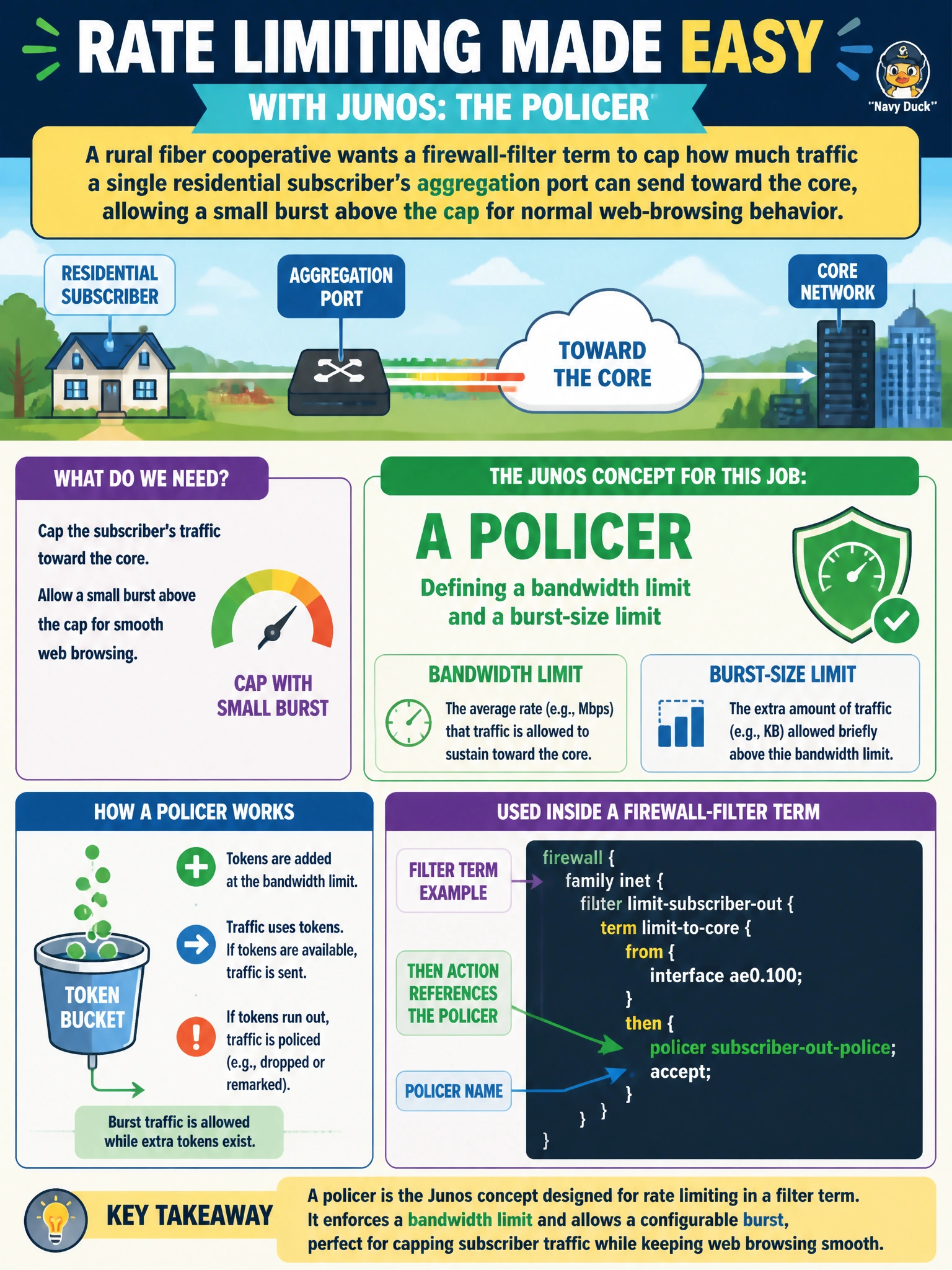
A rural fiber cooperative wants a firewall-filter term to cap how much traffic a single residential subscriber's aggregation port can send toward the core, allowing a small burst above the cap for normal web-browsing behavior. Which introductory Junos concept, referenced inside a filter term's then action, is designed for this kind of rate limiting?
Select an answer to reveal the explanation.
Short Explanation
A policer works like a speed limiter on the subscriber's traffic: it sets a steady bandwidth cap and allows a little extra burst room, similar to how a browser loading a page needs a quick spike before settling down. You reference that policer from inside a filter term's then action, and Junos enforces it right there on the port.
Full Explanation
A Junos policer is configured with parameters such as a bandwidth limit and a burst-size limit, and it is invoked from a firewall-filter term's then action so that traffic matching the term is metered against those thresholds — traffic within the limit and burst allowance is typically accepted, while traffic exceeding it can be discarded or otherwise penalized depending on how the term is written. This is the introductory rate-limiting building block that fits capping a subscriber aggregation port while still tolerating a short burst for ordinary browsing traffic. A routing instance with a metric is unrelated — routing instances create separate routing contexts and metrics influence route preference, neither of which caps traffic volume on an interface. A policy chain describes how multiple routing-policy terms are evaluated in sequence for route acceptance or advertisement, which again governs routes, not the throughput of a subscriber's traffic. A static route's preference value only affects which route Junos prefers among multiple candidates for the same destination and has nothing to do with metering bandwidth. Choosing a policer keeps the enforcement local to the filter term applied on the aggregation port, giving the cooperative a simple per-subscriber ceiling. To validate the configuration, an operator can generate traffic above the configured bandwidth limit and check 'show firewall filter <name>' or interface policer counters for the corresponding drops or markdowns once the burst allowance is exhausted.