
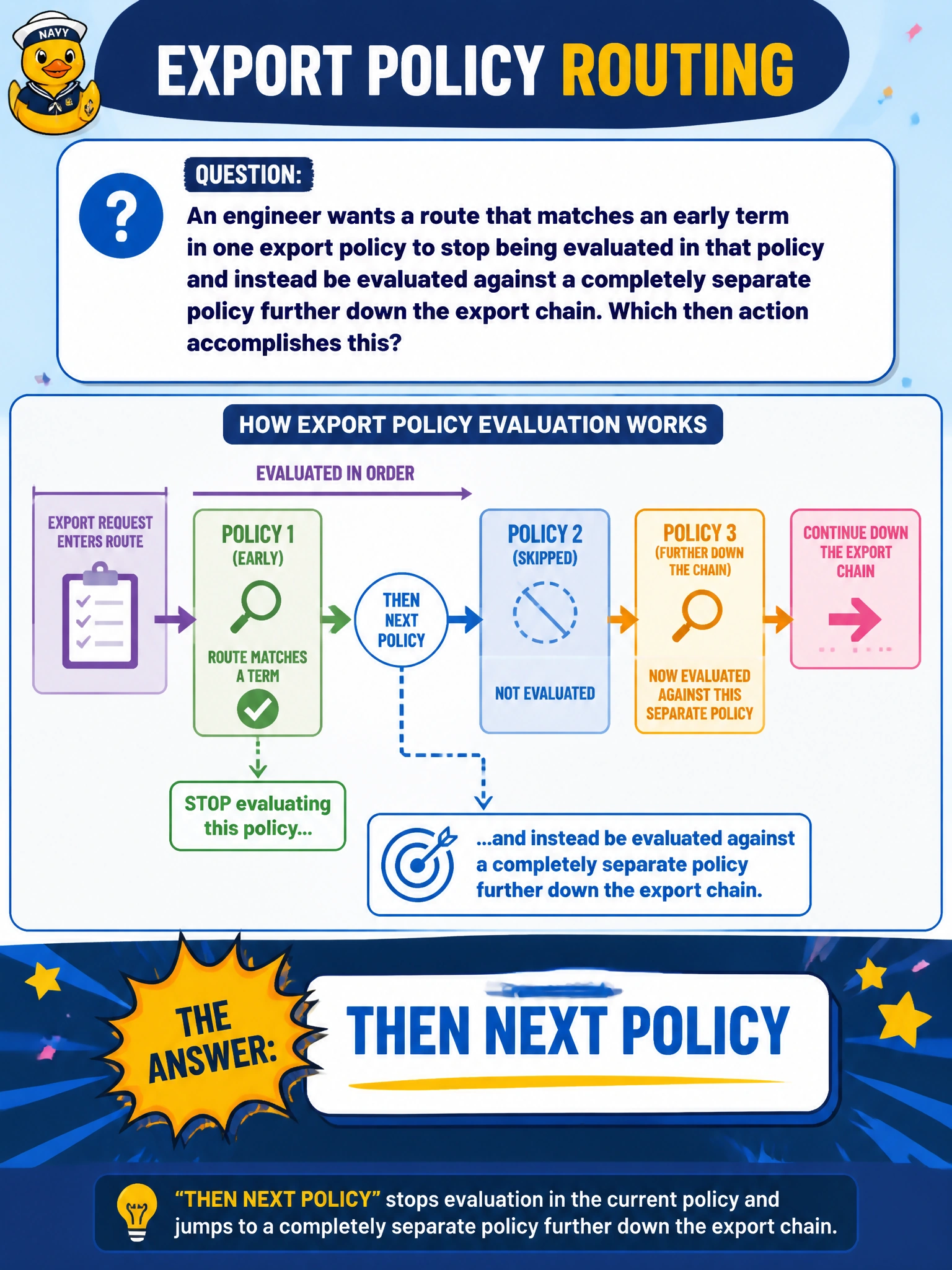
An engineer wants a route that matches an early term in one export policy to stop being evaluated in that policy and instead be evaluated against a completely separate policy further down the export chain. Which then action accomplishes this?
Select an answer to reveal the explanation.
Short Explanation
When the goal is to hop out of the current policy entirely and let a different policy in the chain take a look, next policy is the action for the job. It's a deliberate jump to a sibling policy, not just the next term down the list. Accept and reject would end the whole evaluation right there, and next term only moves within the same policy.
Full Explanation
The then next policy action is a flow-control action, not a terminating one, that ends evaluation of the current policy for a matching route and moves directly to the next policy listed in the export or import chain, which is exactly the behavior needed when a cooperative wants a match in one policy to defer the final decision to a separate, later policy rather than resolving it locally. This is commonly used when a general policy needs to hand off certain routes to a more specialized policy applied afterward, without terminating the whole evaluation outright. Accept and reject are both wrong because they are terminating actions that end evaluation of the route against the entire chain, not just the current policy, so neither one allows a later policy to have any say. Next term is also wrong because it only advances evaluation within the same policy, continuing to the next term below it, and it has no mechanism to jump into a different policy-statement entirely. A caveat worth keeping in mind is that if the current policy is the last one listed in the export or import chain, then next policy behaves like falling through to the protocol's own default policy, since there is nothing left to jump to. A concrete check is applying export [ POLICY-A POLICY-B ] on a protocol stanza and using show route advertising-protocol with test routes to confirm a route matched in POLICY-A with next policy is actually being decided by POLICY-B.