
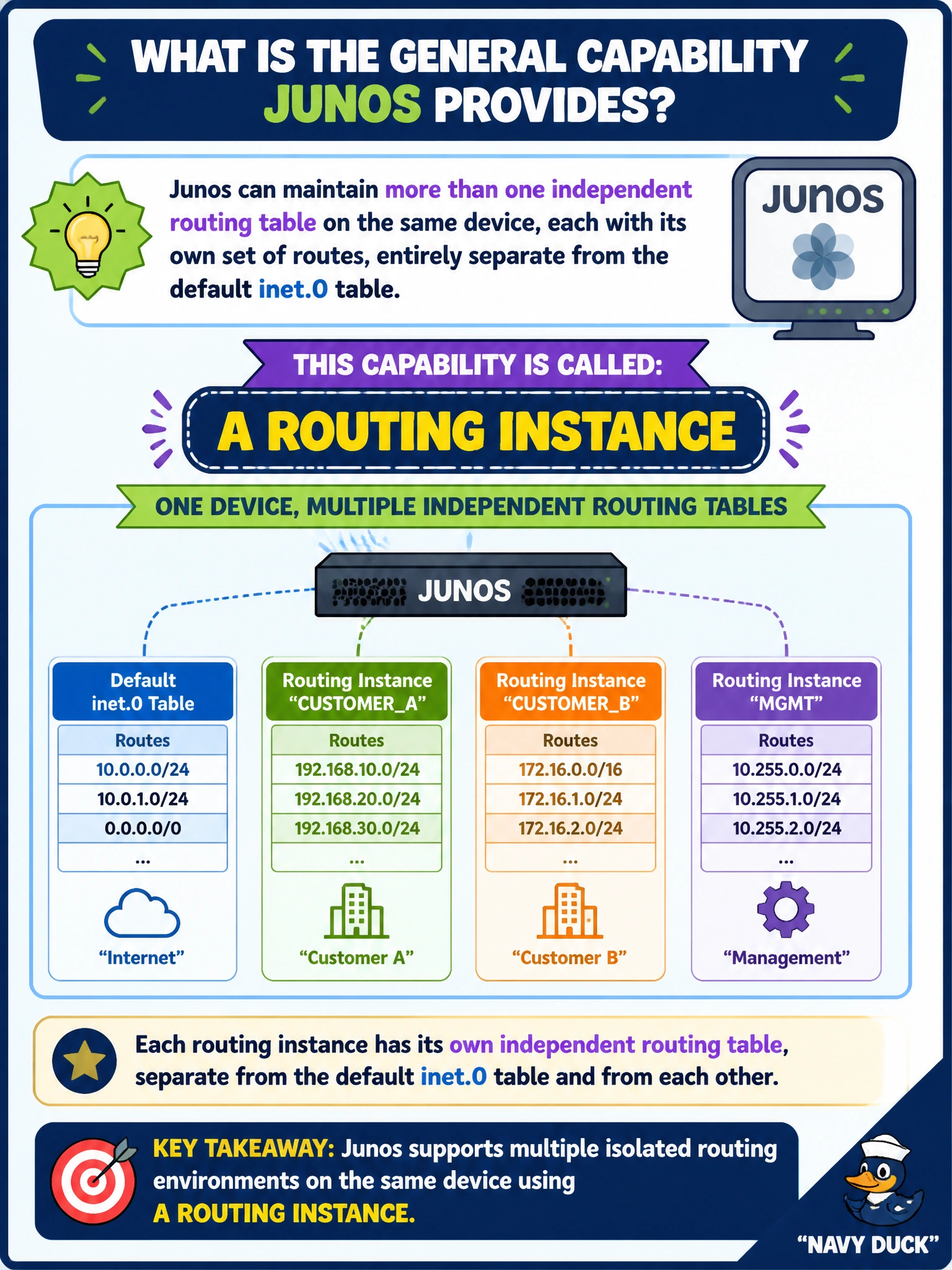
A network engineer explains that Junos can maintain more than one independent routing table on the same device, each with its own set of routes, entirely separate from the default inet.0 table. What is this general capability called at an introductory level?
Select an answer to reveal the explanation.
Short Explanation
A routing instance is like giving the router a second, separate binder of routes that doesn't mix with the main one. Same physical box, same Junos software, but a logically distinct set of routing tables living side by side with the default one.
Full Explanation
A routing instance is a collection of routing tables, interfaces, and routing protocol parameters that Junos manages as a logically distinct unit, separate from the default routing instance (inet.0) that exists on every device out of the box. At an introductory level, the key idea is separation: routes, and often interfaces, assigned to one routing instance don't leak into another unless explicitly permitted, which is useful for keeping different traffic domains apart on shared hardware. A floating static route describes a preference relationship between two next-hops for a single route within one routing table — it's a route-selection technique, not a separate table structure. A firewall filter is a packet match-and-action construct applied to interfaces or protocols; it doesn't create or separate routing tables. A qualified next-hop assigns a preference to a next-hop on a static route, again a detail within a single table rather than a mechanism for creating multiple tables. The exam-relevant caveat at this associate level is scope: JN0-106 expects recognition of the concept and its purpose, not the configuration syntax for building custom routing instances, which belongs to more advanced Junos exams. A conceptual check is simply asking whether two sets of routes are meant to be reachable from each other by default — if not, separate routing instances are the tool for that boundary.