
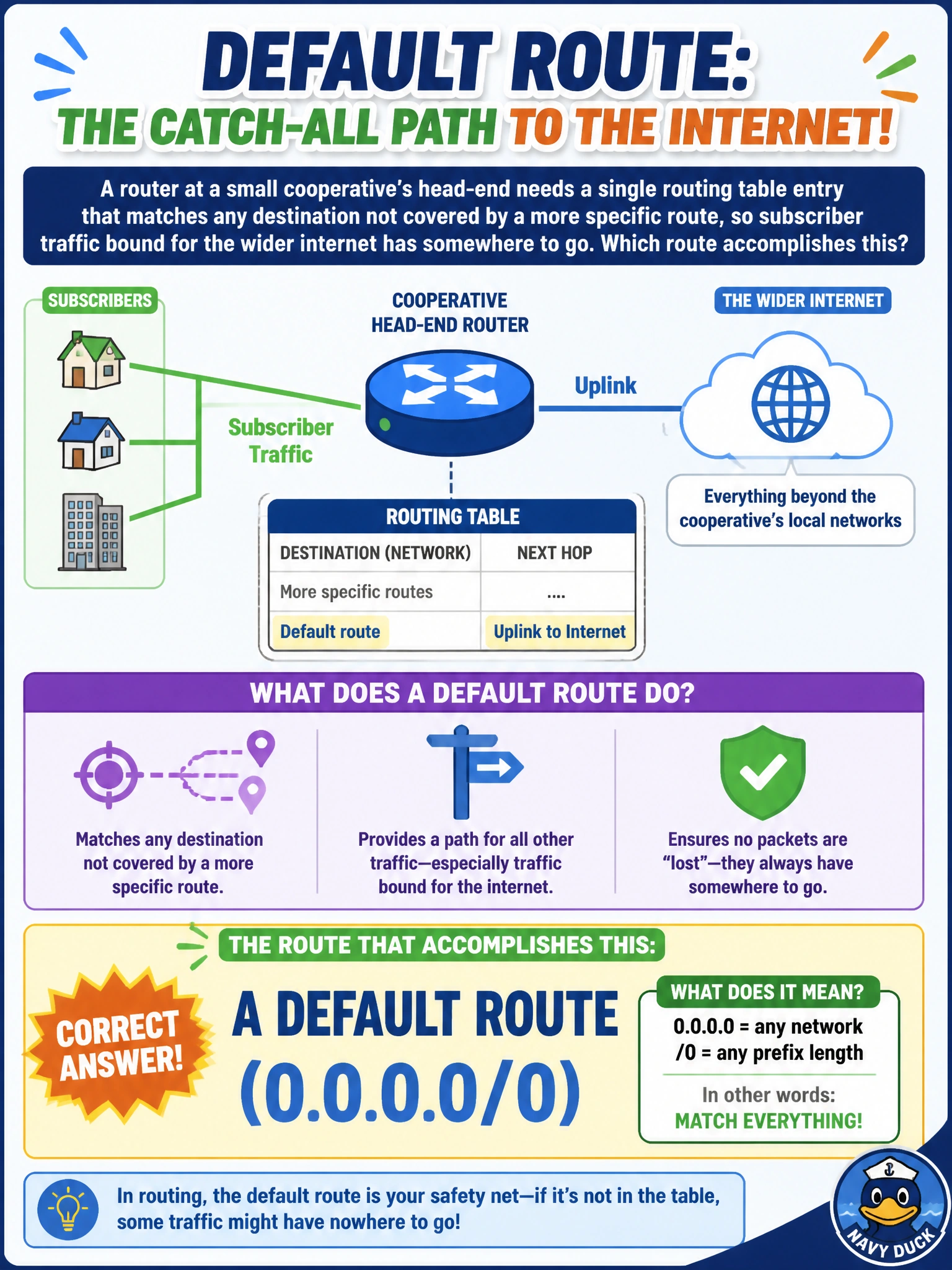
A router at a small cooperative's head-end needs a single routing table entry that matches any destination not covered by a more specific route, so subscriber traffic bound for the wider internet has somewhere to go. Which route accomplishes this?
Select an answer to reveal the explanation.
Short Explanation
Think of the default route as the co-op's catch-all mailbox: if a packet's destination doesn't match anything more specific in the routing table, it lands here. Written as 0.0.0.0/0, it matches literally everything, which is exactly why it's the go-to path toward the wider internet.
Full Explanation
A default route, expressed as the prefix 0.0.0.0/0, matches every possible IPv4 destination because it has no bits fixed in its mask — any address satisfies it. Junos only uses the default route for a given packet when no more specific route exists for that destination, since longest-match route selection always prefers a more specific prefix when one is present. This makes it the standard way to give a stub site (like a small co-op's head-end with a single upstream) reachability to the entire internet without listing every possible destination individually. A floating static route describes a backup-path preference relationship between multiple next-hops for the same prefix — it's an independent concept from a route's scope, and a floating route could itself be a default route or a specific one. A qualified next-hop is the mechanism used to build a floating route, not a route type on its own. An inactive route is simply a route currently not selected as best for its destination, a status that has nothing to do with whether the route's prefix is 0.0.0.0/0. The caveat worth remembering: a default route doesn't override a more specific matching route, it only fills the gap when nothing else matches. A concrete check is show route 0.0.0.0/0, confirming the route exists and is active toward the intended upstream.