
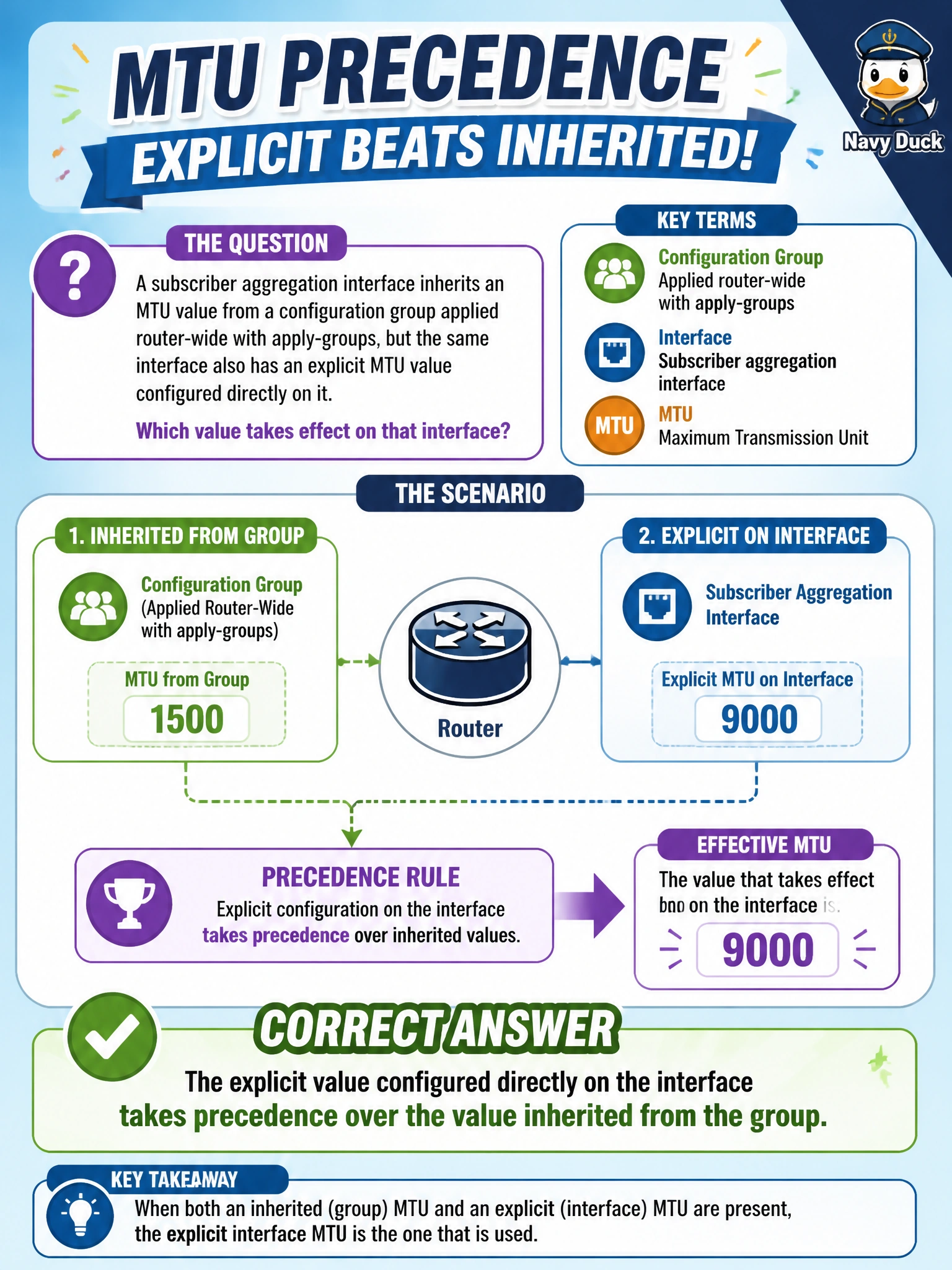
A subscriber aggregation interface inherits an MTU value from a configuration group applied router-wide with apply-groups, but the same interface also has an explicit MTU value configured directly on it. Which value takes effect on that interface?
Select an answer to reveal the explanation.
Short Explanation
Think of the group as a default setting whispered in the background, and the explicit line on the interface as someone speaking up directly. The direct, specific statement always wins over the inherited, general one.
Full Explanation
Junos configuration group inheritance follows a most-specific-wins rule: a value explicitly configured directly at a given point in the hierarchy always overrides the same value inherited from an applied group at that point, because the group mechanism exists to supply defaults and shared boilerplate, not to force override a deliberately customized setting. This lets an operator apply one group router-wide for consistency while still hand-tuning exceptions on specific interfaces without fighting the group. The claim that the group always wins gets the precedence backwards and would make per-interface customization impossible anywhere a group is applied, defeating a major reason groups are used at all. Falling back to a factory default is incorrect because both an explicit and an inherited value are present — there is no scenario here where neither applies. Commit timing has no bearing on precedence; Junos evaluates the final merged configuration by hierarchy specificity, not by when each line was typed. The operational check is show configuration interfaces <name> | display inheritance, which explicitly marks which lines came from a group versus which were configured locally and confirms the local value is the one in effect.