
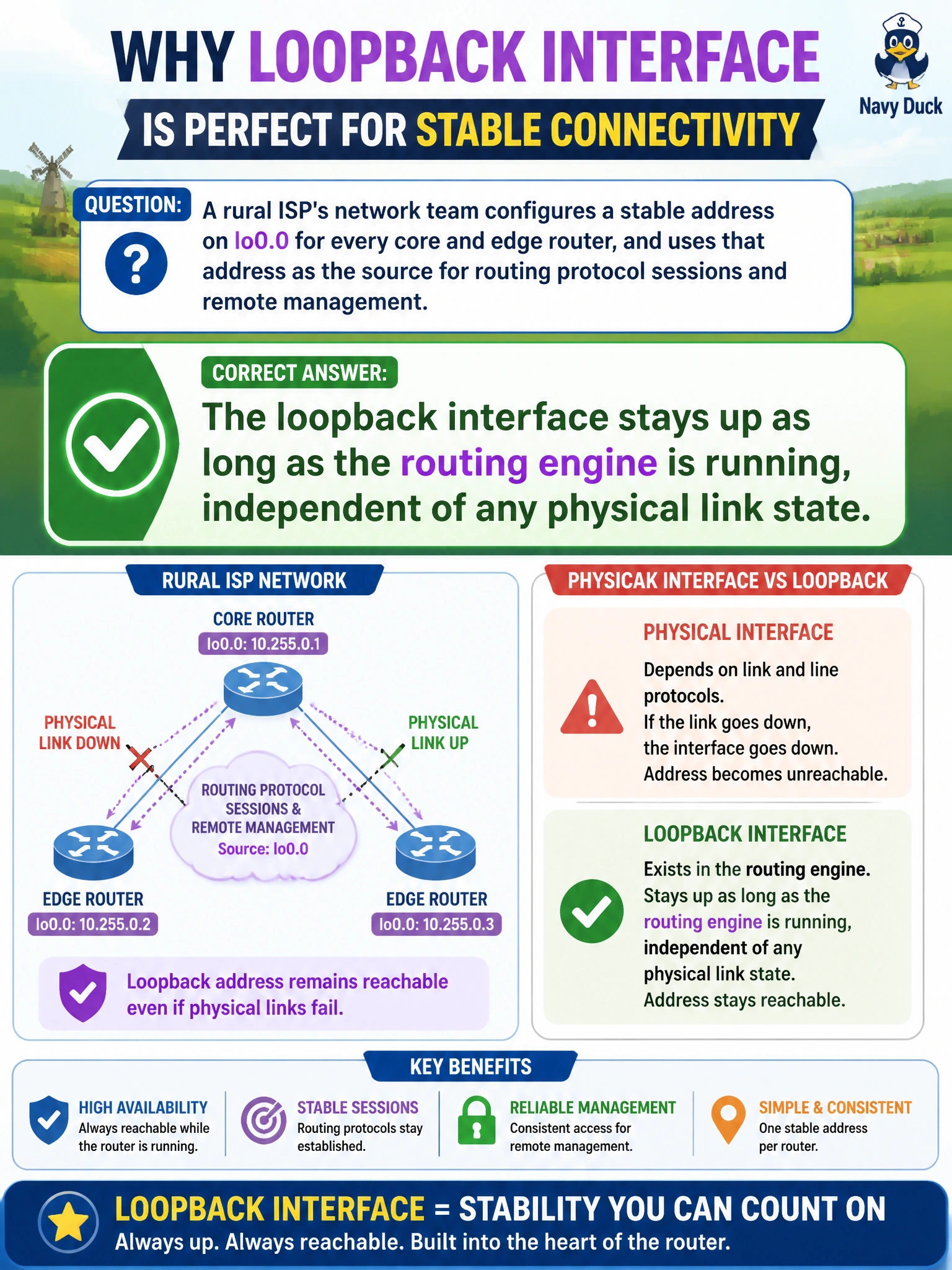
A rural ISP's network team configures a stable address on lo0.0 for every core and edge router, and uses that address as the source for routing protocol sessions and remote management. What makes the loopback interface well-suited for that role?
Select an answer to reveal the explanation.
Short Explanation
Every physical port can flap when a fiber gets cut or a card resets, but the loopback isn't tied to any physical link at all. As long as the box is up and running Junos, lo0.0 stays reachable — which is exactly why it makes a rock-solid, stable identity for the router.
Full Explanation
The loopback interface is a virtual, software-only interface with no dependency on any physical port, transceiver, or cable, so it remains up whenever the routing engine is operational, even if every physical uplink on the chassis goes down or is reconfigured. That stability is exactly why network operators anchor routing-protocol router IDs, management access, and monitoring on the loopback address: the identity of the device does not change when a specific physical path fails or is rerouted. The load-balancing claim describes ECMP or aggregated Ethernet behavior, which is unrelated to what the loopback does. VLAN bridging between subscriber ports is a Layer 2 switching or bridge-domain function, not something the loopback interface performs. Loopback addresses are also always configured statically, never via DHCP, because a management or protocol anchor point that could silently change its own address would defeat the purpose of using it as a stable identity. To verify, show interfaces lo0 should report the interface as up regardless of the physical uplinks' state, and pinging the loopback address confirms reachability independent of any single physical path.