
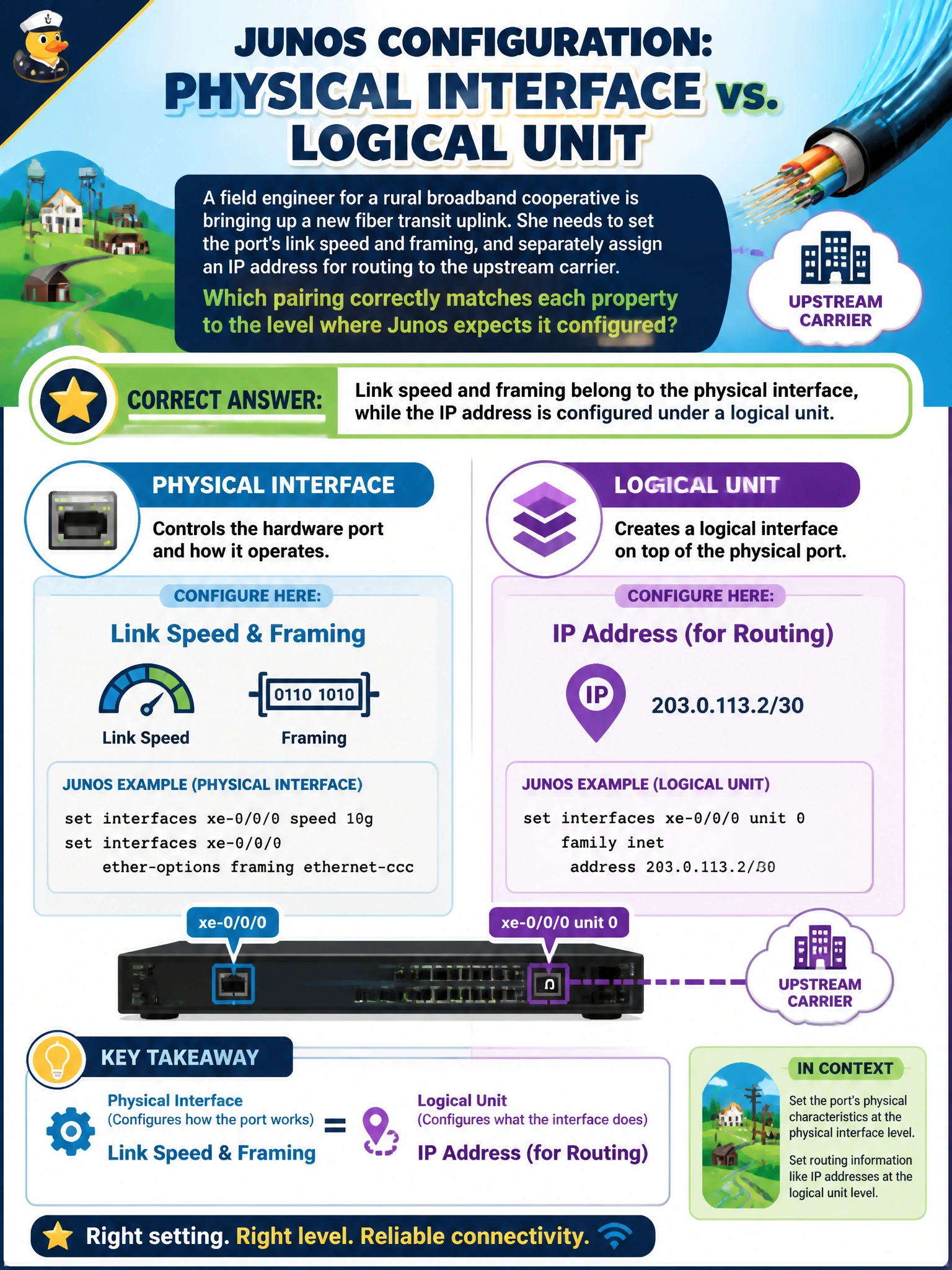
A field engineer for a rural broadband cooperative is bringing up a new fiber transit uplink. She needs to set the port's link speed and framing, and separately assign an IP address for routing to the upstream carrier. Which pairing correctly matches each property to the level where Junos expects it configured?
Select an answer to reveal the explanation.
Short Explanation
Picture the physical interface as the wire itself and the logical unit as an envelope you put on top of it. Speed and framing describe the wire, so they live on the physical port; the IP address describes traffic riding that wire, so it belongs to a logical unit underneath.
Full Explanation
Junos splits interface configuration into a physical layer and one or more logical units beneath it. Properties tied to the medium itself — link speed, framing, duplex, MTU at the physical level — are configured directly under the physical interface stanza, because they describe the hardware regardless of what traffic rides over it. The IP address is a family inet (or inet6) property, and family statements only exist under a logical unit, since a single physical port can carry multiple logical units each with its own addressing and encapsulation. Reversing the pairing fails because Junos has no family inet hierarchy at the physical level — attempting it produces a configuration error. Forcing both properties onto one logical unit ignores that speed and framing are hardware attributes with no per-unit meaning. Claiming everything lives at the FPC level misunderstands the FPC as a chassis slot grouping, not a place where per-port properties are set. To confirm the split on a live router, run show configuration interfaces ge-x/y/z and note that speed/framing sit above the unit block while family inet address sits inside it.