
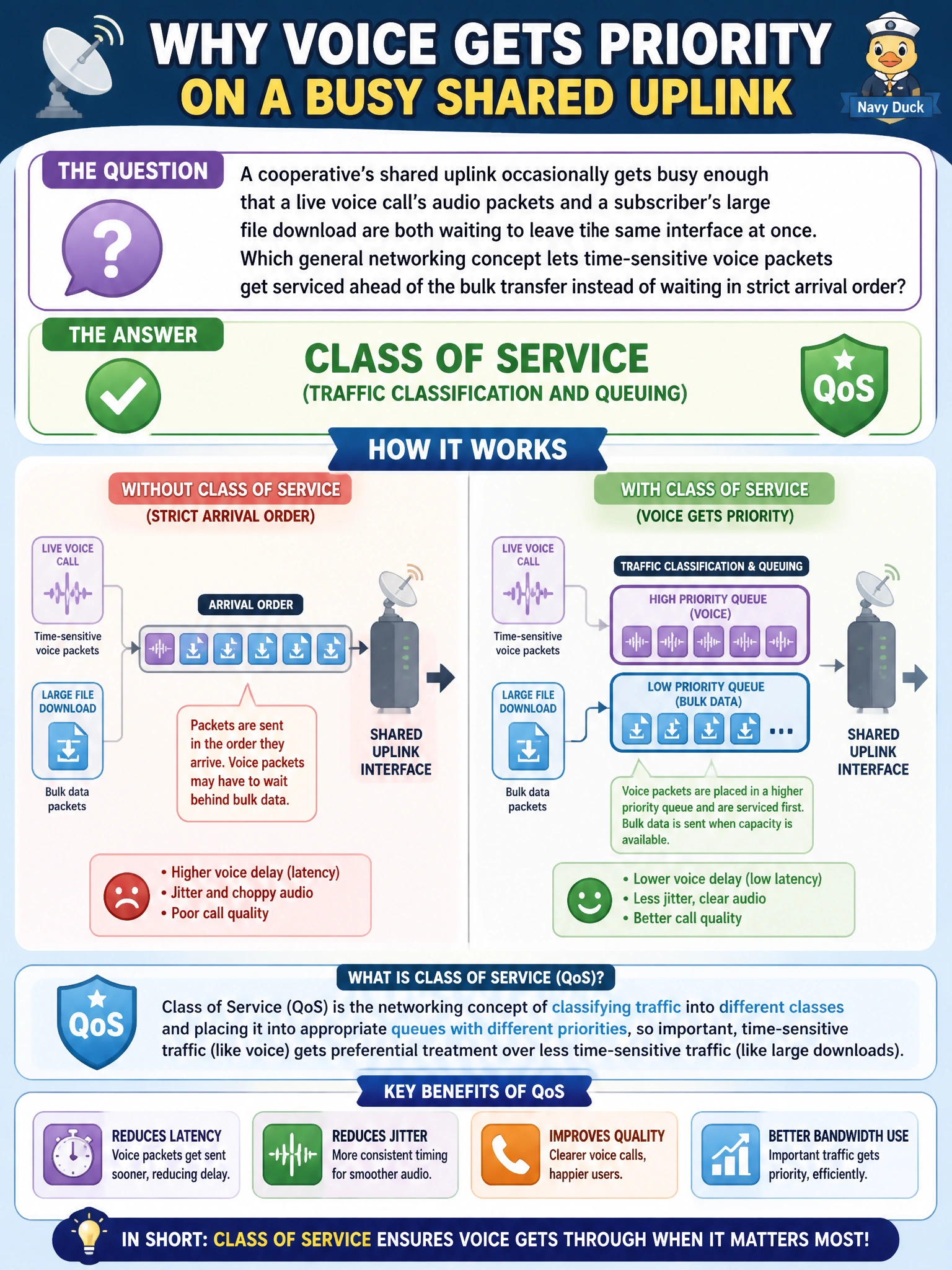
A cooperative's shared uplink occasionally gets busy enough that a live voice call's audio packets and a subscriber's large file download are both waiting to leave the same interface at once. Which general networking concept lets time-sensitive voice packets get serviced ahead of the bulk transfer instead of waiting in strict arrival order?
Select an answer to reveal the explanation.
Short Explanation
Picture one checkout lane with two customers: someone buying a single item and someone with a full cart. Class of service is what lets the router wave the light, time-sensitive voice packet ahead of the heavy bulk-download cart instead of first-come-first-served. It's not about picking a route or clearing a MAC table entry — it's about scheduling order at a busy moment.
Full Explanation
Class of service classifies arriving traffic into forwarding classes and places each class into its own outbound queue, then services those queues with different priority or scheduling weight so that latency-sensitive traffic, like live voice, doesn't sit stuck behind a large bulk transfer once an interface gets busy. This scheduling behavior only matters during actual congestion; the concept exists precisely to decide who goes first when demand briefly exceeds the link's capacity. Broadcast domain segmentation controls where Layer 2 broadcasts are allowed to propagate and has nothing to do with the order packets leave a congested interface. Longest-match route selection decides which path a packet takes toward its destination, a Layer 3 forwarding decision made before the packet ever reaches an output queue, not a scheduling mechanism for packets already queued on an interface. MAC address table aging is Layer 2 housekeeping that removes stale entries from a switch's forwarding table and has no bearing on how urgently any packet is transmitted. A caveat worth remembering is that class of service is invisible on an idle link, since every queue drains immediately regardless of classification — its effect only shows up as utilization approaches capacity. An operational check is comparing queue-level drop counters during a busy period against the same counters during an idle one, confirming the prioritized queue stays clean while a lower-priority queue absorbs the congestion.