
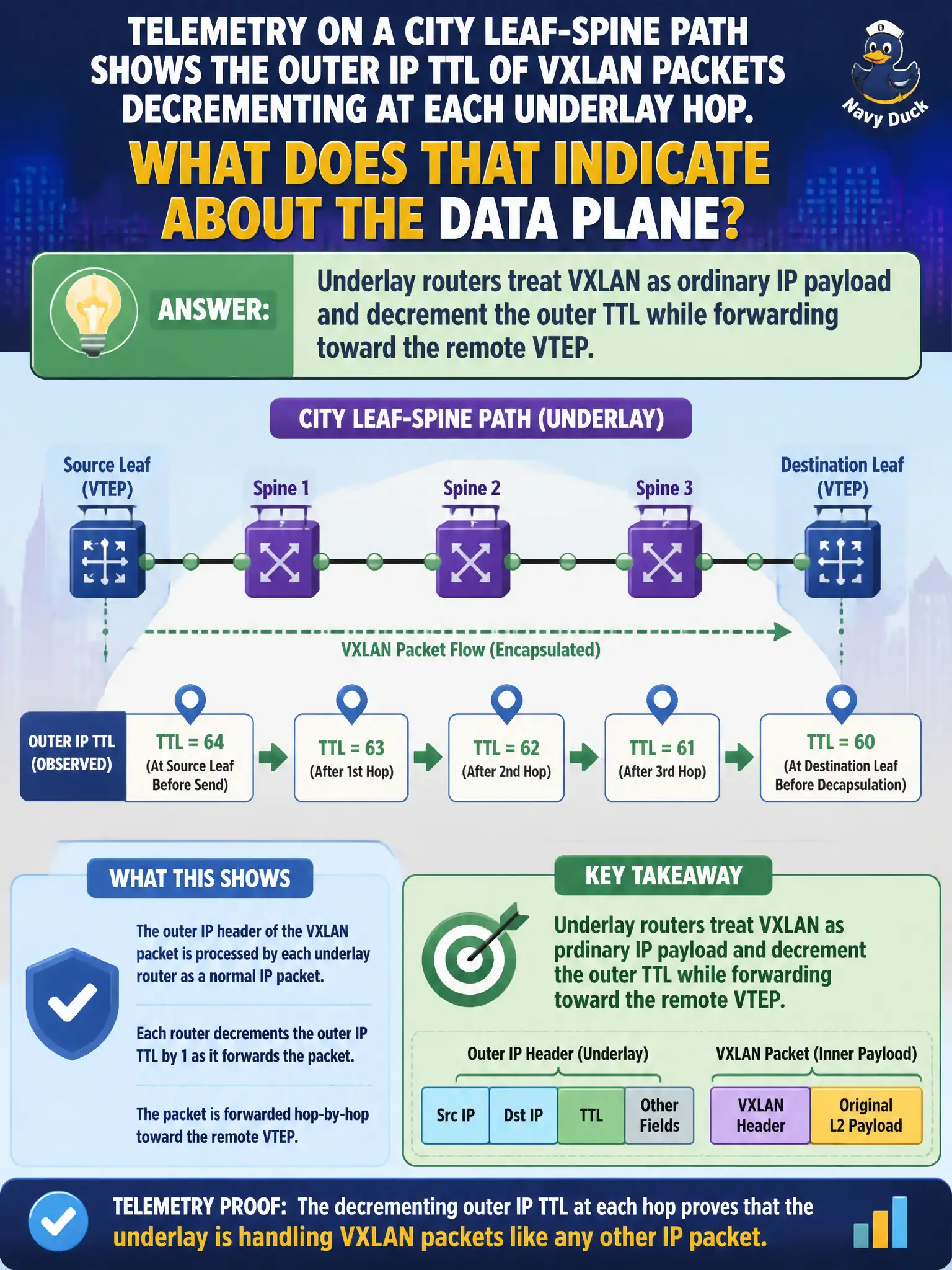
Telemetry on a city leaf-spine path shows the outer IP TTL of VXLAN packets decrementing at each underlay hop. What does that indicate about the data plane?
Select an answer to reveal the explanation.
Short Explanation
The outer TTL is the underlay’s hop counter—the truck’s odometer, not the letter inside. Each underlay router ticks it down while shipping UDP/IP toward the far VTEP. That is normal IP behavior, not proof the overlay is being terminated on every spine.
Full Explanation
Telemetry showing the outer IP TTL of VXLAN packets decrementing at each underlay hop on a city leaf-spine path indicates underlay routers treat VXLAN as ordinary IP payload and decrement the outer TTL while forwarding toward the remote VTEP. Intermediate devices forward on the outer header and do not need to parse or terminate the tenant overlay on each hop—this is expected Clos behavior.
Tenant applications are not decrementing TTL inside the VXLAN header reserved bits. Outer TTL change does not mean VXLAN has failed and fallen back to hop-by-hop MAC-in-MAC. Each spine is not required to terminate the overlay and run tenant routing for every packet merely because outer TTL decreases.
Exam caveat: outer TTL decrement is normal underlay IP forwarding of encapsulated traffic, not proof of per-hop overlay termination.
Operational check: traceroute the underlay to the remote VTEP while capturing VXLAN, confirm outer TTL decreases per hop, and verify inner TTL is unchanged until after egress decapsulation on the destination leaf. If outer TTL hits zero before the remote VTEP, raise hop-count or fix routing loops—do not blame the VNI map first. Compare outer versus inner TTL in the same capture to teach NOC staff the encapsulation boundary.