
A library data-center leaf-spine fabric load-balances VXLAN traffic across multiple underlay uplinks. What does underlay ECMP primarily hash on for those encapsulated flows?
Select an answer to reveal the explanation.
Short Explanation
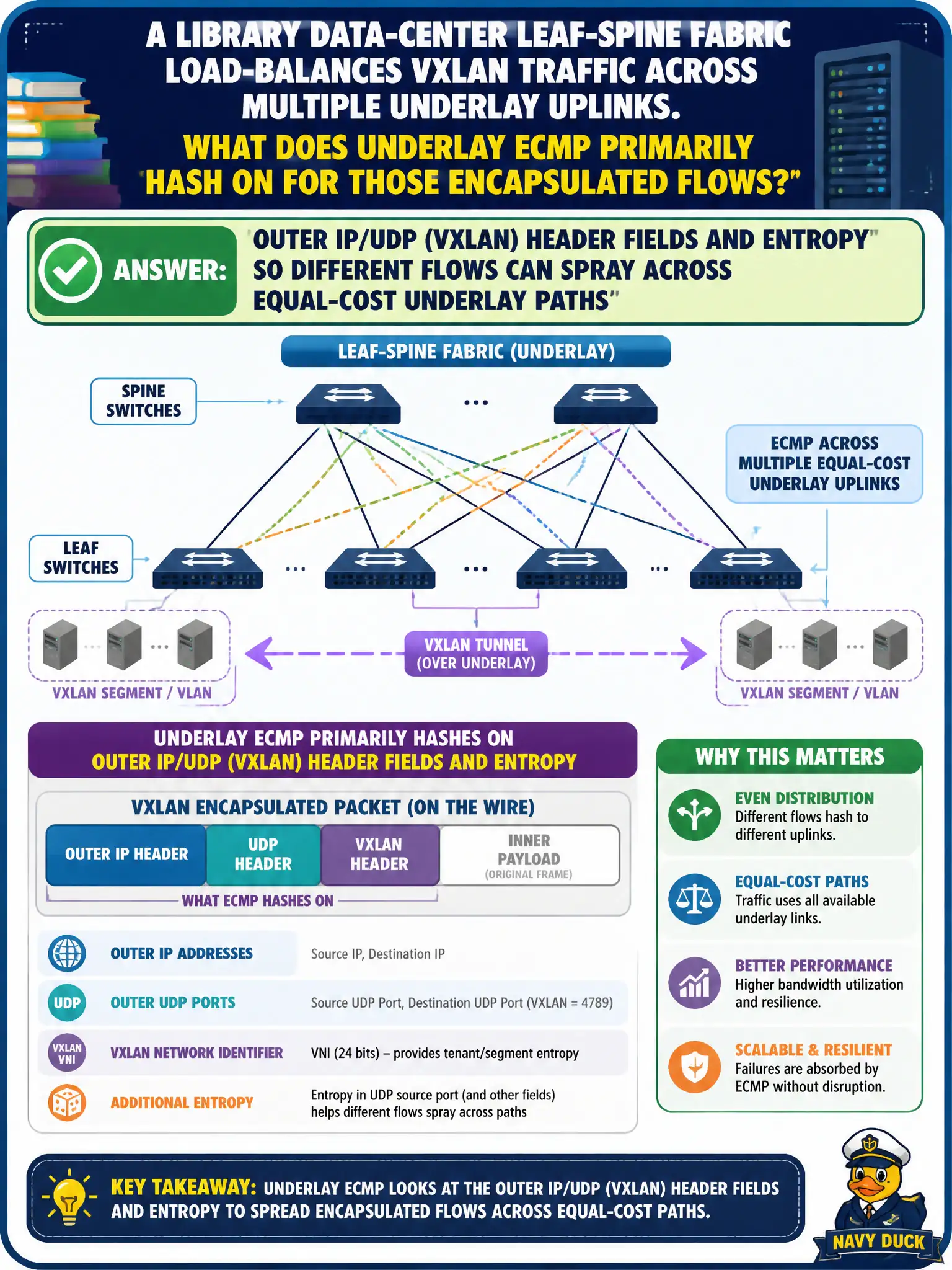
The underlay trucks only read the outer shipping label—source/dest VTEP, UDP ports, and friends. That’s the entropy ECMP uses to spray flows across spines. Inner tenant headers stay sealed in the box unless something is doing deep inspection you didn’t ask for.
Full Explanation
In a library data-center leaf-spine fabric, underlay ECMP for VXLAN traffic primarily hashes on outer IP/UDP (VXLAN) header fields and entropy so different flows can spray across equal-cost underlay paths. Ingress VTEPs typically vary UDP source ports to provide entropy; underlay devices treat the packets as ordinary IP/UDP without parsing past encapsulation for every hash decision.
ECMP does not hash only on inner tenant TCP ports while ignoring outer headers entirely on standard fabric forwarding. It does not use a civic asset-tag string embedded in VXLAN reserved bits. It does not hash on the destination server’s BIOS UUID carried in a nonexistent VXLAN footer.
Exam caveat: outer-header entropy drives underlay ECMP for VXLAN; assuming inner-header hashing without special underlay parsing is a trap answer.
Operational check: generate multiple flows between the same VTEP pair, observe distribution across leaf-spine uplinks, and confirm UDP source-port variation in captures; polarize intentionally with a single flow to see single-path behavior for contrast. If all overlay flows pin to one uplink, inspect entropy settings and whether UDP source ports are static. Document ECMP hash fields in the library fabric design notes for capacity planning.