
A township wonders what happens to the access VLAN tag when a frame crosses the VXLAN fabric between leaves. Which data-plane statement is correct?
Select an answer to reveal the explanation.
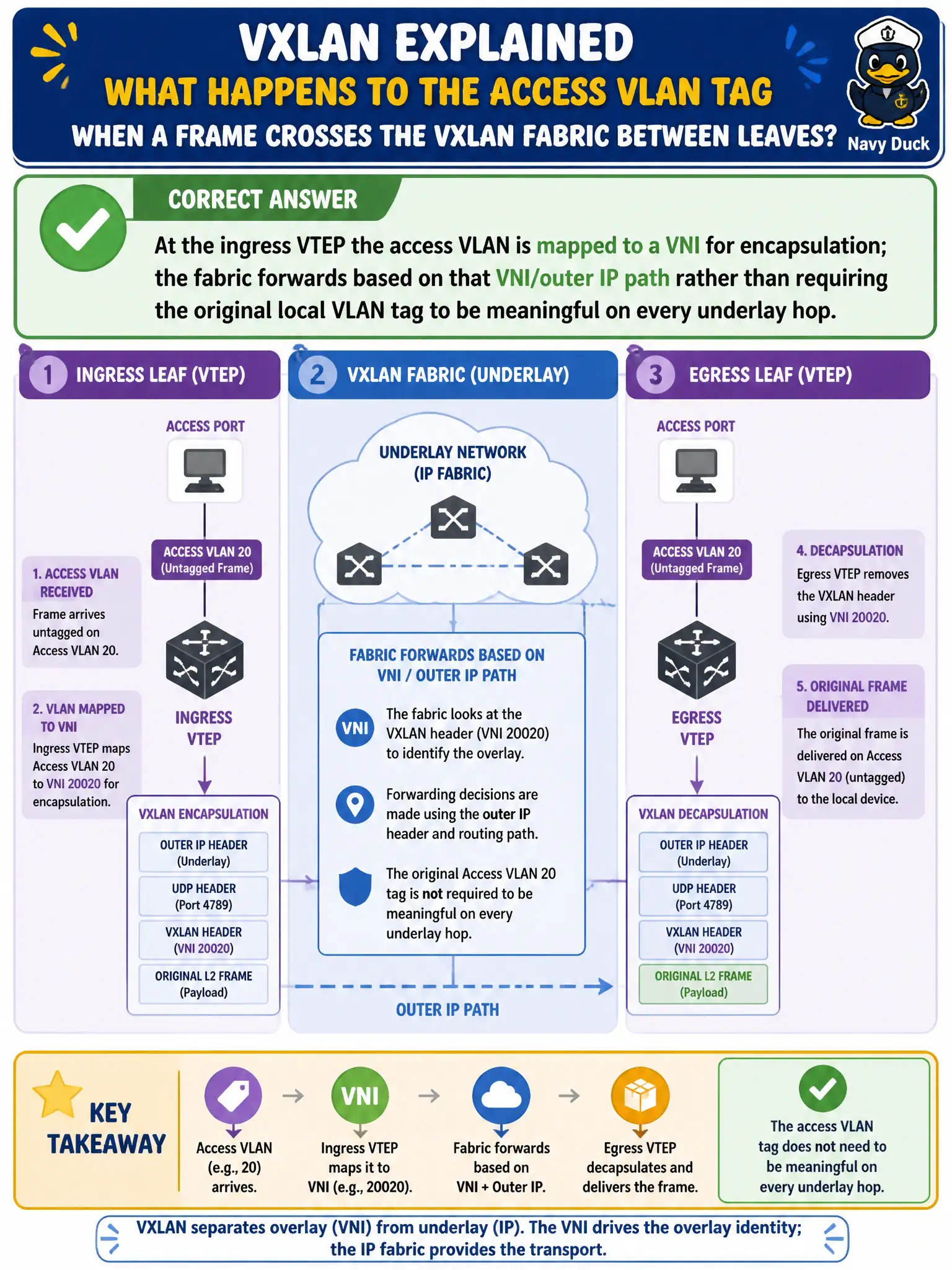
Short Explanation
The access VLAN is a local door tag—the VTEP maps it to a VNI before the courier pouch goes across town. Spines care about outer IP reachability to VTEPs, not about preserving that original door tag on every hop. The VNI is what keeps the overlay neighborhood identity straight.
Full Explanation
When a township frame crosses the VXLAN fabric between leaves, the ingress VTEP maps the access VLAN to a VNI for encapsulation; the fabric then forwards based on that VNI and the outer IP path toward the remote VTEP rather than requiring the original local VLAN tag to remain meaningful on every underlay hop. Local VLAN IDs may differ between buildings if both edges map into the agreed VNI for the tenant segment.
The exact same VLAN ID need not appear as a tagged header on every spine interface or else be dropped—that requirement misunderstands overlay encapsulation. VLAN tags are not copied into the underlay DSCP field while VNIs are ignored. VXLAN does not delete all Layer-2 information and forward only IPv6 neighbor discovery; it preserves the inner Ethernet frame for bridging use cases across the civic fabric.
Exam caveat: VLAN-to-VNI mapping is an edge function; spines forward outer IP, not tenant VLAN semantics, across the Clos underlay.
Operational check: configure different access VLAN IDs mapping to one VNI on two leaves, confirm inter-leaf L2 connectivity works, and show that spines lack the access VLAN yet still forward VXLAN outer-IP traffic successfully. Capture a packet to verify the VNI in the VXLAN header matches the municipal mapping table.