
A packet between two VMs on different municipal leaves must cross the VXLAN fabric. What data-plane behavior is fundamental?
Select an answer to reveal the explanation.
Short Explanation
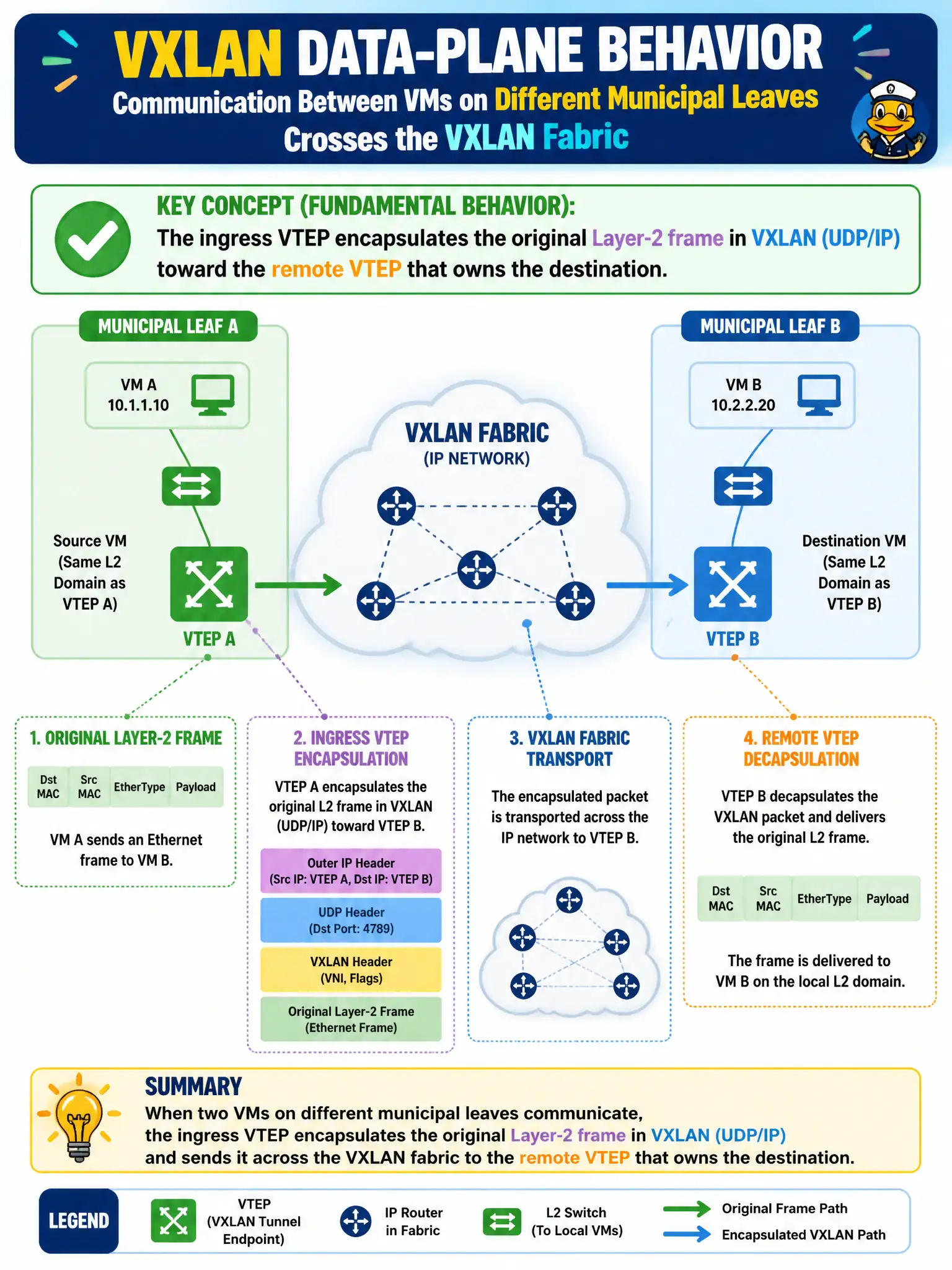
The leaf wraps the original Ethernet frame in a VXLAN UDP/IP envelope addressed to the far VTEP—like putting a campus letter in a city courier pouch. Spines forward that outer IP; they are not supposed to peel VXLAN on every hop and bridge the inner VLAN across the underlay.
Full Explanation
A packet between two VMs on different municipal leaves must cross the VXLAN fabric when the ingress VTEP encapsulates the original Layer-2 frame in VXLAN (UDP/IP) toward the remote VTEP that owns the destination. Intermediate underlay hops forward on the outer IP header without needing tenant MAC visibility; the egress VTEP decapsulates and delivers the inner frame to the local host.
The original Ethernet frame is not forwarded natively across spine ports without any outer header in a VXLAN design. Spines do not decapsulate VXLAN on every hop and re-bridge the inner VLAN across the underlay for ordinary transit. The packet is not converted to an MPLS Layer-3 VPN label stack because VXLAN cannot carry Ethernet frames—carrying Ethernet is VXLAN’s purpose.
Exam caveat: ingress encapsulation to the remote VTEP, underlay outer-IP forwarding, and egress decapsulation form the foundational unicast data-plane walk for JNCIP-DC.
Operational check: capture on a leaf uplink showing outer VTEP IPs and VNI for an inter-leaf VM flow; traceroute underlay reachability to the remote VTEP; confirm egress leaf decapsulation counters increment for that VNI.
In civic fabric operations, retain the correct idea—The ingress VTEP encapsulates the original Layer-2 frame in VXLAN (UDP/IP) toward the remote VTEP that owns the destination—and reject distractors that confuse layers or tools. Specifically, do not treat “The original Ethernet frame is forwarded natively across spine ports without any outer header.” as valid, do not accept “Spines decapsulate VXLAN on every hop and re-bridge the inner VLAN across the underlay.” as a substitute design, and do not operationalize “The packet is converted to an MPLS Layer-3 VPN label stack because VXLAN cannot carry Ethernet frames.” in production runbooks. Re-validate after changes with show commands for sessions, routes, VTEP reachability, and a simple tenant traffic test appropriate to the VNI under review.