
A design review asks who the “controller” is in a controllerless EVPN-VXLAN municipal fabric. Which answer best reflects the architecture?
Select an answer to reveal the explanation.
Short Explanation
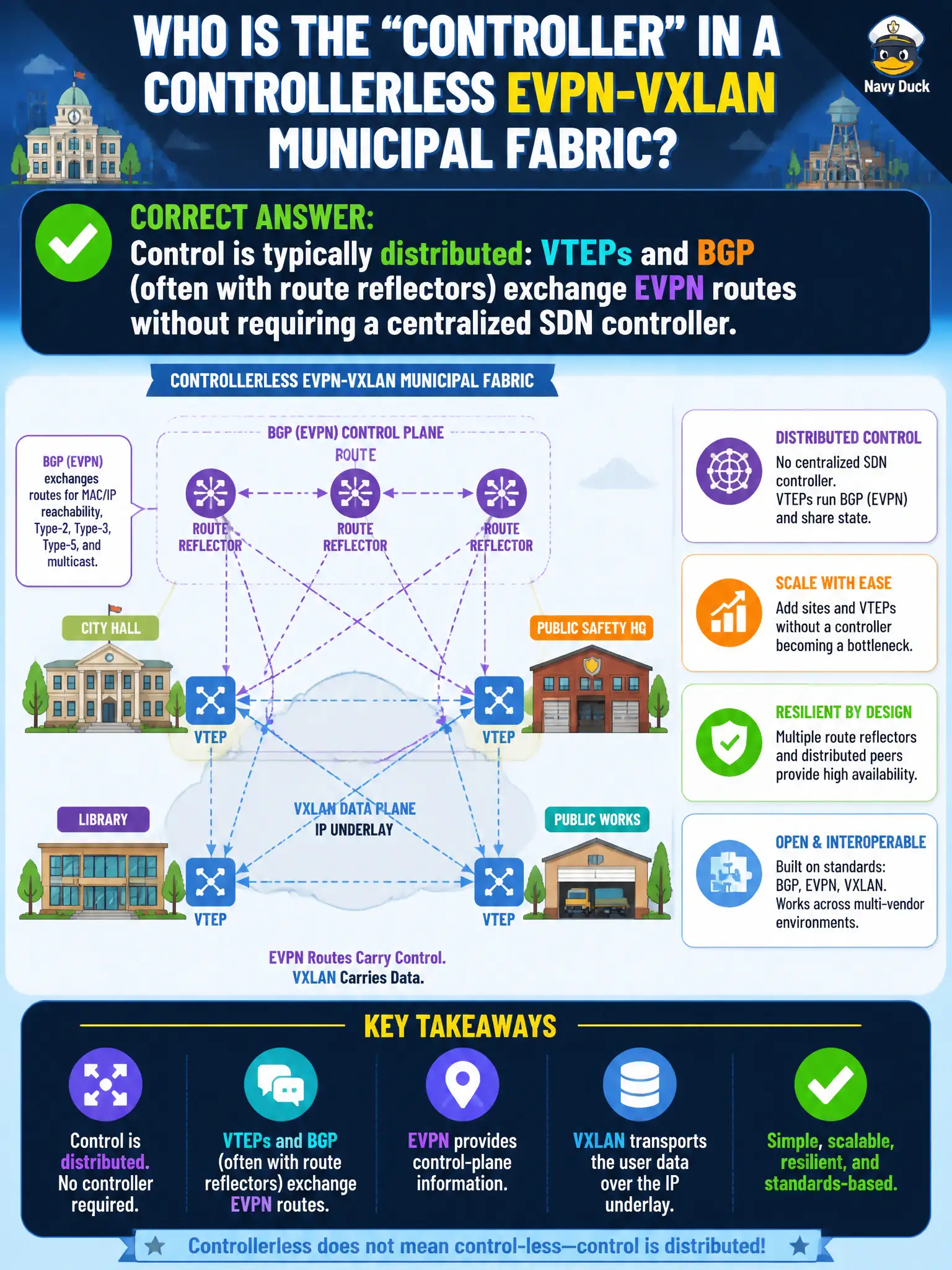
Controllerless EVPN-VXLAN means the leaves and BGP do the talking—no mandatory brain-in-a-box pushing every MAC first. Route reflectors help scale BGP, but they are still part of that distributed control plane story. STP roots and console servers are not the EVPN controller.
Full Explanation
A design review asking who the “controller” is in a controllerless EVPN-VXLAN municipal fabric is answered by distributed control: VTEPs and BGP—often with route reflectors—exchange EVPN routes without requiring a centralized SDN controller to program every MAC before any VXLAN packet can forward. “Controllerless” means Multiprotocol BGP EVPN itself provides the overlay control plane among civic leaves.
A mandatory centralized SDN controller is not a prerequisite for standard Juniper EVPN-VXLAN professional designs. The active STP root bridge is not the authoritative EVPN controller for all pods. Only the out-of-band serial console server is not the exclusive originator of EVPN Type-2 routes—consoles are unrelated to EVPN route origination.
Exam caveat: distributed MP-BGP EVPN is the normal controllerless model; centralized controllers may appear in some ecosystems but are not required for JN0-683-style fabrics.
Operational check: verify EVPN routes originate on VTEPs or route reflectors with no SDN controller in the signaling path; document BGP EVPN as the civic fabric control plane for architecture reviews and audits.
In civic fabric operations, retain the correct idea—Control is typically distributed: VTEPs and BGP (often with route reflectors) exchange EVPN routes without requiring a centralized SDN controller—and reject distractors that confuse layers or tools. Specifically, do not treat “A mandatory centralized SDN controller must program every MAC before any VXLAN packet can forward.” as valid, do not accept “The active STP root bridge is the authoritative EVPN controller for all pods.” as a substitute design, and do not operationalize “Only the out-of-band serial console server may originate EVPN Type-2 routes.” in production runbooks. Re-validate after changes with show commands for sessions, routes, VTEP reachability, and a simple tenant traffic test appropriate to the VNI under review.