
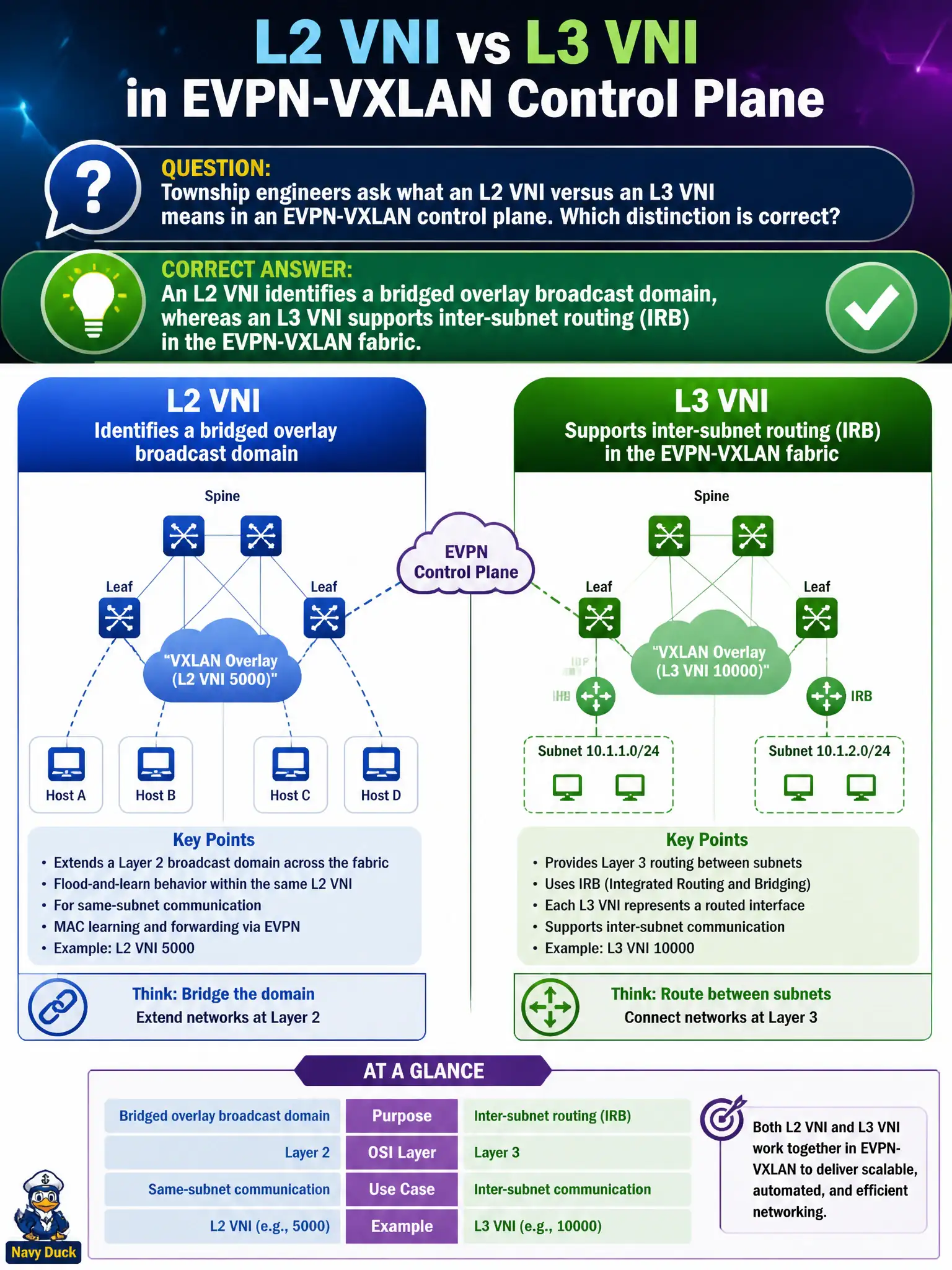
Township engineers ask what an L2 VNI versus an L3 VNI means in an EVPN-VXLAN control plane. Which distinction is correct?
Select an answer to reveal the explanation.
Short Explanation
L2 VNI is the bridged neighborhood where MACs hang out; L3 VNI is the routed hallway that lets subnets talk through IRB. Mixing those names up sends you troubleshooting the wrong door. Neither one is just a nickname for a loopback address family.
Full Explanation
Township engineers asking what an L2 VNI versus an L3 VNI means in an EVPN-VXLAN control plane need this distinction: an L2 VNI identifies a bridged overlay broadcast domain for MAC learning and intra-subnet bridging, whereas an L3 VNI supports inter-subnet routing with IRB so traffic between tenant subnets can be routed in the fabric. That role split is foundational when reading Junos EVPN state on data-center leaves.
L2 and L3 VNIs are not interchangeable names for the underlay loopback address family. An L3 VNI is not used only for Spanning Tree BPDUs while an L2 VNI carries only default routes. L2 VNIs are not spine-only objects that force leaves to use only L3 VNIs for bridging—leaves commonly host L2 VNIs for attached servers.
Exam caveat: L2 VNI equals bridge domain; L3 VNI equals inter-subnet/IRB routing context—core vocabulary for JNCIP-DC EVPN questions.
Operational check: map a tenant VLAN to an L2 VNI and confirm Type-2 MAC behavior; configure IRB with an L3 VNI for inter-subnet traffic and verify routed overlay between two civic subnets on different L2 VNIs.
In civic fabric operations, retain the correct idea—An L2 VNI identifies a bridged overlay broadcast domain, whereas an L3 VNI supports inter-subnet routing (IRB) in the EVPN-VXLAN fabric—and reject distractors that confuse layers or tools. Specifically, do not treat “L2 and L3 VNIs are interchangeable names for the underlay loopback address family.” as valid, do not accept “An L3 VNI is only used for Spanning Tree BPDUs, while an L2 VNI carries only default routes.” as a substitute design, and do not operationalize “L2 VNIs exist solely on spines; leaves may use only L3 VNIs for bridging.” in production runbooks. Re-validate after changes with show commands for sessions, routes, VTEP reachability, and a simple tenant traffic test appropriate to the VNI under review.