
During a city DR test, BGP EVPN sessions flap while some existing VXLAN data-plane flows briefly continue. What operational nuance is most accurate at concept level?
Select an answer to reveal the explanation.
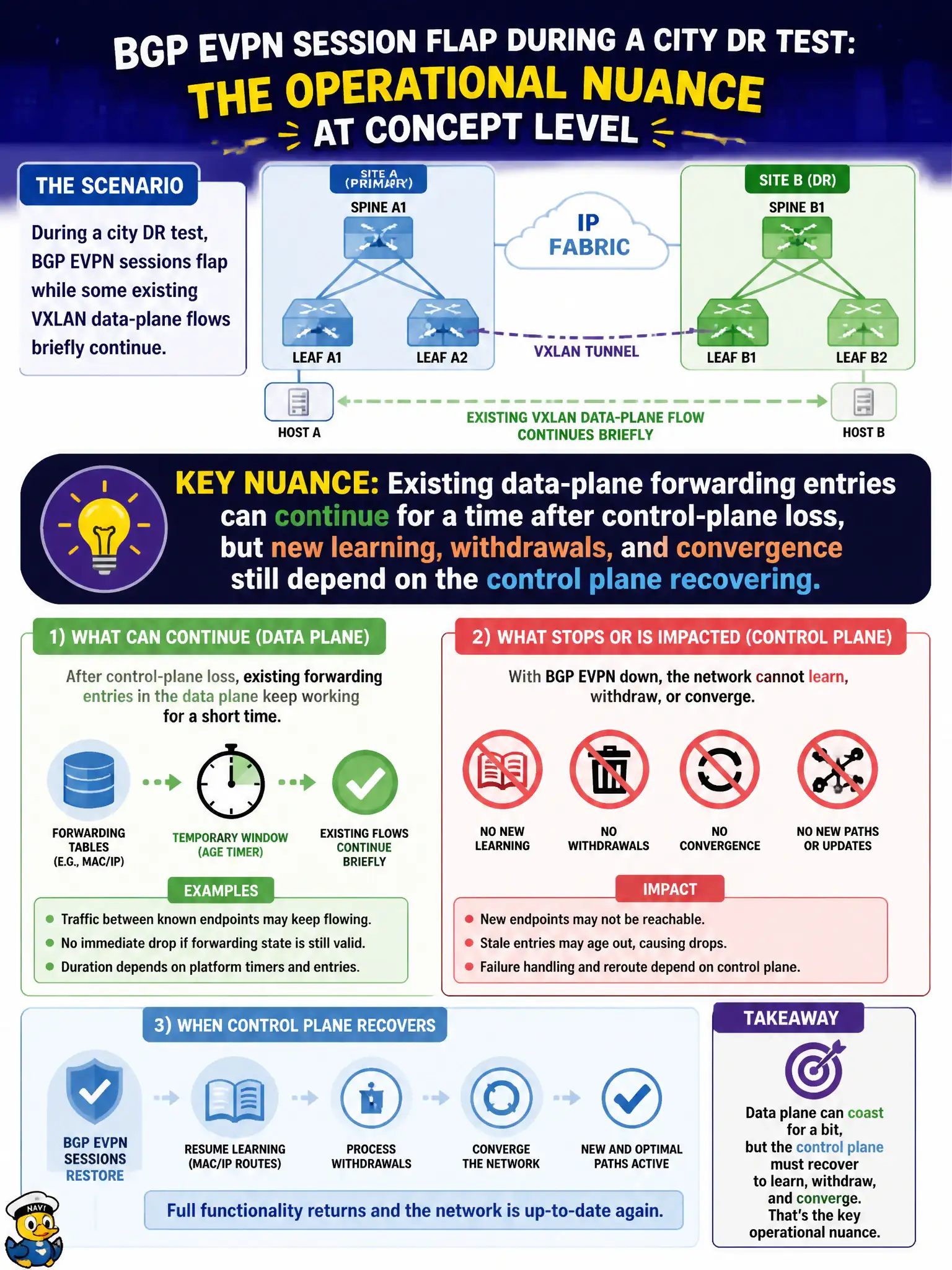
Short Explanation
Think of the control plane as the dispatcher and the data plane as cars already on the road—traffic already queued can keep moving for a bit even if the radio cuts out. New learning and clean withdrawals still need the dispatcher back. That is nuance, not a claim that BGP keepalives ride inside every tenant frame.
Full Explanation
During a city DR test, BGP EVPN sessions can flap while some existing VXLAN data-plane flows briefly continue because installed forwarding entries may keep forwarding known flows for a time after control-plane loss, depending on timers, graceful behaviors, and implementation. Residual forwarding does not make the control plane optional: advertisements, MAC moves, withdrawals, and new learning still depend on EVPN/BGP recovery.
Any control-plane flap does not necessarily erase all forwarding entries and drop every in-flight frame within one millisecond. VXLAN data plane does not require a continuous BGP keepalive inside every tenant packet or forwarding stops. DR tests do not prove control-plane state is irrelevant because VXLAN always floods forever without tables.
Exam caveat: data plane may briefly outlive control plane; control plane remains mandatory for ongoing correctness and convergence in municipal EVPN-VXLAN fabrics.
Operational check: flap EVPN BGP in a maintenance window, observe whether known flows continue briefly, then introduce a new MAC and confirm remote learning fails until EVPN recovers; document observed timers in the civic DR playbook.
In civic fabric operations, retain the correct idea—Existing data-plane forwarding entries can continue for a time after control-plane loss, but new learning, withdrawals, and convergence still depend on the control plane recovering—and reject distractors that confuse layers or tools. Specifically, do not treat “Any control-plane flap instantly erases all forwarding entries and must drop every in-flight frame within one millisecond.” as valid, do not accept “VXLAN data plane requires a continuous BGP keepalive inside every tenant packet or forwarding stops.” as a substitute design, and do not operationalize “DR tests prove control-plane state is irrelevant because VXLAN always floods forever without tables.” in production runbooks. Re-validate after changes with show commands for sessions, routes, VTEP reachability, and a simple tenant traffic test appropriate to the VNI under review.