
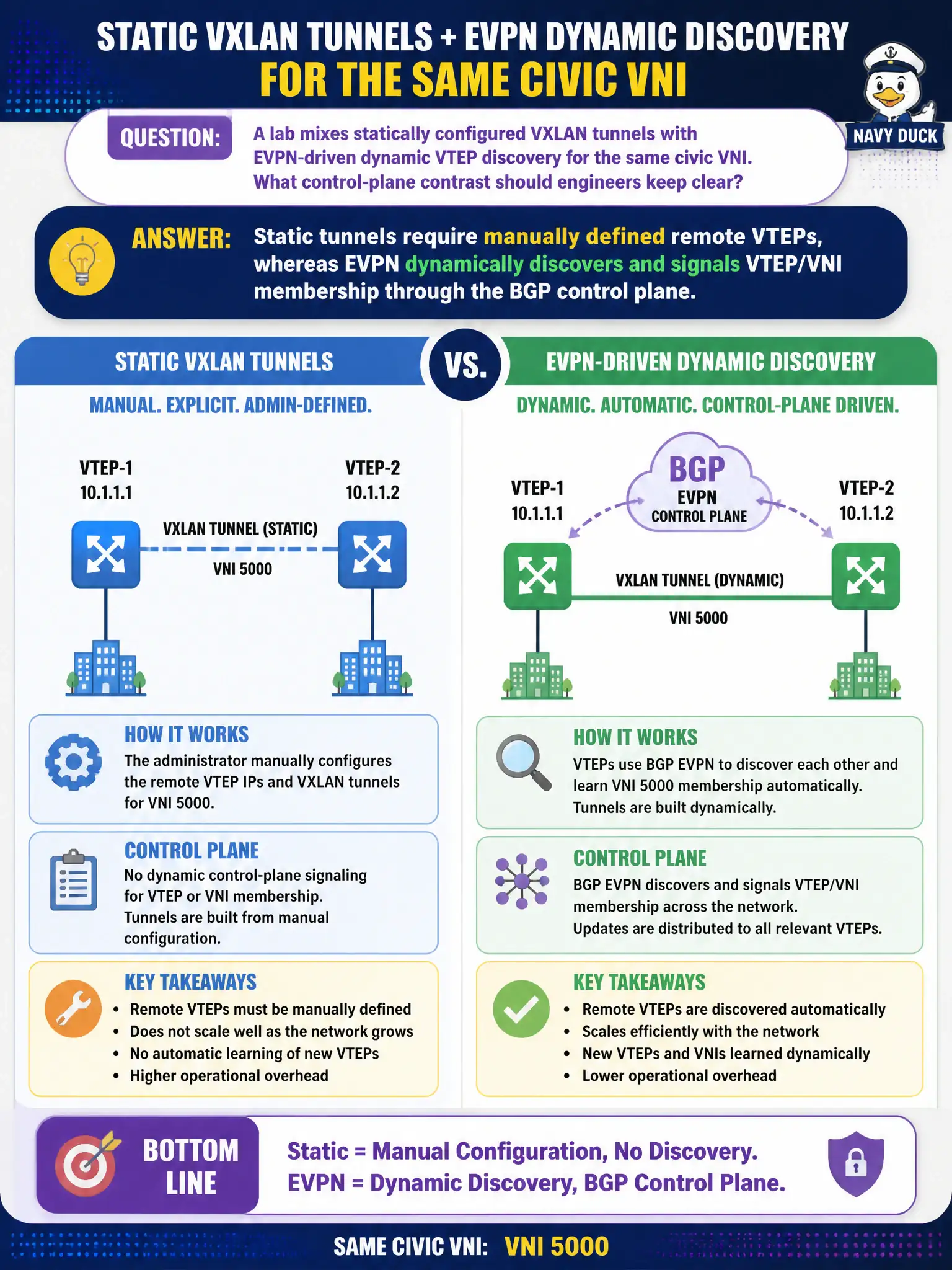
A lab mixes statically configured VXLAN tunnels with EVPN-driven dynamic VTEP discovery for the same civic VNI. What control-plane contrast should engineers keep clear?
Select an answer to reveal the explanation.
Short Explanation
Static tunnels are handwritten phone numbers for remote VTEPs; EVPN is the auto-updated contact list. Mixing them in a lab is fine for learning, but do not pretend they discover peers the same way. EVPN does not wait on STP roots, and neither design ignores VNI membership.
Full Explanation
A lab that mixes statically configured VXLAN tunnels with EVPN-driven dynamic VTEP discovery for the same civic VNI must keep this control-plane contrast clear: static tunnels require manually defined remote VTEPs, whereas EVPN dynamically discovers and signals VTEP/VNI membership—and MAC/IP state—through the BGP control plane. Static configuration is simple at tiny scale and brittle as membership changes; EVPN scales discovery with the control plane as the municipal pod grows.
Static tunnels do not automatically learn every MAC worldwide through DNS, and EVPN does not forbid dynamic peer discovery—dynamic discovery is the point of EVPN. EVPN does not require STP to elect a root bridge on the underlay before tunnels can form. Static VXLAN and EVPN are not identical on the claim that both ignore VNI membership—both still key on VNI segmentation for isolation.
Exam caveat: static means a manual remote VTEP list; EVPN means BGP-signaled membership and MAC/IP state—operators must know which path builds the tunnel list.
Operational check: for one test VNI, compare a manually configured remote VTEP list against EVPN-learned tunnels or next-hops; add a new leaf via EVPN only and confirm the static-only leaf does not learn it until an operator edits the static configuration.