
A municipal standard mandates EVPN for VXLAN signaling across the city’s leaf-spine pods. Which statement correctly identifies that control plane?
Select an answer to reveal the explanation.
Short Explanation
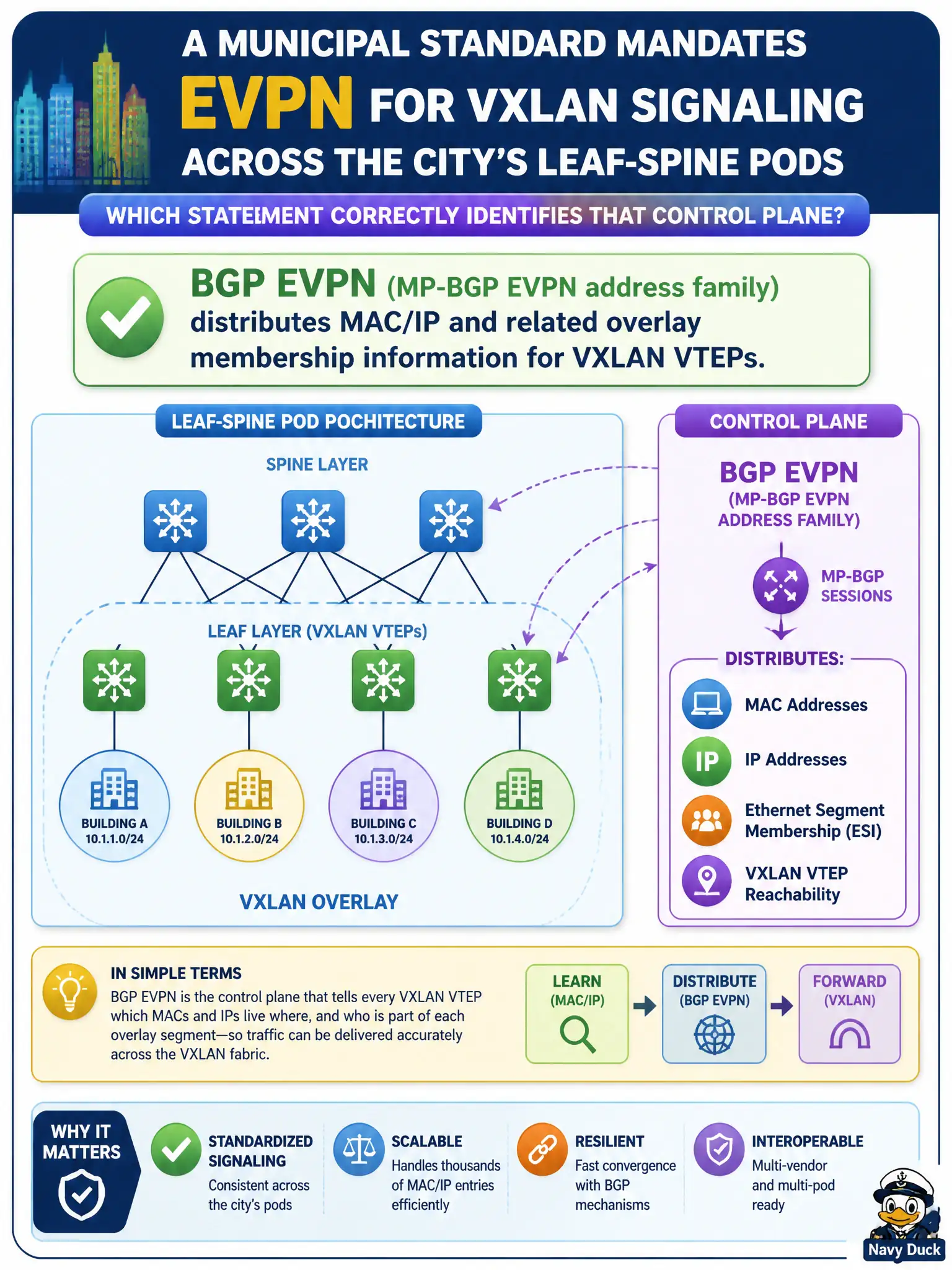
When the city says “EVPN for VXLAN,” they mean BGP carrying EVPN routes—the shared phone book for MAC/IP and membership. STP pinouts and PIM-by-itself are not that phone book, and telemetry watching the network is not the same as signaling reachability. MP-BGP EVPN is the modern control plane the standard is pointing at.
Full Explanation
A municipal standard that mandates EVPN for VXLAN signaling across the city’s leaf-spine pods means BGP EVPN: Multiprotocol BGP with the EVPN address family distributing MAC/IP bindings, Ethernet Segment information, and related overlay membership among VTEPs. That MP-BGP EVPN control plane is what civic operators enable, monitor, and troubleshoot when architecture documents say the fabric must “run EVPN for VXLAN.”
Spanning Tree plus static MAC pinouts on every spine is not an overlay MAC distribution protocol for VXLAN and cannot replace EVPN. PIM sparse-mode alone does not advertise EVPN MAC/IP host routes between VTEPs without BGP. NETCONF telemetry streams improve observability but do not substitute for control-plane exchange of MAC or IP reachability between leaves.
Exam caveat: on JN0-683-style items, EVPN-for-VXLAN equals MP-BGP EVPN AFI/SAFI plus consistent route-target policy—STP, PIM-only, and telemetry-as-control-plane are distractors.
Operational check: confirm leaves negotiate the EVPN address family with route reflectors or peers, verify matching route targets for the tenant MAC-VRF, and show EVPN MAC/IP routes for a test VNI on multiple municipal leaves before declaring the overlay control plane healthy.