
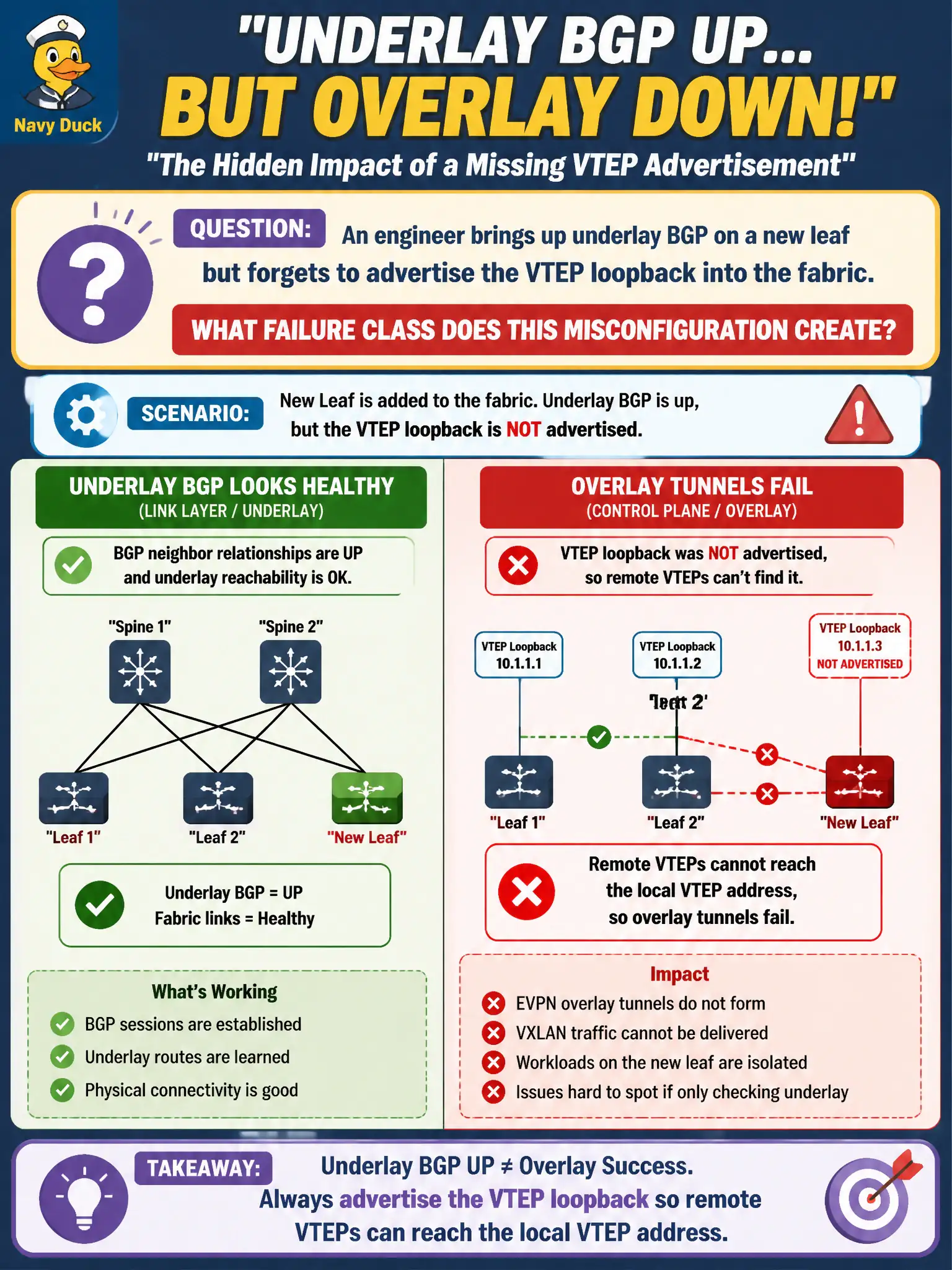
An engineer brings up underlay BGP on a new leaf but forgets to advertise the VTEP loopback into the fabric. What failure class does this misconfiguration create?
Select an answer to reveal the explanation.
Short Explanation
No advertisement for the VTEP loopback is like publishing a tunnel entrance with no street address. Underlay BGP can look fine on the links while overlays stay dark because nobody can route to that VTEP.
Full Explanation
An engineer who brings up underlay BGP on a new leaf but forgets to advertise the VTEP loopback into the fabric creates a classic failure class: remote VTEPs cannot reach the local VTEP address, so overlay tunnels fail even though underlay link BGP looks healthy on the point-to-point fabric sessions. VXLAN and EVPN depend on underlay IP reachability to tunnel endpoints—typically stable loopbacks carried in the fabric IGP/BGP—not merely on adjacent link sessions being Established.
Spines will not automatically proxy VTEP discovery using LLDP so overlays still form; LLDP adjacency is not a substitute for advertising and routing to the VTEP address. The breakage is not limited to multicast VXLAN while unicast EVPN ignores missing VTEP host routes—both need VTEP reachability. Access VLANs do not fail open by bridging ethertype 0x8906 without IP reachability to the VTEP endpoint.
Exam caveat: link BGP up + missing VTEP loopback advertisement = overlay down; memorize this municipal bring-up misconfiguration pattern.
Operational check: confirm the VTEP loopback is originated into underlay BGP on the new leaf; traceroute from remote VTEPs to that address; retest overlay MAC learning and tenant pings once underlay host reachability exists.