
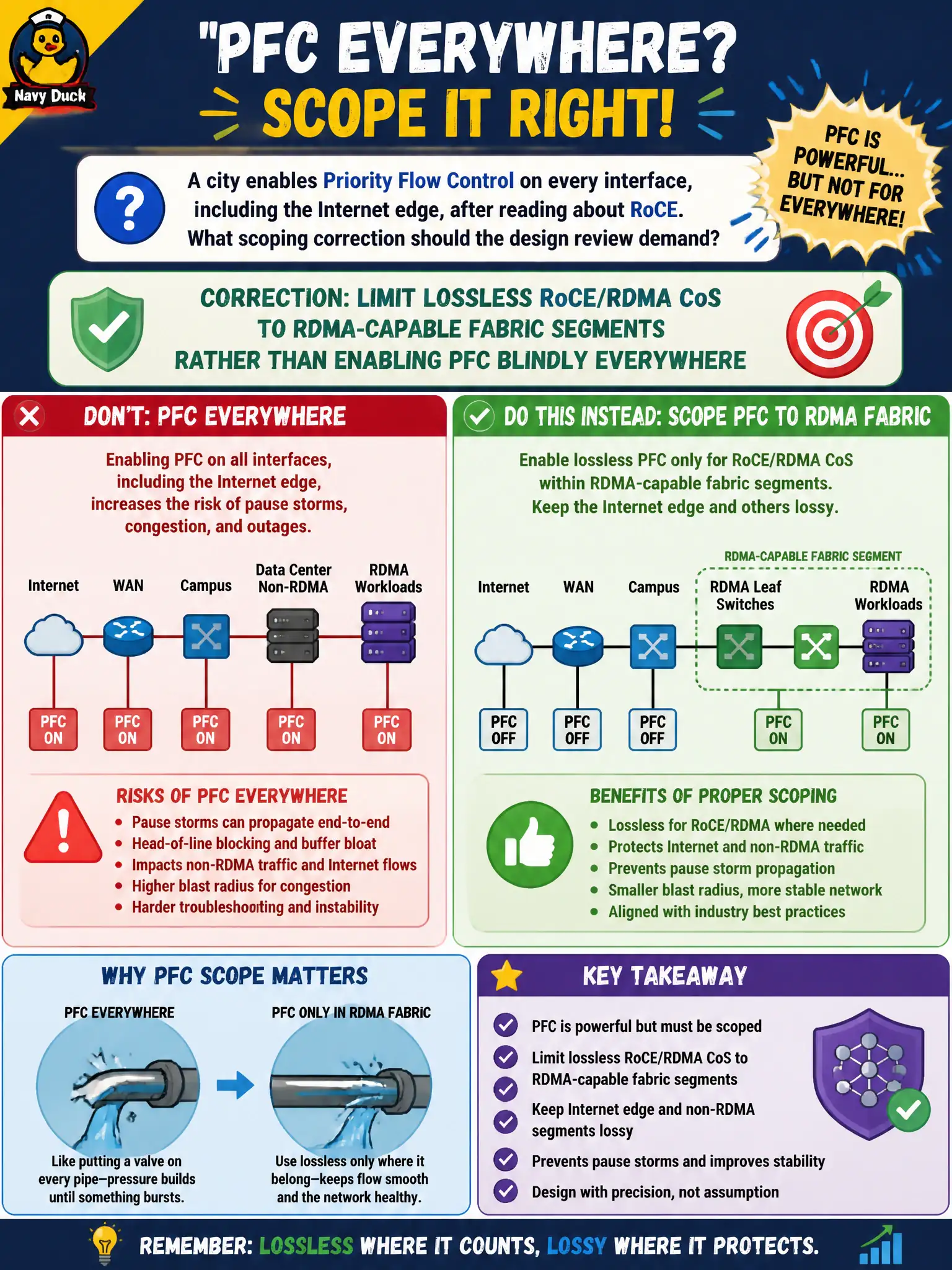
A city enables Priority Flow Control on every interface, including the Internet edge, after reading about RoCE. What scoping correction should the design review demand?
Select an answer to reveal the explanation.
Short Explanation
PFC is a local fire hose for carefully plumbed RoCE hallways—not something you spray onto the Internet porch. Scope lossless classes to the RDMA domain or you risk pause storms and weird WAN behavior.
Full Explanation
When a city enables Priority Flow Control on every interface—including the Internet edge—after reading about RoCE, the design review must demand scoping correction: limit lossless RoCE/RDMA CoS to RDMA-capable fabric segments where endpoints, buffer contracts, and peers expect pause behavior. Blind global PFC is not a civic best practice; pause frames on WAN or public Internet edges can propagate harmful backpressure into networks that should remain ordinary lossy best-effort forwarding.
Keeping PFC global so pause frames can cross the public Internet doubles down on the mistake and is operationally dangerous. Replacing PFC with unfiltered best-effort only on GPU-facing leaf ports abandons the RDMA CoS those GPUs need on the actual leaf-spine data path. Applying PFC solely on the OOB management VRF misses RoCE storage entirely, because management VRFs do not carry the GPU data plane.
Exam caveat: lossless classes are domain-scoped; stems that mention Internet or WAN edges are signaling that ubiquitous PFC is the wrong answer.
Operational check: audit CoS configuration interface-by-interface; ensure PFC/lossless is enabled only on RoCE fabric segments, disabled on Internet-edge and general WAN links, then retest GPU storage latency and PFC counters under load within the scoped domain.