
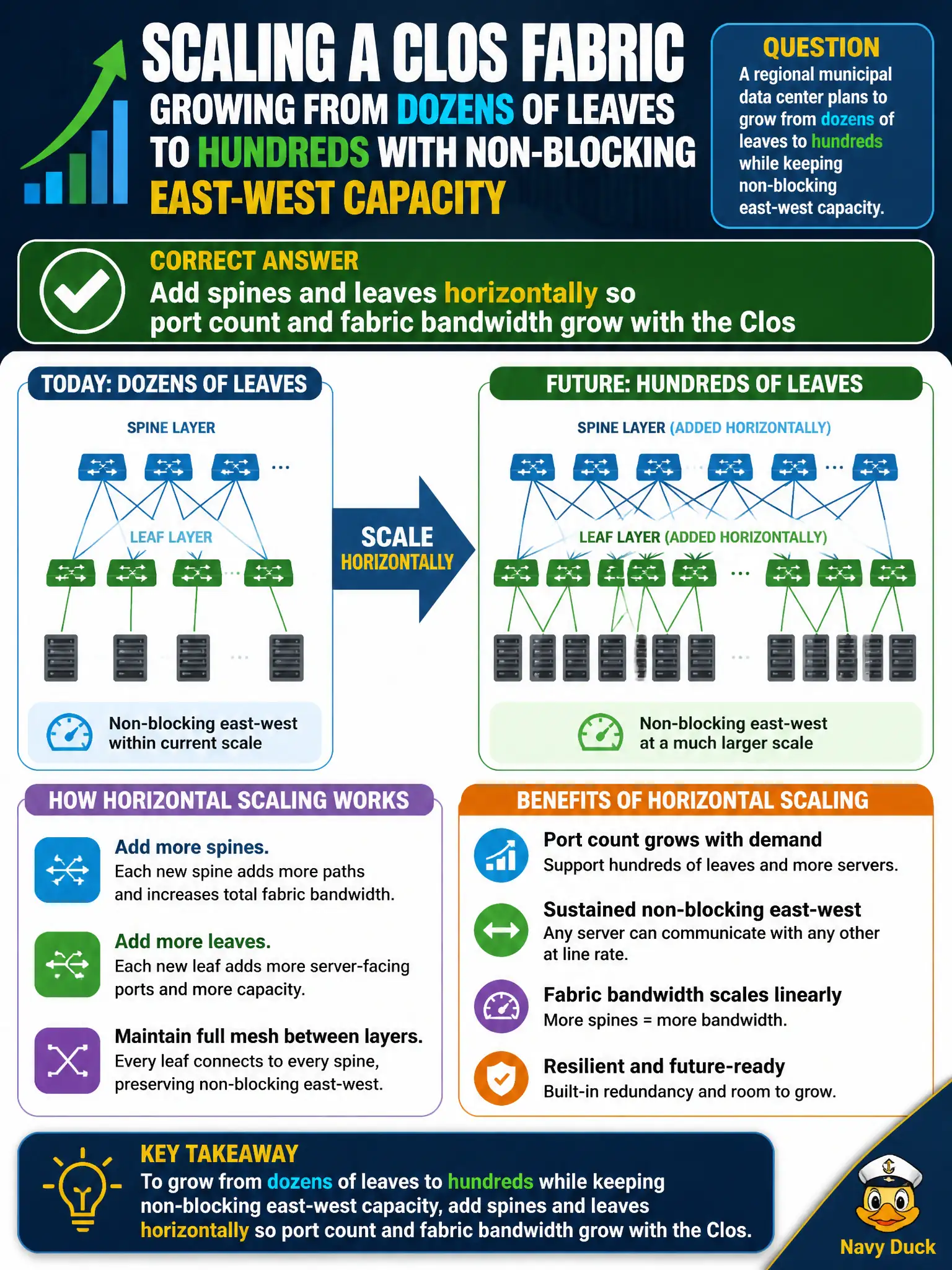
A regional municipal data center plans to grow from dozens of leaves to hundreds while keeping non-blocking east-west capacity. How should the architects scale the Clos fabric?
Select an answer to reveal the explanation.
Short Explanation
Think of a Clos like a highway system: when traffic grows, you add lanes and on-ramps—more spines and leaves—not one giant overpass. Horizontal scale-out is how a regional DC keeps bandwidth and ports climbing together.
Full Explanation
Regional municipal Clos fabrics scale primarily by growing horizontally: add spines to increase uplink bandwidth and ECMP fan-in, and add leaves to increase server attachment ports. That model preserves non-blocking east-west capacity as the civic workload moves from dozens of leaves toward hundreds, because port count and fabric bandwidth expand together with the topology rather than depending on a few oversized boxes.
Collapsing all leaves onto two oversized chassis and abandoning the spine layer reintroduces classic chassis bottlenecks and single points of concentration that Clos was meant to avoid. Converting every leaf-spine link to a Layer 2 VLAN trunk abandons IP-fabric multipath routing and invites large L2 failure domains. Pinning all server traffic through a single spine simplifies nothing useful—it eliminates ECMP and creates an intentional bottleneck.
Exam caveat: exam items often contrast scale-out Clos with scale-up chassis thinking; choose horizontal leaf/spine growth when the stem emphasizes non-blocking east-west growth with leaf count.
Operational check: model required leaf downlink ports and oversubscription, then verify planned spine count provides enough equal-cost uplinks per leaf; after growth, confirm leaves install multipath next hops toward all intended spines for fabric prefixes.