
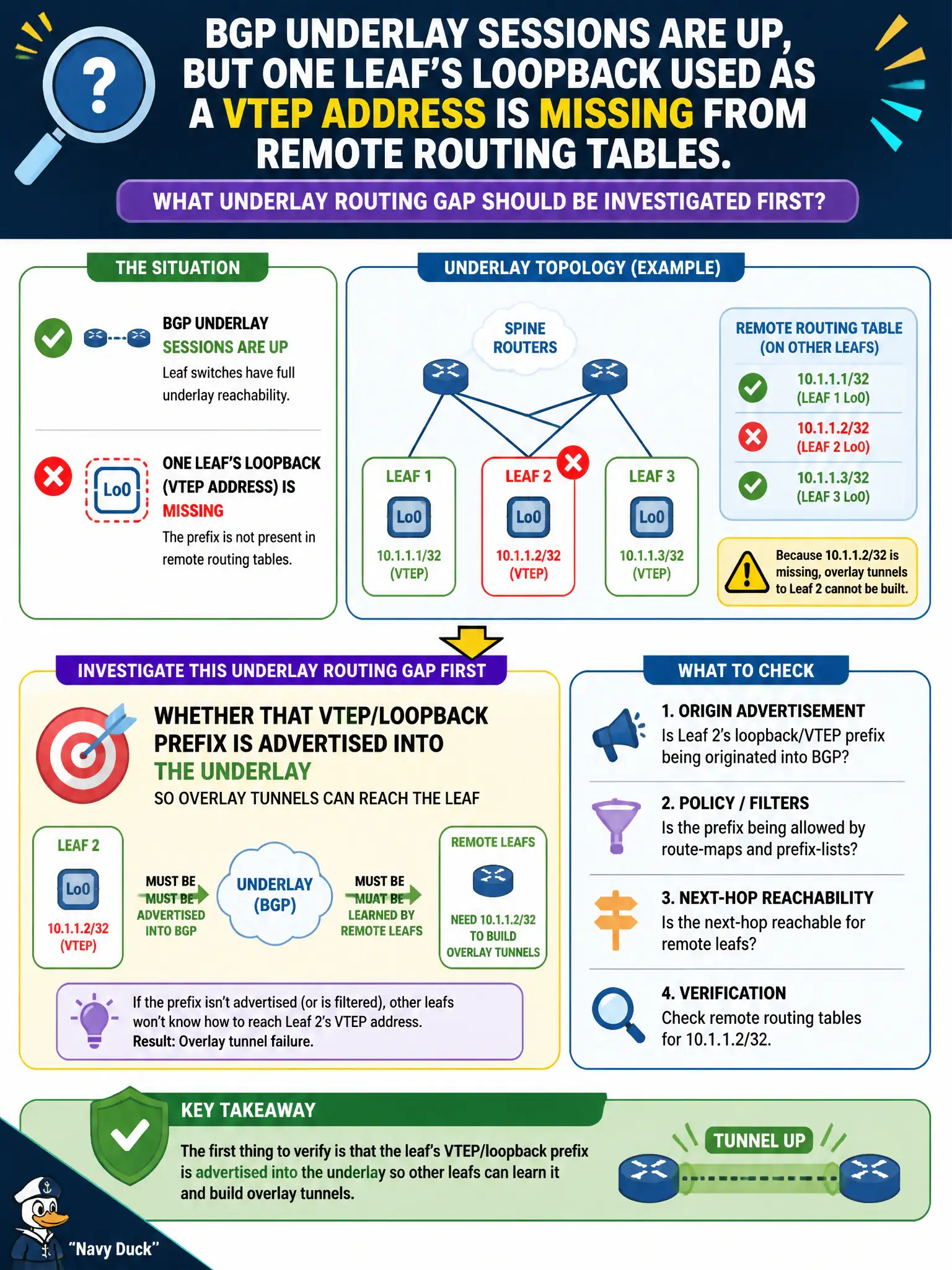
BGP underlay sessions are up, but one leaf’s loopback used as a VTEP address is missing from remote routing tables. What underlay routing gap should be investigated first?
Select an answer to reveal the explanation.
Short Explanation
Sessions up but no loopback route is like having phone signal and no phone number published. The VTEP address has to be advertised in the underlay or remote leaves cannot build the tunnel. Do not go hunting STP on a loopback.
Full Explanation
When BGP sessions are up but a leaf’s VTEP loopback is missing remotely, investigate whether that loopback prefix is advertised into the underlay so overlay tunnels can reach the leaf. STP does not block loopback interfaces on spines as fabric ports. Disabling VXLAN globally does not publish VTEP reachability via L2 flooding. Redistributing every server VLAN is not the clean way to inject infrastructure loopbacks. Exam caveat: Sessions up ≠ all required prefixes advertised; check export policy for loopbacks. Operational check: On a remote leaf, confirm the VTEP loopback route exists; if not, fix origin advertisement/policy on the source leaf. In civic data-center operations, record the expected CLI or collector evidence for this concept so the next on-call engineer can validate fabric behavior without re-deriving the design under incident pressure. In civic data-center operations, record the expected CLI or collector evidence for this concept so the next on-call engineer can validate fabric behavior without re-deriving the design under incident pressure. In civic data-center operations, record the expected CLI or collector evidence for this concept so the next on-call engineer can validate fabric behavior without re-deriving the design under incident pressure.