
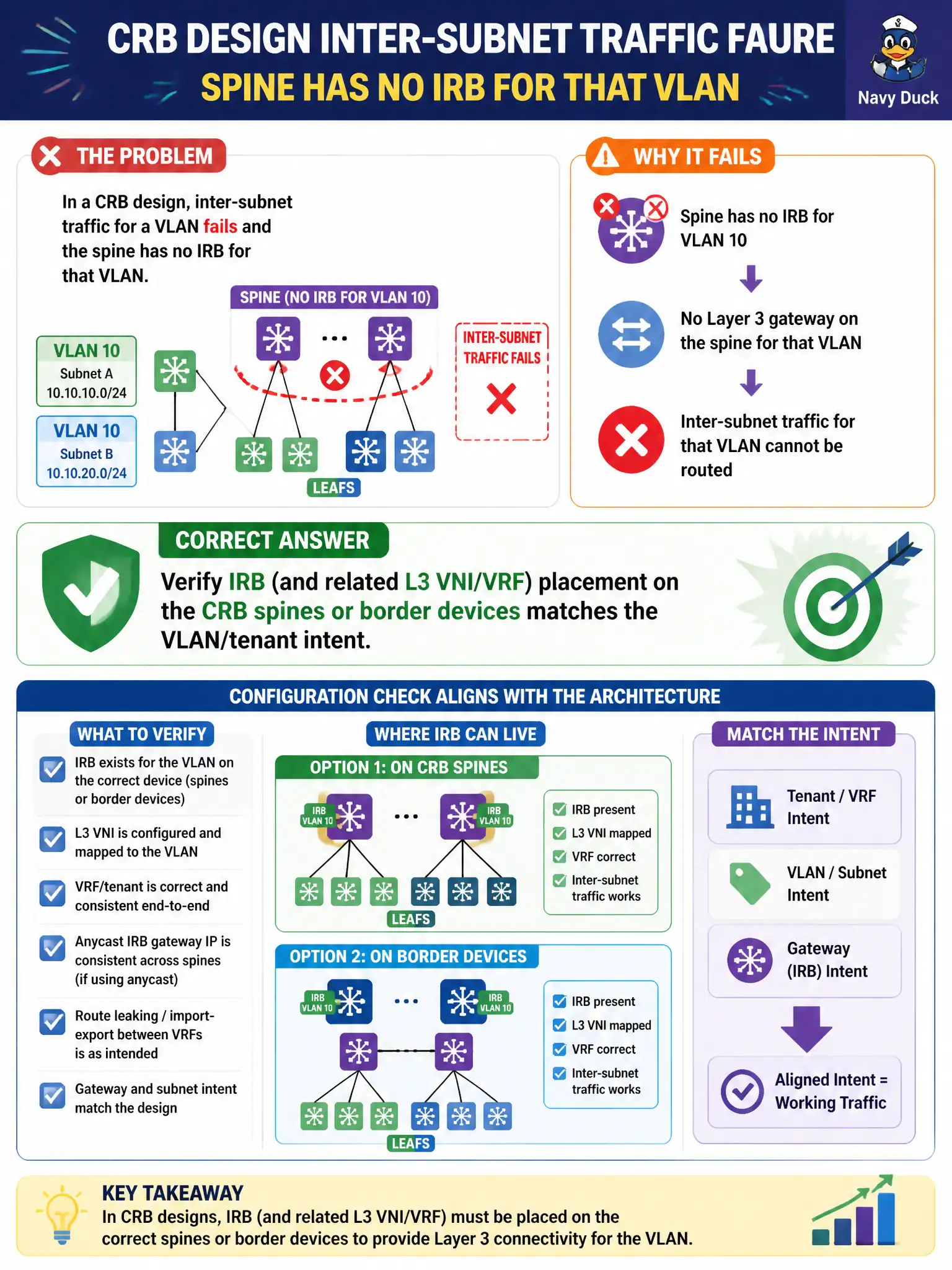
In a CRB design, inter-subnet traffic for a VLAN fails and the spine has no IRB for that VLAN. What configuration check aligns with the architecture?
Select an answer to reveal the explanation.
Short Explanation
CRB expects the gateway upstairs on the spine — if that IRB is missing for the VLAN, inter-subnet dies. Check spine/border IRB placement against the design, do not relocate everything to ERB leaves by accident.
Full Explanation
In CRB, inter-subnet routing for a VLAN depends on IRB and related L3 VNI/VRF placement on the spines or border devices. If inter-subnet traffic fails and the spine has no IRB for that VLAN, verify IRB placement matches the VLAN/tenant intent on those central devices. Moving all IRBs exclusively to every leaf would abandon CRB for ERB and is not the CRB-aligned check. Deleting EVPN Type-1 routes so the spine learns MACs only from STP is incorrect. Disabling VXLAN on the spines and bridging through the underlay IGP breaks the EVPN-VXLAN CRB model. Exam caveat: the VLAN may be bridged on leaves while forgotten on the CRB spine IRB list—L2 works, L3 fails, which is a signature CRB provisioning gap. Operational check: list tenant VLANs on municipal leaves, confirm each routed VLAN has IRB and VRF on the CRB spines, ping between subnets, and inspect spine EVPN/IRB state for the missing VLAN. For CRB tenants, include spine IRB presence in the VLAN turn-up checklist so L2-only success does not mask missing L3 gateways. For CRB tenants, include spine IRB presence in the VLAN turn-up checklist so L2-only success does not mask missing L3 gateways. For CRB tenants, include spine IRB presence in the VLAN turn-up checklist so L2-only success does not mask missing L3 gateways.