
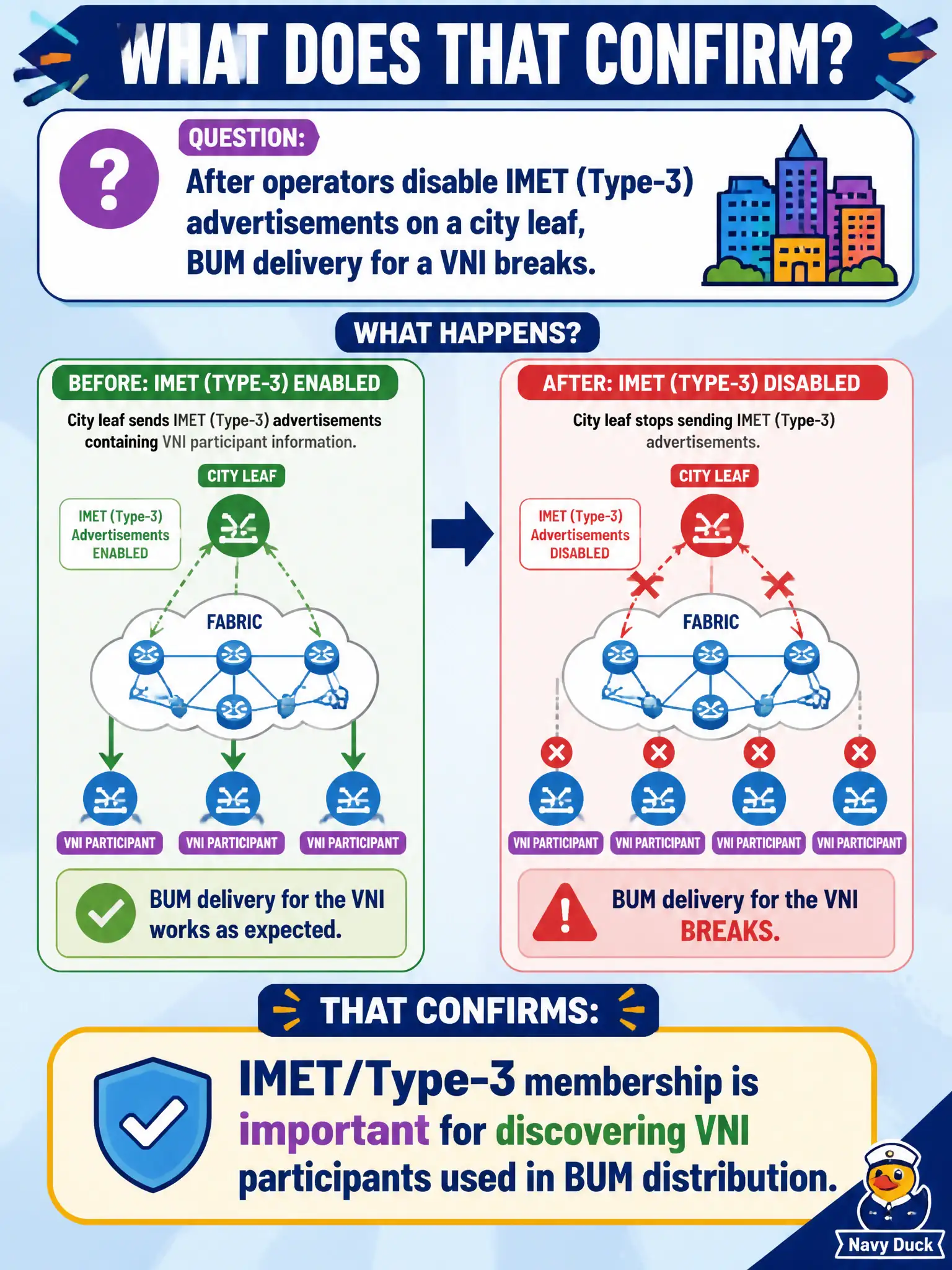
After operators disable IMET (Type-3) advertisements on a city leaf, BUM delivery for a VNI breaks. What does that confirm?
Select an answer to reveal the explanation.
Short Explanation
Turn off IMET and the VNI guest list goes blank—BUM has nowhere sensible to go. Type-3 is how leaves learn who is in the broadcast domain for inclusive floods. It is not optional wallpaper, and Type-5 will not fill that seat.
Full Explanation
IMET Type-3 advertisements tell the EVPN fabric which VTEPs participate in a VNI for inclusive BUM distribution. Disabling IMET on a city leaf removes that membership signal, so other VTEPs stop including it in replication lists and BUM for the VNI breaks—confirming Type-3's operational role. Type-3 is not optional cosmetic signaling. BUM does not depend only on Type-5 prefixes; disabling IMET while keeping Type-5 will not preserve L2 BUM membership. Disabling IMET does not improve unknown-unicast handling via hub-and-spoke spanning tree; EVPN-VXLAN fabrics are not trying to reintroduce STP hub-and-spoke as a substitute for IMET. Exam caveat: some selective multicast designs still rely on related EVPN membership/interest routes—removing Type-3 without a deliberate alternate design is not a performance tweak. Operational check: withdraw Type-3 for a lab VNI on one municipal leaf, confirm remote leaves remove it from the BUM list, restore IMET, and verify broadcast/unknown-unicast delivery recovers in both directions. Keep Type-3 enabled in change templates for every production VNI unless a documented selective-multicast substitute is already active. Keep Type-3 enabled in change templates for every production VNI unless a documented selective-multicast substitute is already active.