
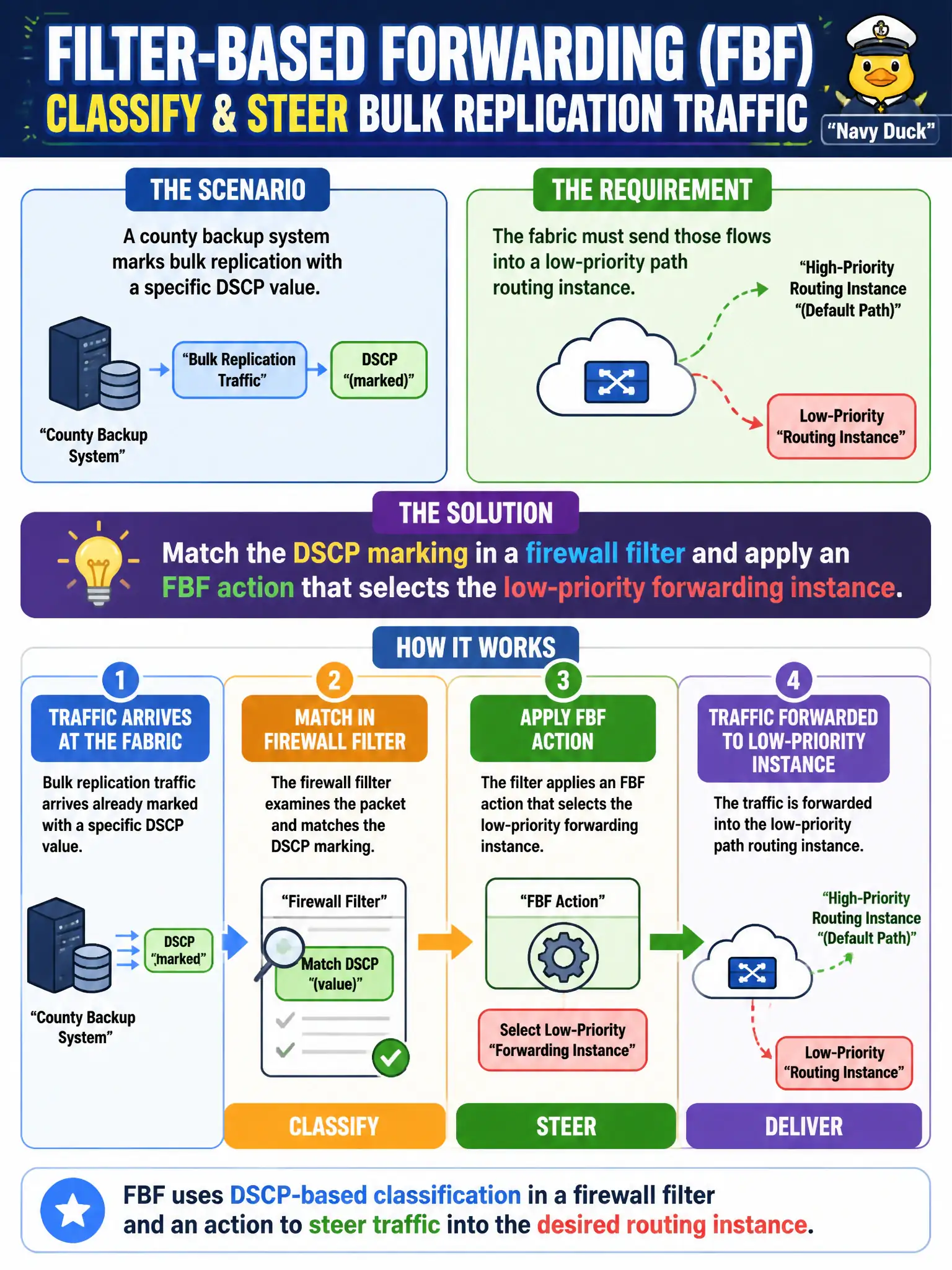
A county backup system marks bulk replication with a specific DSCP value, and the fabric must send those flows into a low-priority path routing instance. How should filter-based forwarding classify and steer that traffic?
Select an answer to reveal the explanation.
Short Explanation
DSCP is the sticky note on the box saying “bulk backup—use the slow dock.” The filter reads that mark and FBF ships those packets into the low-priority instance. ECMP guessing or wiping DSCP throws away the classification you already paid for.
Full Explanation
When a county backup system marks bulk replication with a specific DSCP value and the fabric must send those flows into a low-priority path routing instance, filter-based forwarding should match the DSCP marking in a firewall filter and apply an FBF action that selects the low-priority forwarding instance. Classification keys for FBF commonly include addresses, ports, and DSCP, so the backup marking becomes the civic signal that places replication on the intended lower-priority context without rewriting every destination. Matching only on VXLAN VNI and ignoring DSCP fails when multiple applications share a VNI yet only backup needs the low-priority path. Using underlay ECMP hash alone so DSCP never influences instance selection may spray packets across equal underlay links but does not select a logical routing instance from the DSCP policy. Rewriting DSCP to zero on the spine and relying on MAC learning for path choice destroys the classification signal and confuses L2 learning with L3 instance steering. Exam caveat: DSCP-aware FBF is a valid describe-level pattern for marking-based path or instance selection in municipal fabrics. Operational check: mark a backup test flow with the agreed DSCP, confirm the leaf filter hits the FBF term, show that forwarding occurs in the low-priority routing instance, and ensure unmarked agency traffic remains on the normal tenant instance.