
Municipal operators need leaf management reachability without exposing tenant VRFs. Which separation practice is most appropriate?
Select an answer to reveal the explanation.
Short Explanation
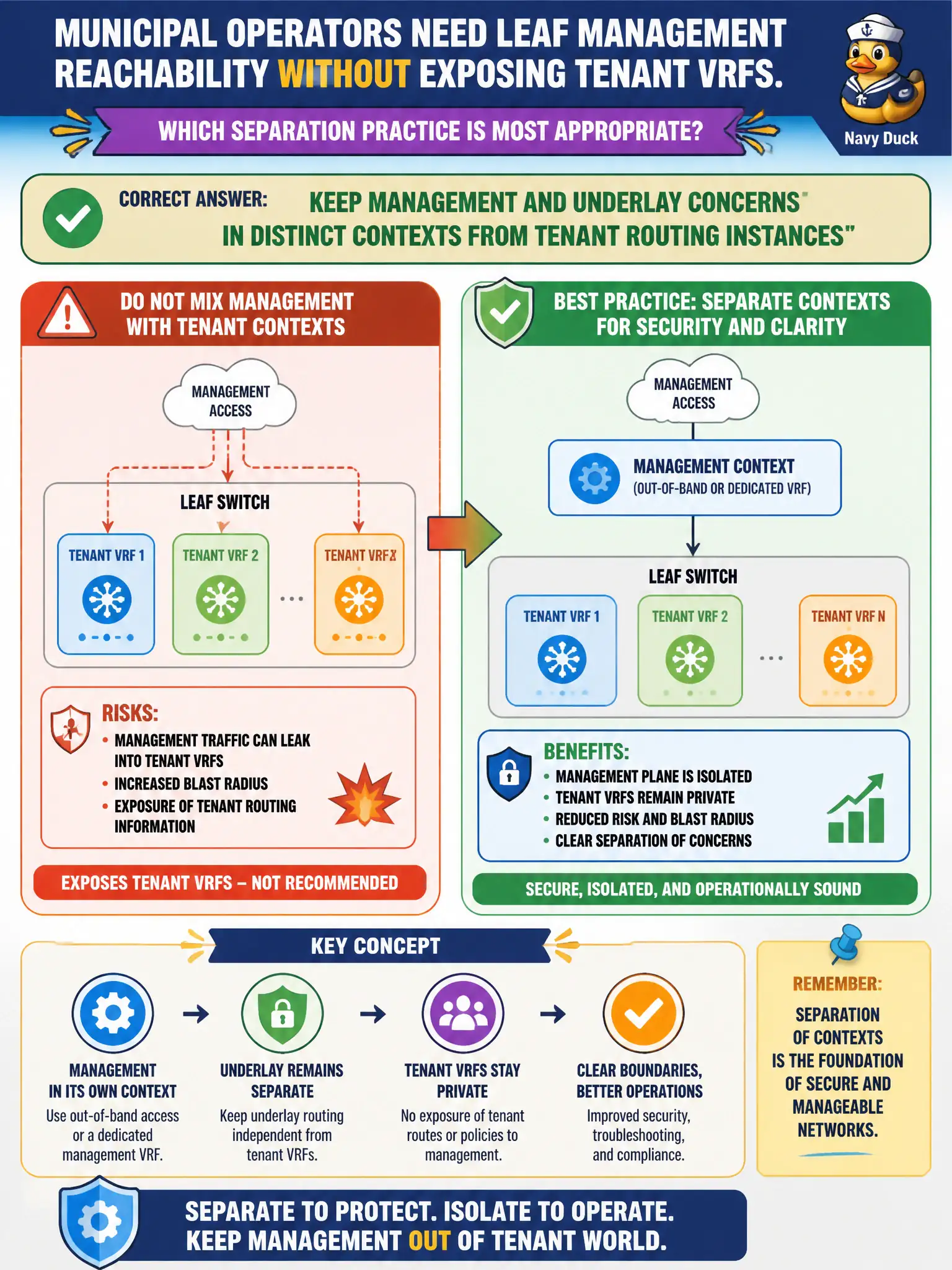
Management is staff-only stairs; tenants get public elevators. Do not pour SSH and telemetry into every agency VRF or haul tenant defaults into the management plane. Keep mgmt/underlay apart from tenant instances so a tenant outage is not a lockout—or a backdoor.
Full Explanation
Municipal operators need leaf management reachability without exposing tenant VRFs by keeping management and underlay concerns in distinct contexts from tenant routing instances. SSH, telemetry, and underlay loopbacks should not depend on Parks or Courts tables, and agencies should not receive management routes that belong to the civic network operations plane.
Moving SSH and telemetry into every tenant VRF so agencies can manage the leaf exposes the control plane to tenant reachability and policy mistakes. Advertising all tenant defaults into the management instance for symmetric routing pollutes management with tenant exits. Disabling the management Ethernet and managing devices only via tenant data ports couples OOB loss to tenant outages.
Exam caveat: management/underlay versus tenant separation is part of multitenancy hygiene, not an afterthought.
Operational check: verify management instance or master underlay context reaches the NOC, confirm tenant VRFs lack management prefixes, and test that losing a tenant instance does not black-hole SSH to the leaf. Periodically traceroute management from the NOC while shutting a lab tenant instance in a maintenance window to prove decoupling.