
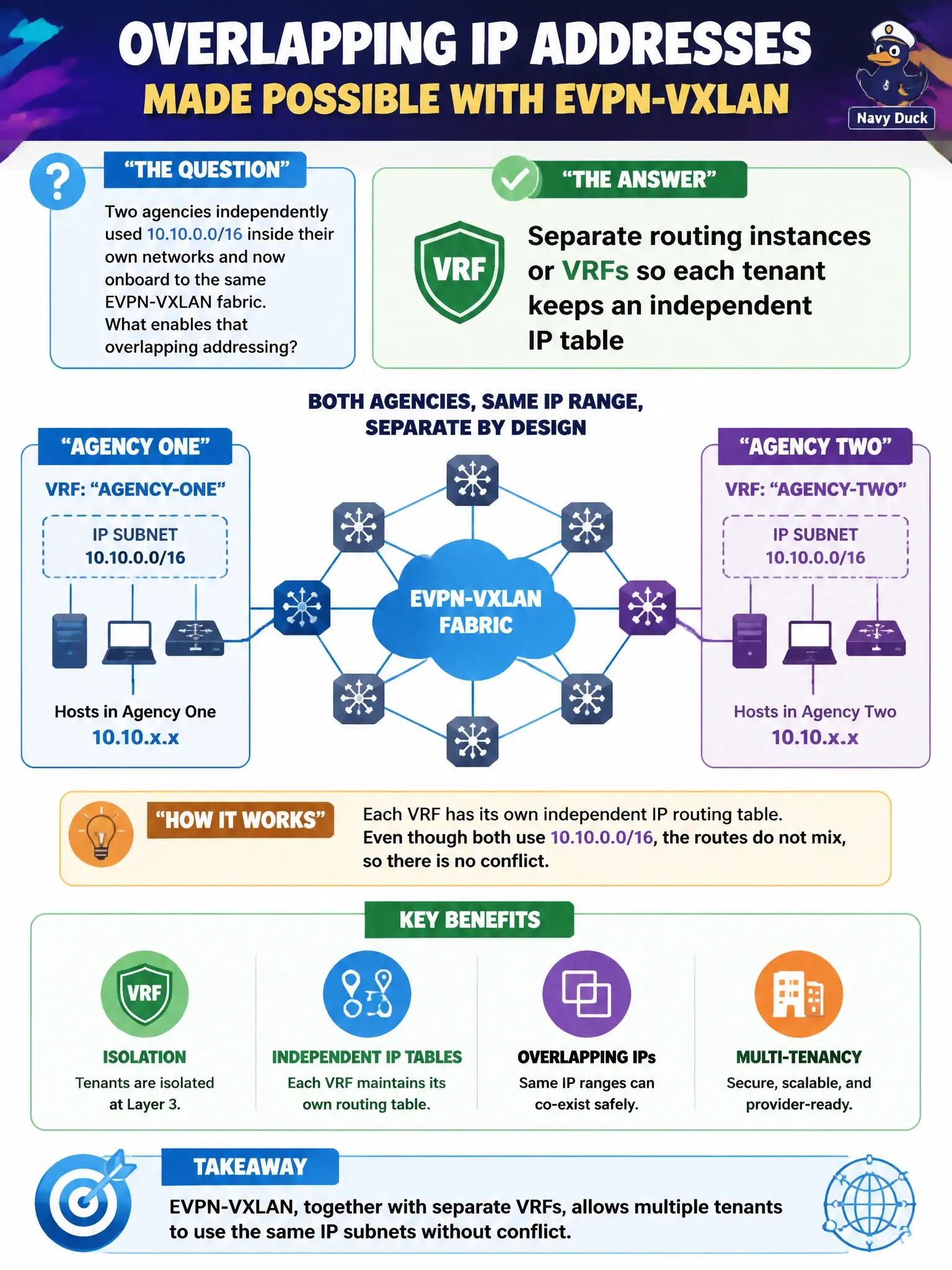
Two agencies independently used 10.10.0.0/16 inside their own networks and now onboard to the same EVPN-VXLAN fabric. What enables that overlapping addressing?
Select an answer to reveal the explanation.
Short Explanation
Overlapping 10-nets are fine when each agency lives in its own routing instance—like two towns reusing house numbers on different streets. Smash them into one table and BGP (and your weekend) explode. Separate VRFs are what make reuse legal.
Full Explanation
Two agencies that independently used 10.10.0.0/16 can onboard to the same EVPN-VXLAN fabric because separate routing instances or VRFs keep each tenant an independent IP table. Overlapping civic address plans are workable when each town keeps its own map book; they become collisions only when smashed into one table or advertised without proper VPN disambiguation.
A single shared VLAN with proxy-ARP rewriting every conflicting host does not provide clean overlapping L3 tenancy and still shares an L2 domain. Identical route distinguishers so BGP treats both /16s as one prefix is the opposite of what overlapping tenants need. Disabling EVPN Type-5 so only underlay host routes exist removes the normal L3 overlay tool without solving table separation.
Exam caveat: overlapping space answers almost always point to VRF/RD separation, not VLAN tricks or identical RDs.
Operational check: instantiate both tenants with unique RDs in separate instances, advertise each 10.10.0.0/16 in its VRF, and confirm BGP keeps them distinct while hosts in each VRF still reach their own local peers. Spot-check that route distinguishers differ and that a show route for 10.10.0.0/16 lists distinct VPN paths per agency.